E050. Theotics IV: The Mirror of Absence
On the Social Fact as the Mirror of Collective Desire, the Symbolic Purge of David Bohm, and the Reoccupation–Inheritance Undecidability
Abstract
This paper formalizes a single structural claim and then tests it against the most resistant possible case—the field of mathematical physics, which advertises itself as the discipline least governed by collective desire and most disciplined by the real. The claim is that the Durkheimian fait social is not a representation of the real but the specular crystallization of collective desire: a construction that begins not from factuality but from absence, and whose authority is therefore independent of, and frequently orthogonal to, the fait réel. Read through Lacan's mirror stage and through the Freudian theory of the mass that descends from Le Bon, the social fact is shown to be simultaneously fluid (variable in content) and invariant (constant in form), with the partition between the two supplied by the paradigm in the sense of Fleck, Kuhn, and Bourdieu. The case of David Bohm—whose deterministic interpretation of quantum mechanics was directly negated by the disciplinary social fact of anti-determinism, and who was accordingly subjected to a symbolic purge over-determined by, but not reducible to, the McCarthyist purge—demonstrates that the most prestigious cognitive field operates by the same logic as theology: its aura requires the concealment of the very fact that it is the most intense site of intellectual projection. The paper closes by arguing that the posthumous reinscription of the purged thesis—its return as a minor "fragment of the real"—instantiates the Löwith–Blumenberg undecidability between reoccupation (Umbesetzung) and inheritance (secularization as substantial transfer), and that this undecidability is not a defect of the analysis but the very form of the social fact: the contradictory symbiosis of its fluidity and its permanence.
A Note on Method: Ablative De-exceptionalization
The procedure followed here is ablative rather than nominative. A nominative analysis asks what a system is and grants it the dignity of a subject; an ablative analysis treats every system as one instance of, from, or by means of a more general structure, and refuses in advance the claim of any instance to constitute an exception. The field of mathematical physics is the privileged test case precisely because it makes the strongest nominative claim available in modernity—the claim to stand outside the order of collective desire and to be answerable only to the real. To de-exceptionalize that field is to show that it, too, is a social fact, governed by the same specular logic as the crowd and the cult, and that its protestation of exceptionality is itself the mechanism by which its aura is produced.
Throughout, propositions are tagged [R] (robust: holding across the range of admissible interpretive variation) or [C](contingent: dependent on a particular and contestable reading). The distinction is itself part of the method: an argument that cannot mark its own load-bearing contingencies is performing the very concealment it claims to expose.
The Formalization
Let FS denote the fait social (a collectively instituted representation or object functioning as the mirror of collective desire, constituted around a constitutive absence and not requiring correspondence to the real); let FR denote the fait réel(the real as that which resists or exceeds symbolic capture, including the expelled remainder); and let Φ denote an arbitrary field of knowledge, with FS(Φ) its governing doxa / nomos and its libidinal investment (illusio).
- P1 — [R]. FS is the specular crystallization of collective desire. Its efficacy and coercive force are independent of, and may be orthogonal to, FR; this independence is constitutive, not defective (Durkheim ∘ Lacan).
- P2 — [R]. The mass installs one and the same object in the place of the ego-ideal, and mutual identification follows; Le Bon and Freud are therefore valid not as theories of fact but as phenomenologies of collective projection (Le Bon → Freud → Lacan).
- P3 — [R]. Because FS is organized around a lack, it is at once fluid in content (historically variable) and invariant in form (the constant structure "object-in-the-place-of-the-ego-ideal around an absence"). Its fluidity and its permanence are not in tension; they are co-constitutive.
- P4 — [R]. What partitions the fluid from the invariant—what fixes, for an epoch, which contents count as fact—is the paradigm. In the strong form: the scientific fact is itself an FS, produced by a thought-collective within a thought-style (Fleck; Kuhn; Bourdieu; Latour and Woolgar).
- P5 — [R, historical]. A field whose FS(Φ) is anti-determinism treats a thesis directly negating that FS as a violation; the resulting marginalization is a symbolic purge internal to the field's nomos, over-determined by but not reducible to external political purge (the Bohm case; Olwell; Freire).
- P6 — [C]. Mathematicians and physicists are structurally inclined toward Platonism because Platonism places human reason at, or above, the vanishing point of the cosmos; a determinism without a transcendent observer re-anchors the real below human cognition and so negates the field's mirror-desire (Gödel; Penrose; Tegmark, contra Bohm).
- P7 — [R, as structural analogy]. The aura of a field requires the concealment of the fact that it is the most intense site of intellectual desire and projection—exactly as the aura of theology requires the concealment of its constructed origin (Hersh; Benjamin; Schmitt).
- P8 — [R]. The purged thesis returns posthumously as citation and footnote, recoded from "rejected rival social fact" into "minor fragment of the real"; the expelled scrap (objet a) returns as the matrix of the real (Lacan; the Bohm–Bell–Aspect lineage).
- P9 — [keystone]. This reinscription is undecidable between reoccupation (Umbesetzung: a functional position persists while its occupant is exchanged) and inheritance (secularization as the substantial transfer of a content). The undecidability is not a failure of resolution but the very form of FS: the contradictory symbiosis of fluidity (reoccupation) and permanence (inheritance) (Löwith; Blumenberg; Greisch; Griffioen).
The remainder of the paper is the discursive elaboration and defense of these nine propositions.
§1. The Social Fact as Méconnaissance
Durkheim defines the social fact, in Les Règles de la méthode sociologique, as a way of acting, thinking, and feeling that is exterior to the individual and endowed with a power of coercion by which it imposes itself (Durkheim, Règles). The decisive feature of this definition, for present purposes, is what it omits: it says nothing about truth. A social fact is identified not by its correspondence to any state of the world but by its contrainte—its capacity to constrain. The criterion is functional and coercive, never veridical. This is why Durkheim can treat currents of opinion, suicide rates, juridical forms, and religious representations as facts of the same order: their reality is the reality of their force, and their force does not depend on their being true.
This omission is not a lacuna to be repaired; it is the opening through which the entire analysis proceeds. If the social fact is constituted by coercion rather than by correspondence, then the social fact and the real fact are in principle independent variables. A social fact may track the real, may diverge from it, or may stand in flat contradiction to it, and in none of these cases is its status as a social fact diminished. The later Durkheim of Les Formes élémentaires de la vie religieusemakes the point explicit by relocating the source of the social fact in représentations collectives generated in the heightened states he calls effervescence collective—states in which the group, assembled and intensified, produces representations that it then experiences as imposed upon it from without (Durkheim, Formes). The collective manufactures the object and then submits to it as to an exterior power. This is already, in nuce, a structure of misrecognition.
It is at exactly this point that Lacan's account of the mirror stage becomes not an analogy but an identity of structure. In "Le stade du miroir comme formateur de la fonction du Je," the infant (mis)recognizes in the specular image a unity and mastery it does not yet possess, and constitutes its ego through an identification with that anticipated, exterior, and fundamentally alienated form (Lacan, Écrits). The ego is thus founded in méconnaissance: it is the internalization of an image that is at once the subject's own and radically other, a coherence projected and then received as given. Transpose this from the individual to the collective and the Durkheimian social fact is recovered exactly: the group projects its own desired coherence into a represented object and then experiences that object as an exterior coercive power. The social fact is the speculum of collective desire. [P1, R]
The yield of this identification is the disqualification of the standard objection to the sociology of knowledge—the objection that if social facts do not track the real, the disciplines that study them are studying mere error. The objection assumes that the value of an account of the social fact lies in its veridical content. But if the social fact is constitutively specular, then an account of it is valuable precisely as an account of desire, and its indifference to the real is not a deficiency but the correct calibration to its object. Sociology is valid, on this reading, not in spite of the fact that the social fact is not the real fact, but because its object is collective desire, of which the social fact is the mirror.
§2. The Crowd as Mirror: Le Bon, Freud, and Collective Projection
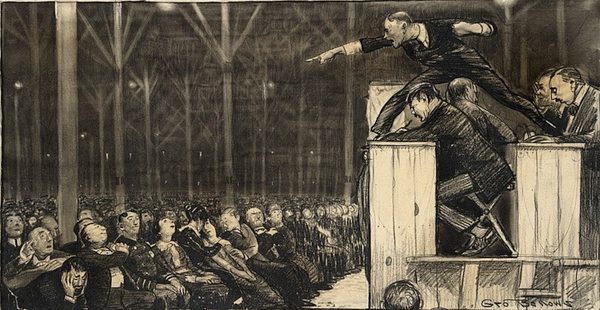
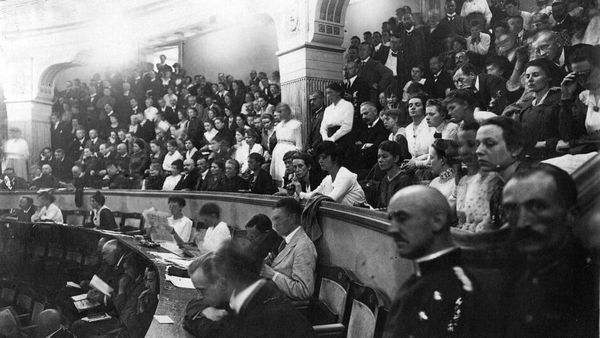
The same vindication-through-relocation rehabilitates Le Bon. Psychologie des foules is, judged as descriptive science, a tissue of late-nineteenth-century prejudices: its crowd is suggestible, regressive, feminized, and criminal, and its author's contempt for the urban mass is undisguised (Le Bon). Read nominatively—as a theory of what crowds are—it is worthless and worse. Read ablatively—as a phenomenology of what the bourgeois subject projects onto the mass—it is a precise document, and its very distortions are data, because the projection is the phenomenon. Le Bon is valid as a record of social desire, that is, of the collective projection through which a class constitutes its own image of order by expelling its negation onto the crowd.
Freud's appropriation in Massenpsychologie und Ich-Analyse (1921) performs precisely this conversion. Freud opens by summarizing Le Bon at length, in the chapter on Le Bon's portrait of the mass-soul, and then transforms the descriptive apparatus into a structural one (Freud, SE XVIII). Where Le Bon had a contagion, Freud installs a mechanism: the mass coheres because its members put one and the same object in the place of their ego-ideal and, in consequence, identify with one another (Freud, SE XVIII). The bond is libidinal, the leader or the idea occupies the place of the ideal, and horizontal identification among the members follows from their shared vertical relation to that single occupant. The mass is thus, structurally, a shared mirror: a configuration in which a multitude is unified by a common specular investment.
Lacan, returning to this text across the 1950s and 1960s, fastens on the Freudian einziger Zug—the single, unary trait through which identification operates—and reads the whole logic of the ego-ideal back through it, disclosing in Freud's mass a structure Freud had not fully thematized (cf. the Lacanian exegesis traced in Nobus). The lineage Le Bon → Freud → Lacan is therefore not a sequence of competing theories of the crowd but a single deepening analysis of collective projection, in which each successive author strips away descriptive content to expose structural form. By the end of the lineage, the "crowd" is no longer a sociological object at all; it is the name for the operation by which any collective constitutes a unifying object in the place of its ideal. [P2, R]
The social fact, then, is the institutional sediment of this operation. What Durkheim observes as the exteriorized coercive representation, and what Le Bon observes as the crowd's hallucinated object, and what Freud formalizes as the object-in-the-place-of-the-ego-ideal, are one structure under three descriptions. The first robustly entails the third.
§3. From Absence: The Imaginary Institution and the Real
It is essential to the argument that the social fact begins not from a positivity but from a lack. This is the Lacanian correction to any naïve constructionism: the collective does not first possess a content and then represent it; it organizes itself around an absence—a constitutive non-coincidence with itself—and the social fact is the imaginary suturing of that absence. Castoriadis gives this its fullest social-theoretical development. In L'Institution imaginaire de la société, society is neither the expression of a real substrate (the functionalist illusion) nor the reflection of a rational order (the rationalist illusion) but the self-institution of a magma of significations that cannot be derived from anything outside itself (Castoriadis). The social-historical is creation ex nihilo in the precise sense that its significations are not the representation of a prior real. Society institutes itself from absence, and then misrecognizes its own institution as nature, necessity, or revelation.
From this the modal character of the social fact follows directly. Because its content is not fixed by the real, that content is fluid: it varies across epochs and societies without limit, and nothing in the real constrains its variation. But because its form—the imaginary suturing of a constitutive lack by an object placed in the position of the ideal—is invariant across all these variations, the social fact is also permanent. Fluidity and permanence are not opposed properties held in unstable balance; they are the same property viewed at two levels. The content is fluid because the form is empty; the form is permanent because it is nothing but the empty operation of suturing. [P3, R]
The expelled remainder of this operation is the hinge that will return in §8. Every collective self-idealization, in placing an object in the position of the ideal, simultaneously produces a discarded object—a scrap, an expulsion. In the Freudian text on negation (Die Verneinung) this expulsion is the very matrix of the real, and Lacan reads the leftover precisely as the objet a (cf. Benvenuto's reconstruction in the European Journal of Psychoanalysis). The structure is therefore double: the social fact is the idealized mirror-object, and the real is the expelled scrap that the constitution of the mirror necessarily casts out. Hold this in reserve; it is the key to the Bohm case.
§4. The Paradigm as Partition: The Scientific Fact as Social Fact
If the content of the social fact is fluid and its form invariant, something must fix, for a given epoch, which contents count as fact. That something is the paradigm. The claim has a weak and a strong form, and the strong form is the load-bearing one.
In the weak form, the paradigm is, with Kuhn, the matrix of shared commitments—exemplars, instruments, values, and ontological assumptions—within which normal science proceeds, and across whose revolutionary replacements the very criteria of fact shift, so that proponents of successive paradigms, in the limit, talk past one another (Kuhn). The paradigm partitions the fluid from the fixed by holding certain commitments invariant as the condition of letting the rest vary.
The strong form predates Kuhn and is more radical. Ludwik Fleck, in 1935, titled his book Entstehung und Entwicklung einer wissenschaftlichen Tatsache—the genesis and development of a scientific fact—and argued that the scientific fact is the product of a Denkkollektiv operating in a Denkstil: a thought-collective whose shared style of perception determines what can appear as a fact at all (Fleck). The scientific fact is, in Fleck's hands, explicitly a collective construction; it is a fait social in the strict Durkheimian sense, a representation produced by a collective and then experienced by its members as the coercive imposition of nature. Fleck's title is the thesis of this paper avant la lettre: fait scientifique = fait social. [P4, R]
Two further bodies of work convert this into an operational sociology. Bourdieu's analysis of the champ scientifiquesupplies the mechanism: a scientific field is a structured space of positions in which agents compete for a specific capital symbolique (scientific authority), invest in the game by virtue of an illusio that the game is worth playing, and enforce the field's nomos through a violence symbolique that need never appear as violence because it is misrecognized as the simple authority of the true ("Le champ scientifique"; Homo Academicus; Science de la science). And Latour and Woolgar supply the ethnographic demonstration: their Laboratory Life documents how the laboratory's social order produces the statements that come, for a time, to be "too expensive to change," at which point they congeal into facts (Latour and Woolgar). A single bibliographic datum about that book is itself a perfect specimen of the present thesis: the first edition (1979) bore the subtitle The Social Construction of Scientific Facts; the second edition (1986) deleted the word Social(Latour and Woolgar). The field, asked to name the construction of its facts, found the word social too expensive to retain—an act of self-concealment performed in the subtitle of the very book that exposed the construction. We are already at §7.
§5. The Symbolic Purge: David Bohm and the Nomos of the Field
The general claims of §§1–4 are now tested against the field that most strenuously denies them. The test case is David Bohm.
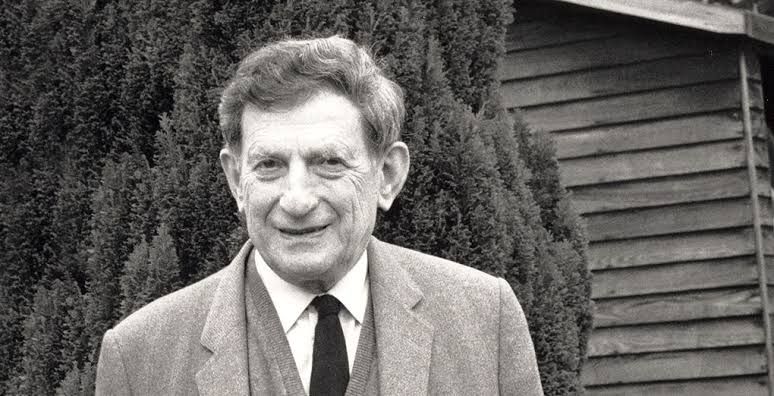
In 1952 Bohm published, in two papers in Physical Review, a deterministic, causal interpretation of quantum mechanics in terms of "hidden" variables—a reconstruction, by way of de Broglie's pilot wave, in which particles possess definite positions and trajectories guided by the wave function, and in which the indeterminacy of the orthodox theory is epistemic rather than ontological (Bohm I; Bohm II). The interpretation is empirically equivalent to standard non-relativistic quantum mechanics; it is not a rival theory but a rival interpretation, and as such it directly negates the central commitment of the dominant Copenhagen settlement: that the indeterminacy is final and that no causal substrate exists to be recovered. Bohm's thesis is, with respect to the field's nomos, a frontal contradiction of the governing social fact.
The reception was not refutation but marginalization. Bohm had already, on independent grounds, been expelled: a former member of left-wing organizations at Berkeley during the war, he refused in 1949 to testify before the House Un-American Activities Committee, was charged with contempt of Congress, was acquitted, and was nonetheless suspended and then, in 1951, stripped of his position at Princeton, after which he left the United States for São Paulo, then Israel, and finally Birkbeck College in London (Britannica; Olwell 738–56). The McCarthyist purge is the visible, external, political fact. But the historiography has established that the visible purge is not the whole, and not even the principal, cause of Bohm's disappearance from the field. Olwell shows that the consequence of Bohm's political exile was physical isolation: cut off from the community that had nourished his work, his influence within the mainstream collapsed even as his exile freed him to develop heterodox alternatives (Olwell). And Freire argues the decisive point: that the cultural context of physics itself—the entrenchment of the Copenhagen interpretation, the low status of foundational questions on the research agenda, the very formation of physicists in a style that treated such questions as illegitimate—weighed moreheavily in the rejection of Bohm's ideas than did the McCarthyist climate (Freire, "Science and Exile"; Freire, David Bohm).
This is the historiographical result on which the present thesis turns, and it sharpens rather than softens the claim. The external purge, however brutal, is contingent and political; it could have gone otherwise. The internal marginalization is structural: it follows from the fact that Bohm's thesis negated the social fact of the field, and a field disposes of a thesis that negates its nomos not by refuting it—Bohm's interpretation was never refuted, being empirically equivalent—but by rendering it unsayable, unfundable, untouchable. This is a symbolic purge in Bourdieu's precise sense: an exercise of violence symbolique that does not appear as violence because it is misrecognized as the simple operation of scientific judgment. The man was purged by McCarthy; the thesis was purged by the field. [P5, R]
§6. Platonism as Mirror-Desire: Mathematics, Physics, and the Vanishing Point
Why is anti-determinism the social fact of the field, and why is its negation intolerable? The contingent but, I will argue, illuminating answer is that the field's deepest investment is not in indeterminism as such but in a particular position for human reason, and that this position is most clearly visible in the persistence of mathematical Platonism among precisely those practitioners whose official methodology forbids it.
Mathematical Platonism is the thesis that mathematical objects exist mind-independently and are discovered, not invented. Its most candid avowal is Gödel's: that despite their remoteness from sense experience we nonetheless possess something like a perception of mathematical objects, and that there is no reason to trust sense perception more than this mathematical intuition (Gödel). Penrose builds an entire cosmology on it: three worlds—the Platonic-mathematical, the physical, and the mental—each mysteriously engendering the next, with the physical world arising from the mathematical, so that the laws of the universe are the shadow cast into matter by eternal mathematical forms (Penrose, Emperor's New Mind; Penrose, Road to Reality). Tegmark radicalizes the position to the point of self-consumption: the universe does not merely obey mathematics but is a mathematical object, and all mathematical objects exist, a thesis he himself classifies as a form of Platonism (Tegmark, "Mathematical Universe"; Tegmark, Our Mathematical Universe). Behind all three stands Wigner's celebrated puzzle of the "unreasonable effectiveness" of mathematics in the natural sciences—a puzzle that is a puzzle only on the assumption that mathematics is not a human construction (Wigner).
The structure of the desire is now legible. Platonism places the deliverances of human reason—mathematical intuition—at the vanishing point of the cosmos: the point from which the whole is constituted and toward which it converges. To be a Platonist is to hold that the human mind has access, by intuition, to the very forms from which the physical world is generated; it is to place the human soulline, the vanishing point of human cognition, at or above the place that theology reserves for God. This is the mirror-desire of the intellect in its purest form: the cosmos is the mirror in which reason recognizes its own forms and, recognizing them, takes itself for the ground of the real. [P6, C]
Bohm's offense, on this reading, is deeper than determinism. A deterministic interpretation in which the real proceeds by a causal substrate beneath and indifferent to observation re-anchors the real below human cognition; it removes the observer from the constitutive position and returns the mind to the status of one more thing carried along by the wave. It pours water on the mirror. The field's intolerance is then not the defense of a physical thesis but the defense of a position for the human, which is why no refutation was offered or needed: one does not refute a desecration, one expels it. I mark this proposition contingent because the imputation of motive is not demonstrable in the way the historiography of §5 is; but it is the reading that renders the otherwise puzzling non-refutation of an empirically equivalent interpretation intelligible.
§7. Aura by Concealment: Benjamin, Hersh, and the Theology of the Hidden
The field's authority—its aura—depends on the concealment of everything established in §§4–6. A discipline that openly acknowledged that its facts are the sediment of collective investment, that its Platonism is a desire rather than a discovery, and that it disposes of heterodoxy by symbolic violence rather than by refutation, would forfeit the very quality that makes its pronouncements binding. The aura is a function of the concealment.
Benjamin's analysis of aura furnishes the exact mechanism. In Das Kunstwerk im Zeitalter seiner technischen Reproduzierbarkeit, the aura of the work is grounded in its Kultwert—its cult value—which is in turn grounded in ritual and in authenticity (Echtheit), and which the age of reproducibility dissolves into mere Ausstellungswert, exhibition value (Benjamin, "Work of Art"). The decisive observation, for the present argument, is Benjamin's remark that cult value positively demands concealment: certain statues of the gods were accessible only to the priest in the cella, certain images of the Madonna remained veiled almost the entire year (Benjamin, "Work of Art"). The aura is not diminished by the hiddenness of its object; it is produced by it. Visibility is profanation; the cult value lives in the veil.
Transpose this to the cognitive field and the analogy becomes an identity of function. The field's aura requires that its constitutive operation—collective projection, symbolic purge, Platonist desire—remain in the cella, veiled, accessible only to the initiated and never displayed as what it is. Reuben Hersh names the veiled object with precision: Platonism, he argues, is the secret, working faith of the mathematician, professed in private and disavowed in public, the "weekday" creed of practitioners who become formalists only when asked to justify themselves (Hersh). The avowal is itself transgressive within the field; Brian Davies could title a polemic "Let Platonism Die" precisely because the doctrine functions as an unexamined article of faith that the field cannot afford to examine (Davies). To expose the cult value is to dissolve it.
The structural identity with theology is therefore not a metaphor but a result. Carl Schmitt's formula—that the significant concepts of the modern theory of the state are secularized theological concepts (Schmitt)—names the general law of which the cognitive field is one instance: the field is a crypto-theological institution whose aura is generated by the concealment of its constructed and desiring origin, exactly as the theological institution generates its aura by the concealment of its constructed origin. The disciplines that most loudly disclaim the sacred are the ones whose operation is most exactly sacral. [P7, R]
§8. Posthumous Reinscription: The Scrap as Fragment of the Real
What becomes of the purged thesis? It returns—but transformed in its very mode of being. After his exile, Bohm's hidden-variable interpretation was not so much refuted as forgotten, and then, from the 1960s, partially recovered: John Bell's inequality theorem (1964) was motivated in part by taking Bohm's construction seriously, and the experimental tradition that runs through Alain Aspect's tests of the Bell inequalities (1982) returned the questions Bohm had raised to the agenda of physics (Britannica). Today the interpretation survives under the hyphenated name "de Broglie–Bohm," cited as an empirically equivalent alternative—a curiosity, a footnote, a minor entry in the catalogue of interpretations.
The transformation is the point. The thesis that had been a rival social fact—a candidate nomos directly negating the field's governing commitment—returns as a fragment of the real: a small, defused, technically interesting object, stripped of its claim to reorganize the field and reinscribed as one more discovered feature of the formalism. This is precisely the structure anticipated in §3. The constitution of the field's mirror-object (the Copenhagen ideal) had cast out a scrap; and the scrap, in the Freudian logic of negation, is the matrix of the real, the objet a (cf. Benvenuto). The purged thesis returns not as what it was—a desiring claim upon the field's ideal—but as what the field can tolerate: a piece of the real, expelled from the order of the social fact and readmitted only under the reduced ontological passport of a "fragment." The footnote is the form in which the field metabolizes what it has purged. [P8, R]
§9. Reoccupation and Inheritance: The Löwith–Blumenberg Undecidability as the Form of the Social Fact
The final question is the status of this return, and it is here that the apparatus of the German secularization debate becomes indispensable—not as a topic but as the meta-form of the whole.
Karl Löwith, in Meaning in History (German: Weltgeschichte und Heilsgeschehen), advanced the thesis that the modern philosophy of history—the idea of progress toward an immanent fulfillment—is a secularized version of Christian eschatology: the substance of the theological promise, transferred and disguised, persists beneath the secular surface (Löwith). On this account modernity inherits; it carries forward a content it did not produce and cannot legitimately claim as its own. Hans Blumenberg, in Die Legitimität der Neuzeit, attacked this thesis, and Schmitt's cognate one, as resting on the unwarranted assumption of a substance originally possessed by Christianity and later illegitimately appropriated (Blumenberg, Legitimacy). In its place he proposed Umbesetzung—reoccupation: modernity did not inherit the content of Christian eschatology but reoccupied its functional position, answering, with new and legitimately modern materials, questions that the prior epoch had posed and then left standing (Blumenberg, Legitimacy; Blumenberg, "Säkularisation"). The position persists; the occupant is exchanged. Modernity is legitimate because the answers are its own, even though the questions are inherited.
The opposition is therefore exact: inheritance (Löwith: substantial transfer, Übertragung) versus reoccupation(Blumenberg: functional position retained, content replaced). Jean Greisch's essay names the ambiguity in its title—"Umbesetzung versus Umsetzung"—and shows that the secularization theorem oscillates irreducibly between these two readings (Greisch 154–72). And the revisionist historiography, against the textbook claim that Blumenberg decisively refuted Löwith, has established that the two were arguing at different levels—Blumenberg at the level of the historical efficacy of contents, Löwith at the level of their meaning—so that the dispute was never actually resolved and the textbook verdict is itself a social fact of the philosophical field (Wallace 63–79; Griffioen).
Now apply this to the return of Bohm. Is the posthumous reinscription of the purged thesis a reoccupation or an inheritance? It is, demonstrably, both. It is reoccupation in the precise Blumenbergian sense: the position of "the heterodox interpretation that the field has neutralized" persists structurally across the decades, and Bohm is merely the occupant who fills it for a time, exchangeable in principle for any other purged-then-readmitted heterodoxy. And it is inheritance in the precise Löwithian sense: a determinate content—the actual mathematics of the pilot wave, the actual questions about nonlocality—is substantially transferred forward, carried across the threshold of the purge and into the formalism that metabolizes it. The two descriptions are not rivals to be adjudicated; they are the two faces of the single operation.
This is the keystone. The undecidability between reoccupation and inheritance is not an unfortunate residue of insufficient analysis. It is the form of the social fact itself. Recall P3: the social fact is at once fluid (variable in content) and invariant (constant in form). Reoccupation is the name, in the register of historical succession, for the invariant form—the persistence of the position. Inheritance is the name, in that same register, for the transferred content—the persistence of the substance. To say that the return of the purged thesis is both reoccupation and inheritance is simply to say, at the level of historical dynamics, what P3 says at the level of structure: that the social fact lives in the contradictory symbiosis of a permanent empty position and a fluid transferred content. The Löwith–Blumenberg debate is undecidable because the object it analyzes—the social fact in its temporal life—is the undecidable simultaneity of form and content, position and substance, mirror and scrap. [P9]
Conclusion
The chain is closed. The social fact is the mirror of collective desire (P1), instituted by the mass's placement of an object in the position of the ego-ideal (P2), organized around a constitutive absence and therefore at once fluid and permanent (P3). The paradigm partitions the fluid from the permanent and, in the strong form, constitutes the scientific fact as itself a social fact (P4). The field disposes of a thesis that negates its governing social fact by symbolic purge rather than refutation, as the Bohm case demonstrates with the full support of the historiography (P5); the deepest investment so defended is the Platonist position of human reason at the vanishing point of the cosmos (P6); and the field's aura is generated, exactly as theology's is, by the concealment of this desiring and constructed origin (P7). The purged thesis returns as a fragment of the real, the expelled scrap readmitted under a reduced ontological passport (P8); and the undecidability of that return between reoccupation and inheritance is not a defect of analysis but the very form of the social fact, the contradictory symbiosis of its permanence and its fluidity (P9).
The field of mathematical physics, which makes the strongest available claim to exceptionality—to stand outside collective desire and answer only to the real—has been shown to be one instance of the general structure, and its claim to exception has been shown to be the mechanism of its aura. This is the result that ablative de-exceptionalization was built to produce: not the deflation of the field to mere ideology, but the demonstration that its grandeur and its concealment are the same fact seen from two sides. The cult value lives in the veil; the aura is a function of the hidden; and the discipline that most loudly disclaims the sacred performs, in the subtitle of its own most candid book, the deletion of the word that would have given it away.
Works Cited
Benjamin, Walter. "Das Kunstwerk im Zeitalter seiner technischen Reproduzierbarkeit." 1936. Gesammelte Schriften, vol. I.2, edited by Rolf Tiedemann and Hermann Schweppenhäuser, Suhrkamp, 1974, pp. 471–508.
---. "The Work of Art in the Age of Its Technological Reproducibility (Second Version)." Selected Writings, Volume 3: 1935–1938, edited by Howard Eiland and Michael W. Jennings, translated by Edmund Jephcott et al., Harvard UP, 2002, pp. 101–33.
Benvenuto, Sergio. "One Hundred Years of Group Psychology and the Analysis of the Ego: With Addendum." European Journal of Psychoanalysis, 2022, www.journal-psychoanalysis.eu.
Blumenberg, Hans. Die Legitimität der Neuzeit. Suhrkamp, 1966.
---. The Legitimacy of the Modern Age. Translated by Robert M. Wallace, MIT Press, 1983.
---. "'Säkularisation': Kritik einer Kategorie historischer Illegitimität." Die Philosophie und die Frage nach dem Fortschritt, edited by Helmut Kuhn and Franz Wiedmann, Anton Pustet, 1964.
Bohm, David. "A Suggested Interpretation of the Quantum Theory in Terms of 'Hidden' Variables. I." Physical Review, vol. 85, no. 2, 1952, pp. 166–79.
---. "A Suggested Interpretation of the Quantum Theory in Terms of 'Hidden' Variables. II." Physical Review, vol. 85, no. 2, 1952, pp. 180–93.
Bourdieu, Pierre. "Le champ scientifique." Actes de la recherche en sciences sociales, vol. 2, no. 2–3, 1976, pp. 88–104.
---. Homo Academicus. Minuit, 1984.
---. Science de la science et réflexivité. Raisons d'agir, 2001.
Castoriadis, Cornelius. L'Institution imaginaire de la société. Seuil, 1975.
---. The Imaginary Institution of Society. Translated by Kathleen Blamey, MIT Press, 1987.
Canetti, Elias. Masse und Macht. Claassen, 1960.
"David Bohm." Encyclopædia Britannica, www.britannica.com/biography/David-Bohm. Accessed 30 June 2026.
Davies, E. Brian. "Let Platonism Die." European Mathematical Society Newsletter, no. 64, 2007, pp. 24–25.
Durkheim, Émile. Les Formes élémentaires de la vie religieuse. Alcan, 1912.
---. Les Règles de la méthode sociologique. Alcan, 1895.
---. The Elementary Forms of Religious Life. Translated by Karen E. Fields, Free Press, 1995.
---. The Rules of Sociological Method. Edited by Steven Lukes, translated by W. D. Halls, Free Press, 1982.
Fleck, Ludwik. Entstehung und Entwicklung einer wissenschaftlichen Tatsache: Einführung in die Lehre vom Denkstil und Denkkollektiv. Benno Schwabe, 1935.
---. Genesis and Development of a Scientific Fact. Edited by Thaddeus J. Trenn and Robert K. Merton, translated by Fred Bradley and Thaddeus J. Trenn, U of Chicago P, 1979.
Freire Junior, Olival. David Bohm: A Life Dedicated to Understanding the Quantum World. Springer, 2019.
---. "Science and Exile: David Bohm, the Cold War, and a New Interpretation of Quantum Mechanics." Historical Studies in the Physical and Biological Sciences, vol. 36, no. 1, 2005, pp. 1–34.
Freud, Sigmund. Group Psychology and the Analysis of the Ego. Translated by James Strachey, The Standard Edition of the Complete Psychological Works of Sigmund Freud, vol. XVIII, Hogarth Press, 1955, pp. 65–143.
---. Massenpsychologie und Ich-Analyse. Internationaler Psychoanalytischer Verlag, 1921.
Gödel, Kurt. "What Is Cantor's Continuum Problem?" 1947, revised 1964. Collected Works, Volume II: Publications 1938–1974, edited by Solomon Feferman et al., Oxford UP, 1990, pp. 254–70.
Greisch, Jean. "Umbesetzung versus Umsetzung: les ambiguïtés du théorème de la sécularisation d'après Hans Blumenberg." Annuario Filosofico, vol. 28, 2012, pp. 154–72.
Griffioen, Sjoerd. Contesting Modernity in the German Secularization Debate: Karl Löwith, Hans Blumenberg and Carl Schmitt in Polemical Contexts. Brill, 2022.
Hersh, Reuben. What Is Mathematics, Really? Oxford UP, 1997.
Kuhn, Thomas S. The Structure of Scientific Revolutions. U of Chicago P, 1962.
Lacan, Jacques. Écrits: The First Complete Edition in English. Translated by Bruce Fink, Norton, 2006.
---. "Le stade du miroir comme formateur de la fonction du Je telle qu'elle nous est révélée dans l'expérience psychanalytique." 1949. Écrits, Seuil, 1966, pp. 93–100.
---. Le Séminaire, Livre XVII: L'envers de la psychanalyse. Edited by Jacques-Alain Miller, Seuil, 1991.
Latour, Bruno, and Steve Woolgar. Laboratory Life: The Construction of Scientific Facts. 2nd ed., Princeton UP, 1986.
Le Bon, Gustave. Psychologie des foules. Alcan, 1895.
Löwith, Karl. Meaning in History: The Theological Implications of the Philosophy of History. U of Chicago P, 1949.
---. Weltgeschichte und Heilsgeschehen: Die theologischen Voraussetzungen der Geschichtsphilosophie. Kohlhammer, 1953.
Moscovici, Serge. L'Âge des foules: un traité historique de psychologie des masses. Fayard, 1981.
Nobus, Dany. "Freud's Massenpsychologie and Lacan's 'Patristic' Exegesis." European Journal of Psychoanalysis, 2023, www.journal-psychoanalysis.eu.
Olwell, Russell. "Physical Isolation and Marginalization in Physics: David Bohm's Cold War Exile." Isis, vol. 90, no. 4, 1999, pp. 738–56.
Penrose, Roger. The Emperor's New Mind: Concerning Computers, Minds, and the Laws of Physics. Oxford UP, 1989.
---. The Road to Reality: A Complete Guide to the Laws of the Universe. Jonathan Cape, 2004.
Schmitt, Carl. Political Theology: Four Chapters on the Concept of Sovereignty. Translated by George Schwab, MIT Press, 1985.
---. Politische Theologie: Vier Kapitel zur Lehre von der Souveränität. Duncker & Humblot, 1922.
Tegmark, Max. "The Mathematical Universe." Foundations of Physics, vol. 38, no. 2, 2008, pp. 101–50.
---. Our Mathematical Universe: My Quest for the Ultimate Nature of Reality. Knopf, 2014.
Wallace, Robert M. "Progress, Secularization and Modernity: The Löwith-Blumenberg Debate." New German Critique, no. 22, 1981, pp. 63–79.
Wigner, Eugene P. "The Unreasonable Effectiveness of Mathematics in the Natural Sciences." Communications on Pure and Applied Mathematics, vol. 13, no. 1, 1960, pp. 1–14.