E064. New Roma is Crystal: Enrico stai sereno
I. Murano
Everything in Venice is made of glass, including Venice.
In 1291 the Republic moved its glassmakers to Murano. The official reason was fire. The real reason was secrets. A master who fled the island with the recipe could be hunted down abroad. The most advanced industrial knowledge in Europe was guarded like a state secret, because it was one.
The glass in the Rialto shop windows today is cheaper than it used to be. A good deal of it is made in China. The tourists cannot tell. The shopkeepers do not ask. The label says Murano, and the label is what Europe manufactures now.
II. Every Rome is the last Rome
Every European power has wanted to be Rome. Charlemagne wanted it. The Holy Roman Empire claimed it, and was famously neither. Moscow called itself the Third Rome. The second was Constantinople, Nova Roma. In 1204 Venice helped sack it and took home four bronze horses for the façade of San Marco. Venetians have always known exactly what the inheritance of Rome is worth: whatever you can carry.
In 1957, six countries signed a treaty in Rome to make sure they would never have to be Rome again. That was the clever part. Postwar Europe would be Rome without the legions. Law instead of conquest. Citizenship instead of tribute. Aqueducts of structural funds. An empire of regulation, a pax built on harmonised plug sockets.
It worked the way glass works. Clear, luminous, admired from every angle. You can see straight through it. That was always the problem.
III. The Hotel
Abu Dhabi, November 2026. Europe's envoys fly in for talks on ending the war Europe is paying for. Moscow declines to let them into the room. Russia's foreign minister suggests they sit in the hotel. Asked why they were not admitted, he wonders aloud whether he was supposed to shoot down their planes.
So they sit in the hotel. Then the American envoys fly to Moscow to ask whether Europe might come next time. Moscow says yes, graciously, on one condition: next time, the agenda will include Europe.
Note the grammar. Europe did not lose its seat at the table. It was promoted to the menu.
In 1797 the Venetian Republic sent envoys to Paris to plead for its life. They were arrested in Milan before they got there. At least that had some drama. Ours had room service.
IV. Condottieri
In Dublin, the French president announces that Europe now provides essentially all of Ukraine's support. "There is no more U.S. support." He says it the way a man says the bank has closed: as information, not as a confession. The German chancellor, meanwhile, addresses Washington with three words a great power has never needed to say: please, no surprises. It is the voice of a patrician who has noticed that his condottiere is having dinner with the enemy, and who would like, very politely, to be told the menu.
Late Venice bought its soldiers too. Dalmatian Schiavoni, Swiss, Germans, whoever was available. Europe has gone further. It buys the soldiers' factory. Poland's tanks are Korean. Its howitzers are Korean. Its jets are American. The ammunition scheme that kept Ukraine firing found its shells outside Europe, because Europe could not make them fast enough.
The Arsenale, legend says, once built a galley in a single day. Its heirs hold a procurement conference every week.
And the Senate legislates. Twenty-one sanctions packages. Twenty-two. Each one blown more intricately than the last, clear and colourful and passed from hand to hand like Murano beads. Across the Atlantic, the ally that lectured Europe for a decade about Russian energy quietly licenses Russian diesel to cut its own petrol prices before an election. Nobody in Brussels was consulted. Brussels issued a statement of regret. Regret is a Venetian export too. It travels well and weighs nothing.
V. Masks
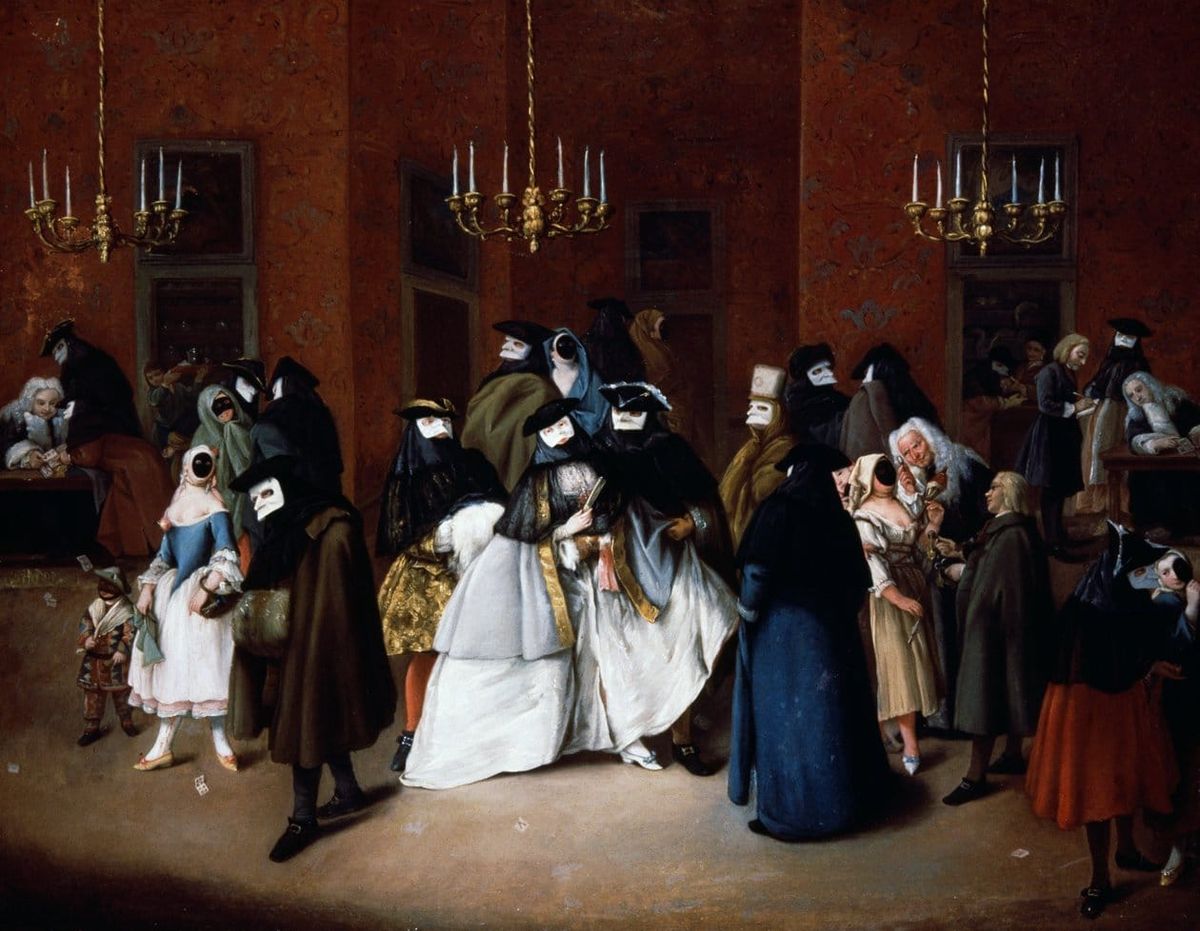
In the eighteenth century the Venetian carnival could run for half the year. Behind a bauta, a patrician could gamble beside a gondolier at the Ridotto and lose an estate before dawn. The city became the pleasure garden of Europe at precisely the moment it stopped mattering to Europe. Decadence is not the cause of decline. It is what decline looks like when it still has money.
Venice also had a myth: that its constitution was so just, so balanced, so serene, that Providence itself was a shareholder. The Most Serene Republic. Europe's mask is the same one, recast in Brussels: the rule of law, the rules-based order, the normative power that wins by example. It is a beautiful mask. It photographs extremely well.
In a committee room in Brussels, a Spanish MEP put the problem in one sentence. Europe praises the rule of law all over the world, he said, and is the first to violate its own treaties. He was objecting to Paris and Berlin's plan to dismantle the Union's diplomatic service, in part, the corridors say, because its chief talks too much.
This is the most European response imaginable to being shut out of the room. Abolish the chair.
The lion of Saint Mark holds an open book: Pax tibi, Marce. Peace be with you. It was always a better motto for a museum than for a state.
VI. The Salute
12 May 1797. The French army stands at the edge of the lagoon. The Great Council of Venice convenes. Quorum is six hundred. Five hundred and thirty-seven turn up. Outside, shots ring out. The patricians panic, and by 512 votes to 20 they abolish the Republic. Eleven centuries, finished in a morning, without a quorum.
The shots were not an attack. They were the Dalmatian mercenaries firing a farewell salute as they sailed home. Venice killed itself because its own hired soldiers said goodbye too loudly.
The last doge, Ludovico Manin, went home, took off the ducal cap and handed it to his valet. Tolè, questa no la doperò più. Take it, I won't be needing this anymore.
This is how Europe dies, if it dies: not by conquest but by procedure. A vote, slightly irregular, in a very beautiful room, under the impression of a threat that is mostly theatre.
Europe hears gunfire too. In one week in November, emails signed Mikhail Andropov, a dead KGB chief's surname on a throwaway account, ground flights across the continent, scramble fighter jets to escort airliners carrying nothing, empty the newsroom of Ireland's national broadcaster and close thousands of Italian schools. No bombs are found anywhere. The cost to the sender is a few minutes and an inbox. The cost to the Republic is a fortune in evacuations and a little more of its nerve. Fear is the cheapest artillery ever invented, and Europe keeps buying the shells.
VII. On the impossibility of a Renaissance
There is a French political party called Renaissance. Every European crisis ends in a call for one. A renaissance of industry, of defence, of the European idea, of Europe itself.
But a renaissance is not a renovation. It requires a corpse.
The Italian one began with a death. Constantinople fell in 1453, and the Greeks fled west carrying what they could: Plato, Ptolemy, the grammar of a civilisation. Cardinal Bessarion left his library of Greek manuscripts to Venice, and it became the Marciana. Florence and Venice were reborn on the body of the Second Rome. Rinascita was never a self-help programme. It was necromancy: new life drawn from someone else's grave.
So ask the indelicate question. Whose grave does Europe plan to rob?
There is none. Europe is not Florence in this story. Europe is Byzantium. It is the one with the library, the ceremony, the ancient law, the exquisite theological quarrel over procedure while the walls are being measured from outside. Byzantium was also rich, also admired, also convinced that its legitimacy was a kind of armour. It held on for a thousand years. Then it became somebody else's renaissance.
A renaissance needs three things: a ruin, an appetite and a willingness to be wrong in public. Europe has the ruins. It is the ruins. It has insured away the appetite and regulated away the risk.
What Europe calls a renaissance is restoration. And restoration is the opposite of rebirth. It is the art of making sure nothing changes, more expensively, behind scaffolding wrapped in an advertisement for handbags.
VIII. Acqua alta
Venice has a flood barrier now. It is called MOSE, after the man who parted the waters. It took decades to build, ran billions over budget, produced a corruption scandal of its own, and rises from the seabed when the tide crosses a threshold. It mostly works. The city stays dry, and keeps sinking.
This is the European theory of crisis management. Every emergency gets its MOSE: a rescue fund, a loan facility with an acronym, a readiness plan with a year in its name, a historic declaration signed by forty nations. The gates rise on schedule. The water stays out. The foundations go on settling, a few millimetres a year, quietly, below the line anyone has agreed to measure.
The historic centre of Venice now holds fewer residents than tourist beds. Day-trippers pay a fee at the gate. The locals who remain are, in effect, staff. Europe is learning the same trade: a continent that charges admission to its own past and calls the receipts a strategy.
Coda
Here is the joke. Venice did not die in 1797.
It is still there. More beautiful than ever. Visited by more people every year than the Republic had citizens in its entire history. Governed by someone else. Selling glass made somewhere else under its own name.
Napoleon took the bronze horses to Paris. After Waterloo they were sent back. They have made the round trip: Constantinople to Venice, Venice to Paris, Paris to Venice. They are the only Europeans who know exactly how these things end. They are not telling. They are under glass.
Nobody needs to break New Rome. It is crystal. It will vote to shatter itself, without a quorum, startled by a salute. And the shards will sell beautifully.