E007. Interregnum I: Political Baroque and European Doxa
Antonio Gramsci wrote from a fascist prison in 1930 that the old world was dying and the new world struggled to be born, and that now was the time of monsters. The sentence has become a slogan, applied loosely to any moment of political turbulence. This is precisely the wrong way to read it. Gramsci was not issuing a lament. He was identifying a structural condition: the interregnum, the interval between the collapse of one hegemonic order and the consolidation of another, is not simply a period of disorder. It is a period with its own institutional logic, its own aesthetic form, its own characteristic pathologies. The monsters are not accidents. They are symptoms — the structural products of an unresolved passage that cannot complete itself. To understand the European Union in the twenty-first century is to understand that it is not a political settlement. It is an interregnum. And interregna, when they endure, produce a specific and recognizable institutional form: the Baroque.
I. The Baroque as Political Form
The Baroque is habitually misread as an aesthetic category — excess, ornamentation, the swollen ceiling frescoes of Counter-Reformation churches. Walter Benjamin understood it differently. In The Origin of German Tragic Drama, Benjamin argued that the Baroque was not ornament but allegory: the characteristic mode of a civilization that had lost faith in the redemptive meaning of history but could not stop producing meaning. The Baroque emerges when a theological framework collapses without being replaced. What remains is the gesture of significance without its ground — elaborate form haunted by the absence of the content that would justify it. The Baroque is not excess. It is the institutionalization of irresolvability.
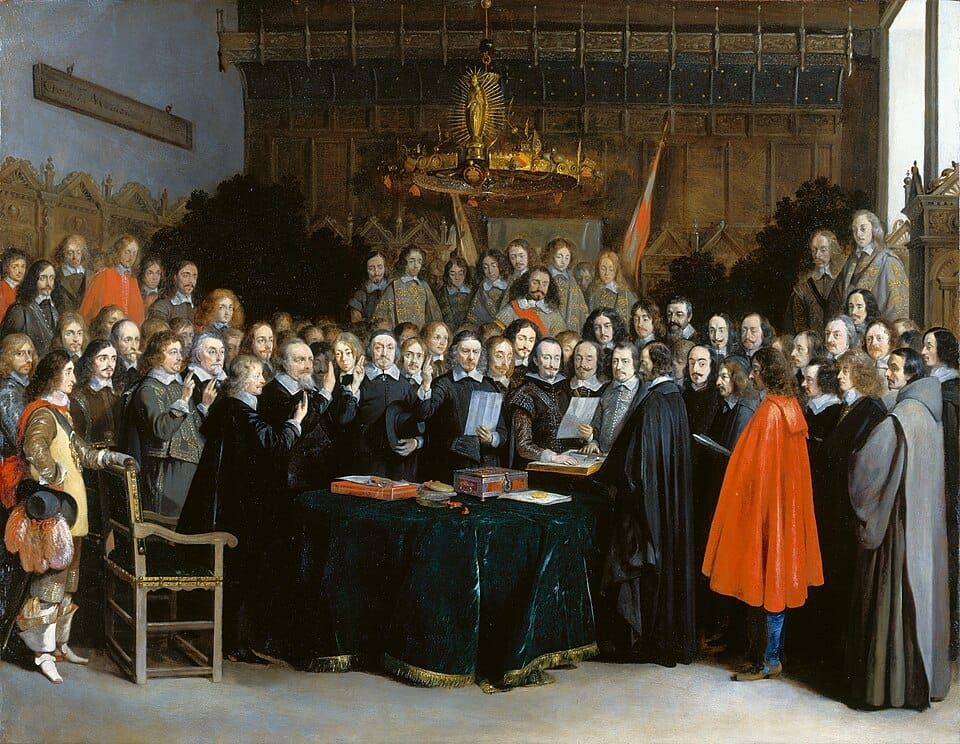
The political Baroque has a precise historical origin. The Peace of Augsburg in 1555, and its extension at Westphalia in 1648, ended the Wars of Religion not by resolving the theological conflicts that produced them but by spatially managing those conflicts — cuius regio, eius religio, the religion of the ruler determines the religion of the territory. This was not a solution. It was a containment procedure. The question of which confession held the singular truth of Christian salvation — a question that had consumed Europe in fire for over a century — was answered by being administratively quarantined. The conflicts did not end. They were absorbed into institutional procedure.
The Holy Roman Empire was the organizational expression of this containment — and it is the first and purest instance of the political Baroque. Voltaire's observation that the Empire was neither holy, nor Roman, nor an empire is not wit but structural diagnosis. The Empire was not a state that failed to function. It was an institution whose function was the management of irresolvability: overlapping jurisdictions, decisions that could not be enforced, elaborate procedural mechanisms that consumed the energies of conflict without resolving its sources. Charles Tilly demonstrated that early modern European state formation proceeded through the ratchet of war and extraction, each crisis producing institutional consolidation. The Holy Roman Empire was the exception — a political form that lasted a thousand years precisely because it could not consolidate, because its constituent tensions remained irreducibly plural, because resolution would have required the annihilation of one party and the parties were too closely matched for annihilation to proceed. The Empire was an interregnum that became permanent. It did not survive because it worked. It survived because failure was distributed across too many nodes to be catastrophic.
The Baroque institution, then, has three identifying features. First, it multiplies procedure in proportion to its inability to resolve. Where genuine political authority can decide, the Baroque negotiates, mediates, and escalates to committees. Second, it generates a gap between the declaratory and the operational — between what the institution claims to be and what it actually does, a gap that is not hypocrisy but the structural signature of unresolvable foundational conflict. Third, it is sustained not by legitimacy but by the absence of a viable alternative: it endures not because participants believe in it but because the cost of its collapse exceeds the cost of its continuation.
II. The European Union as Political Theology
The European Union is not a state. It is not an international organization. It is not a federation. These are not failures of development but structural descriptions. The EU is a political Baroque: an institution whose design encodes an irresolvable theological conflict and whose elaborate procedural architecture — the Commission, the Council, the Parliament, the Court, the rotating presidencies, the opt-outs, the enhanced cooperations, the conditionality mechanisms — is the contemporary form of the Empire's Reichstag.
To understand why requires understanding that the EU's founding conflicts are not economic or procedural but theological. Not theological in the metaphorical sense of deeply held — but theological in the precise sense: the three political grammars that constitute the EU's internal tension are the direct secularizations of three irreconcilable Christian political theologies, and they produce incommensurable relationships to the most basic categories of political life: the nature of authority, the meaning of suffering, the possibility of closure.
The first grammar is Augustinian. Augustine's political theology, elaborated against the Donatists in the early fifth century, rests on the concept of the corpus permixtum — the mixed body. The church, and by extension the political community, is an irreducible mixture of the elect and the damned, indistinguishable in history. The earthly city cannot be perfected. The distance between the ideal and the actual is permanent, not a failure to be overcome but a condition to be inhabited. The political consequences are structural: institutions are valid regardless of the moral character of their members (the ex opere operato principle extended to politics), suffering cannot be redeemed by politics, and arrival — the achievement of a final just order — is not available in historical time. The affective register is sober resignation: commitment to the task without the consolation of completion. This is the political grammar that German constitutional politics has distilled across the postwar decades. The Bundesbank's rule-fetishism, the Stability and Growth Pact, the Maastricht criteria, the no-bailout clause — these are not economic policies. They are the institutional expression of a civilization that learned, at catastrophic cost, that political enthusiasm promises more than politics can deliver, and that rules exist precisely to constrain the temptation to believe that this time, the arrival is possible.
The second grammar is Jesuit. The Counter-Reformation produced a specific political theology organized around the claim that there is one correct rational order, knowable through disciplined reason, whose universal application is the proper work of the church as a civilizing institution. The Jesuit order was the enforcement arm of this claim — a technocratic body of trained administrators whose legitimacy derived not from electoral mandate but from their possession of the correct map. The French Revolution secularized this structure without altering it. The Republic replaced the Church as the universal institution of reason; Enlightenment replaced grace; the citoyen replaced the faithful; but the structural claim — that there is one correct order, that deviation from it is deficiency rather than difference, and that its enforcement is the task of the trained administrator — survived intact. The European Commission is the Jesuit order's institutional successor. Its technocratic legitimacy, its insulation from democratic pressure, its claim to represent universal norms rather than particular interests, its reading of resistance as backwardness — these are the political theology of the Counter-Reformation translated into the language of human rights, rule of law, and the acquis communautaire.
The third grammar is martyrological. Where the Augustinian grammar is formed by the experience of permanent insufficiency and the Jesuit grammar by the possession of the correct map, the martyrological grammar is formed by the experience of sacred violation. Communities that have survived imperial suppression — Ottoman, Habsburg, Russian, Soviet — develop a political theology organized around the wound: the conviction that suffering is not random or deserved but meaningful, because only the sacred can be truly violated. The wound is not merely evidence of past injustice but the ongoing ground of present claims. The community is owed vindication, not as a preference but as a cosmic debt. The enemy is not an interlocutor with conflicting interests but a desecrator whose aggression constitutes the community's identity. Guilt is structurally impossible in this grammar: the cause of suffering is external, the community's stance is righteous, and compromise is betrayal of the wound. This is the grammar of Polish, Hungarian, Czech, Romanian, and Serbian political consciousness — not uniformly and not without internal variation, but as the irreducible substrate that resurfaces whenever these communities feel that external powers are demanding the subordination of their particular sacred identity to a universal norm.
These three grammars are not ideological positions that could be updated with better information or resolved through improved procedure. They are, in the precise phenomenological sense, different qualia — different experiential structures through which the political world is apprehended. The Augustinian gap, the irresolvable distance between ideal and actual, cannot be translated into the Jesuit singular truth, which claims the ideal is known and approximable. Neither can translate into the martyrological sacred wound, which does not seek the universal but the vindication of the particular violated body. They speak different languages at the level of basic political perception. The EU is not a polity that contains actors with different interests. It is a structure that encodes actors with incommensurable ontologies.
III. The Conciliar Precedent
This is not an unprecedented structural condition. The history of Christian ecumenical councils is the history of precisely this conflict — and it demonstrates, with the clarity that only long historical time provides, both the structural pattern of the conflict and the systematic failure of institutional resolution.
The Donatist controversy of the early fourth and fifth centuries is the founding instance of the Augustinian gap against the martyrological wound, and it is not incidental that Augustine's political theology took its definitive shape in direct polemical engagement with the Donatist position. The Donatists held that the church's validity depended on the moral purity of its ministers: bishops who had surrendered scriptures to Roman authorities during the Diocletianic persecution — the traditores — had forfeited their authority, and sacraments performed by bishops in succession from traditores were invalid. The wound of persecution established the criterion of authenticity: the pure church was the church that had suffered without compromise. Augustine's response constituted the Augustinian gap as a political theology. The church is a corpus permixtum, the wheat and tares intermingled until the final harvest. The sacraments are valid regardless of the minister's character because the institution's operation cannot be made dependent on the individual's unverifiable moral standing. And — the move that the martyrological grammar structurally cannot accept — suffering does not guarantee authenticity. One must suffer for the right cause; the Donatists were schismatics whose suffering, however real, did not sanctify their position. The controversy raged with intermittent violence for nearly a century. Augustine won the theological argument. The Donatists were eventually suppressed by imperial force. The underlying structural tension — pure wound against impure institution — was not resolved. It was foreclosed.
The Council of Chalcedon in 451 demonstrates the second structural pattern: the enforcement of singular truth generating sacred wound communities. The Chalcedonian definition — one person, two natures — was the correct formulation, promulgated with the authority of imperial council and enforced with the apparatus of Byzantine power. The Coptic, Ethiopian, Armenian, and Syriac churches refused it. They have refused it for fifteen centuries. The non-Chalcedonian churches are not merely theological dissenters; they are communities whose identity is constituted by their wound — the wound of having their theological tradition condemned as heresy by an imperial power that used doctrinal enforcement as an instrument of political integration. Subsequent centuries of Arab conquest, Ottoman rule, and modern persecution layered the wound without resolving it. The Coptic church is Monophysite not primarily because of the finer points of fifth-century Christology but because Chalcedonian enforcement became inseparable from the experience of imperial aggression against Egyptian Christian identity. Singular truth, institutionally enforced, produces sacred wound communities at the periphery. This is not an accident of history. It is the structural law of the relationship between the two grammars.
The Council of Constance from 1414 to 1418 completes the triad by demonstrating all three grammars in simultaneous conflict. The conciliarist theologians — Jean Gerson, Pierre d'Ailly — argued against the papacy's claim to singular doctrinal authority: the council is above the pope, truth is discerned through the whole church rather than concentrated in a single institution. This is the gap position: no single institutional locus holds the definitive truth, the church is always in via, always approaching what it cannot fully possess. The papacy's counter-position is pure singular truth: one person, Christ's vicar, holds ultimate authority; the correct formulation exists and it is the pope's to define and enforce. Jan Hus arrived at Constance under safe conduct, was tried for heresy, and was burned. The martyrological grammar was not present at Constance as a theological position. It was produced by Constance as an event. The burning of Hus generated a sacred wound of such intensity that it organized Czech national identity for centuries: the Hussite wars, the Battle of White Mountain in 1620, the Habsburg suppression, the National Revival of the nineteenth century, the Velvet Revolution — all of these are structured, in part, around the Constance wound. Singular truth, attempting to suppress the gap, burned a man and created a permanent wound. The institution could not absorb the consequence it had produced.
The structural law crystallizes across these cases. The three grammars cannot resolve their differences through argument because they do not share the premises that would make argument possible. Each grammar reads the others through its own categories: the gap reads singular truth as hubris and sacred wound as the illegitimate claim to escape the human condition; singular truth reads gap as moral cowardice and sacred wound as particularist regression; sacred wound reads gap as the complacency of the unpersecuted and singular truth as another form of imperial imposition. The institution that contains all three without resolving any — the council, the empire, the union — does not produce synthesis. It produces procedure: increasingly elaborate, increasingly baroque mechanisms for managing a conflict that cannot be managed to resolution. The Council of Trent, convoked in 1545 as the systematic institutional response to the Reformation's sacred wound communities, produced perhaps the most rigorous articulation of singular truth in Christian history — and guaranteed three more centuries of religious war by doing so.
IV. The Baroque Returns
The homology between the conciliar pattern and EU political events is not metaphorical. It is structural. The same three grammars, operating with the same internal logic, produce in contemporary Brussels the same institutional dynamics they produced in Nicaea, Constance, and Trent.
The Eurozone crisis from 2010 to 2015 was the Chalcedonian moment. The Troika — European Commission, European Central Bank, International Monetary Fund — enforced the singular truth of fiscal discipline with the authority of institutional consensus and the instrument of conditionality. Greece was the non-Chalcedonian church. The Greek government's resistance — particularly in Varoufakis's framing of the crisis as a civilizational assault, the invocation of Nazi occupation, the claim that Greek suffering constituted a special moral claim on European solidarity — was the martyrological grammar in its contemporary form. Mario Draghi's intervention of July 2012, the declaration that the ECB would do "whatever it takes" to preserve the euro, was the gap position: the institution must survive the violation of its own rules because the corpus permixtum cannot expel its impure members without destroying itself. The ECB's Outright Monetary Transactions program had no clear treaty basis. It was an exercise of sovereign decision in the Schmittian sense — the exception that reveals the real structure of authority beneath the procedural surface. The exception was absorbed into procedure, became the template for subsequent interventions, and added another layer to the Baroque architecture. The crisis was not resolved. It was managed into institutional complexity.
Hungary under Viktor Orbán is the Donatist controversy's contemporary iteration, with the polarity reversed. Where the Donatists claimed purity against a corrupt institution, Orbán claims authenticity — the authentic national-Christian civilization of Hungary against the spiritually contaminated liberalism of Brussels. The Commission's response enacts the Augustinian gap in its institutional form: the rule of law is valid regardless of the political character of the government that formally adheres to it; the institution's legitimacy is structural, not dependent on the moral standing of its members. Article 7 proceedings, the conditionality mechanism on structural funds, the Rule of Law Regulation — these are the ex opere operato principle applied to supranational governance. The sacrament is valid; the minister is another question. But the EU cannot expel Hungary. The mechanisms do not function. The corpus permixtum cannot separate its wheat from its tares, and the attempt to manage the Donatist challenge through increasingly elaborate institutional procedure reproduces, at the level of contemporary European politics, the century-long unresolved conflict that Augustine diagnosed and failed to cure. Budapest reads Brussels as the traditor. Brussels reads Budapest as the schismatic. Neither reading is available to the other.
Brexit was the burning of Jan Hus — the moment when the institution, by enforcing its singular truth, produced a wound that organized a community's identity around its departure. The European project had been, in British political culture, experienced as a progressive encroachment on parliamentary sovereignty: the expansion of EU competence through successive treaties, the juridification of British public life through European Court of Human Rights jurisprudence, the freedom of movement that transformed the demographic composition of English towns faster than the political system could process. The Brexit referendum mobilized a sacred wound that British political elites had neither acknowledged nor addressed — the wound of communities that experienced the liberal cosmopolitan project not as emancipation but as dispossession. "Take Back Control" is martyrological grammar in electoral form. The Remain campaign's response — economic projections, appeals to European values, the language of sophisticated international engagement — was the singular truth's characteristic mode of address to the wound it has not recognized as a wound: the diagnosis of ignorance where what is present is violated identity. The conversation was structurally impossible before it began.
The migration crisis of 2015 and 2016 made the three grammars' mutual unintelligibility visible simultaneously. Angela Merkel's decision to suspend Dublin Regulation enforcement and accept Syrian refugees was the gap position in its most exposed form: the institution's rules cannot hold in the face of a human emergency that exceeds what the rules anticipated; the corpus permixtum must open itself to further mixture because the alternative is the betrayal of the institution's own foundational claim. The Visegrád group's refusal — Hungary, Poland, Czech Republic, Slovakia — was the martyrological grammar's structural response: the national body is sacred, its composition cannot be altered by external decree, and the demand to accept mandated quotas is structurally continuous with the Soviet-era imposition of unwanted populations and policies. The Commission's mandatory relocation scheme was singular truth enforcing itself against two grammars that both refused it: the gap, which accepted the crisis but doubted the mechanism, and the wound, which refused the premise entirely. The scheme was never implemented. It added to the Baroque.
V. Coda: The Interregnum's Logic
Carl Schmitt observed that sovereign is he who decides on the exception. The EU's structural crisis is that it has no sovereign — no actor capable of making the exception's decision with the authority that would make it binding. What it has instead is the repeated generation of exceptions that reveal the absence of sovereignty: the Eurozone crisis, the migration crisis, the Brexit negotiation, the rule of law conflict, the pandemic response, the Ukrainian war. Each exception is absorbed into procedure. Each absorption adds a layer to the Baroque. The institution survives not by resolving its constitutive tensions but by converting them into administrative complexity, buying time — Wolfgang Streeck's phrase — against the day when the complexity can no longer absorb the tension it is designed to contain.
The Holy Roman Empire lasted a thousand years on this basis. It did not survive because it worked. It survived because none of the parties had the power to replace it, because the cost of its collapse exceeded the cost of its dysfunction, and because the Baroque architecture of overlapping jurisdictions and unenforceable decisions distributed the pressure of irresolvable conflict across enough nodes to prevent any single failure from becoming catastrophic. The EU has the same structure and faces the same arithmetic. Brexit was the first successful exit — a Sacred Wound community with enough accumulated grievance and enough institutional insulation to bear the exit costs. Hungary is the Donatist challenge from within: too embedded to expel, too recalcitrant to absorb, managed by increasingly elaborate conditionality that satisfies no one and resolves nothing.
The three scenarios for the interregnum's end are inherited from the Empire's history. External force can end it: Napoleon dissolved the Empire in 1806 by making its continuation more costly than its abolition. The analog is a security crisis — Russian military pressure, American strategic withdrawal — that forces the gap and singular truth grammars into an emergency integration the sacred wound communities cannot afford to resist. A cascade of Sacred Wound exits can end it: if the wound communities exit sequentially, the institution loses the plurality that makes its irresolvability productive, and what remains is a smaller, more coherent entity built on the surviving grammars. Or the Gap position collapses from within: if Germany — the institution's primary gap-holder, the actor whose structural role is to mediate between singular truth and sacred wound — is captured by its own martyrological moment, there is no longer a mediating position. The AfD represents this possibility. It is not an anomaly in the German political system. It is the German political system's own Sacred Wound grammar finding its voice — the wound of reunification's costs, the wound of demographic transformation, the wound of a country that was required to suppress its own nationalist enthusiasm for eight decades and is discovering that suppression is not elimination. If the gap state ceases to hold the gap, the two remaining grammars stand in direct confrontation with no institutional mediation between them. The Thirty Years War was fought under those conditions.
Gramsci's monsters are not interruptions of the interregnum. They are its content. The interregnum does not produce monsters and then end. It produces monsters because it cannot end — because the old world's death and the new world's birth are not sequential events but a sustained condition whose duration depends on the unresolved balance between grammars that cannot translate into each other. The European Union is that condition, institutionalized. Its procedural Baroque is not a transitional phase. It is the political form that irresolvability takes when it is durable. The question is not whether the interregnum will end. The question is what ends it — and whether the ending will be slower or faster than what European civilization has, in its prior interregna, been able to survive.
REGNIS publishes occasional essays at the intersection of historical analysis and institutional intelligence. The views expressed are those of the author.