E017a. The Architecture of Misrecognition I: Putin and NATO Expansion
NATO Expansion, the Anxiety of European Identity, and the Strategic Failure on Both Sides (2000–2008)
I. The Paradox of Contemptuous Confidence
There is a curious feature of Western discourse on Russia in the years between Putin's first election and the August war in Georgia, one that becomes visible only in retrospect: as the West grew more institutionally and territorially expansive — pushing NATO and the European Union eastward through three successive enlargements, embedding missile defense systems on the Russian periphery, encouraging colour revolutions in Russia's traditional sphere — the tone of its discourse toward Russia did not soften but hardened. This is not the behaviour one would expect from a hegemon confident of its position. A truly hegemonic order, secure in its own legitimacy and military superiority, does not need to project contempt at a declining adversary; it can afford the magnanimity of indifference or, if interest dictates, the courtesy of strategic engagement. The contempt that suffused Western coverage and policy discussions of Russia during these years — the routine framing of Putin as a "tsar," the dismissal of Russian security concerns as "imperial nostalgia," the eagerness to predict the imminent collapse of an "obvious kleptocracy" that somehow never collapsed — betrays something more anxious than confident.
The standard interpretation, both within Western policy circles and among most academic observers, treats this period as essentially a story of liberal triumphalism encountering a wounded but increasingly assertive revanchist power. Russia, having lost the Cold War, was supposed to either liberalise into a peripheral European democracy or accept its diminished status. When Putin chose neither path — when he consolidated authoritarian rule at home while seeking to recover Russia's lost sphere of influence abroad — Western contempt is rendered as the natural response of a victorious liberal order to a retrograde holdout. The expansion of NATO is rendered, in turn, as the technical extension of a successful institutional model to states that wanted to escape Russian gravity. Anything else is dismissed as Kremlin propaganda or the work of Western useful idiots.
This story is not exactly wrong. It captures something real about the asymmetry of power and the genuine desire of Central and Eastern European states to escape Russian influence — a desire built on three centuries of bitter historical experience that no analytic framework can or should erase. But it cannot account for the texture of the period: the compulsive quality of Western expansion, the disproportionate intensity of the contempt, the inability of Western diplomats to take seriously Putin's early overtures even when Russia was at its weakest and most accommodating, and the strange persistence of the Western prediction that Russia would imminently collapse, repeated year after year for two decades without yielding to evidence. Something else was going on, beneath the surface of the explicit story, that the explicit story could not name.
The hypothesis advanced here is that Western contempt during these years operated as what one might call a defensive symptom: a discursive formation that disguised, and made possible the disavowal of, a structural feature of post-Cold War European order that its participants could not consciously articulate without destabilising the entire ideological edifice on which their legitimacy rested. That feature is simple to state and devastating to acknowledge. Europe, as a political entity rather than a geographic expression, requires Russia as its constitutive outside. The coherence of the European project after 1991 — the shared identity that holds together states with sharply divergent national interests, the moral authority that legitimates the EU's claims to universalism, the operational logic that justifies NATO's continued existence — depends on the maintenance of Russia as the external Other against which Europe defines itself. This is not a moral judgment but a structural observation, and it follows directly from a tradition of political thought running from Hegel through Schmitt and on into the contemporary constructivist literature on identity formation in international relations.
What makes the situation tragic, rather than merely cynical, is that neither party to the relationship could afford to name this structure. The West could not name it because doing so would expose the contingent and particular character of an order whose legitimacy rested on claims to universal liberal values. To admit that NATO required Russia as an enemy was to admit that NATO was not the universal security architecture of an emergent liberal peace, but the particular alliance system of a Western civilisation defining itself against an Eastern one. Russia could not name it either, because to do so would have required Putin to abandon the framework of great-power realism in which his entire strategic identity was grounded — to admit that the West was not in fact an adversarial rational actor pursuing geopolitical advantage, but an anxious civilisational formation defending its identity through ritual hostility. The first move, had he made it, would have unsettled the West far more profoundly than any military assertion he eventually chose. He did not make it. The cost of that failure compounds even now.
II. The Structure of Liberal Order and Its Constitutive Outside
The post-1991 international order presented itself, and was presented by its principal architects, as the emergent form of a universal political modernity. This was the moment of Fukuyama's thesis, of Krauthammer's unipolarity, of the proliferation of "transition" literatures imagining the entire former communist world as so many waystations on a single developmental path toward liberal democracy and market capitalism. The triumphalism of the period is by now well documented and frequently mocked, but its conceptual structure deserves more careful attention than the easy retrospective dismissal usually accords it. The triumphalists were not simply wrong; they articulated, in a partial and ideologically loaded form, something genuinely true about the post-Cold War conjuncture. The Soviet alternative had collapsed. There was no remaining systemic competitor to the liberal-capitalist order. The institutional apparatus built by the United States and its allies in the late 1940s — the Bretton Woods system, NATO, the GATT-WTO complex, the various regional integration projects of which the European Community-then-Union was the most ambitious — was poised to extend across what had been the Soviet bloc and, perhaps, to define the operating system of an emerging global polity.
What the triumphalist framework systematically obscured, however, was the question of what would now hold this expanded order together. Throughout the Cold War, the Western alliance had cohered around opposition to Soviet communism. This opposition was not merely strategic but ideological and civilisational; it gave content to the otherwise empty signifier of "the West." When American officials spoke of "Western values" during the Cold War, they meant something specific and contestable: liberal democracy, market economies, individual rights, secular pluralism — all defined in opposition to the alternative offered by Marxism-Leninism. The Soviet enemy did not merely threaten the West militarily; it constituted the West conceptually, by providing the negative pole against which Western identity could be articulated. With the Soviet collapse, this constitutive opposition vanished. The "West" remained as a geopolitical fact and an institutional formation, but its conceptual ground had been removed.
This is the moment at which the deeper logic of identity formation, traced in the philosophical tradition from Hegel's account of the dialectical constitution of self-consciousness through opposition, becomes acutely relevant to international relations. Identity, whether individual or collective, is not a positive content one simply possesses but a relational achievement, accomplished through differentiation from what one is not. The Hegelian master-slave dialectic, transposed into the register of group identity, illuminates a structural feature that the triumphalists could not see: a collective subject, like an individual subject, requires the recognition of an other in order to constitute itself, and this recognition is fundamentally entangled with the experience of difference. When the difference vanishes — when the other ceases to exist as a meaningful counterpart — the self that depended on this opposition is thrown into a crisis of self-understanding from which it can extract itself only through one of two paths. It can transform itself, acknowledging that its previous identity was contingent on an opposition that no longer obtains and reconstructing its self-understanding on a different basis. Or it can recreate the opposition, projecting onto some available candidate the role that the lost other once played.
The Western order chose the second path, though the choice was never made consciously or articulated as such. The geographic and demographic continuity between the former Soviet Union and the new Russian Federation, the persistence of nuclear arsenals and a militarised state structure, the cultural distinctiveness of Russian Orthodoxy and the Russian intellectual tradition — all of these features made Russia the obvious candidate for the structural role that the Soviet Union had occupied. What was required was a gradual recalibration of discourse, presenting Russia as the natural continuation of the Soviet adversary even as the new Russian state collapsed economically and pleaded for integration into Western institutions. This recalibration could not be performed openly; it had to occur through accumulated small acts of discourse, each of which appeared innocent in itself and only acquired its full meaning through the pattern they collectively formed. The Russian state of the 1990s was discussed as "weak" and "transitional," its weakness understood as temporary and its transition as a process toward integration. By the mid-2000s, the same state — by then considerably stronger but still no military match for NATO — was being discussed as "revanchist" and "aggressive," its strength understood as threatening and its trajectory as a regression toward Soviet adventurism.
What had changed was not Russia, which by every measure remained vastly weaker than the Soviet Union had been at any point in its history. What had changed was the discursive position Russia was being made to occupy. The shift from "weak transitional partner" to "threatening revanchist" tracked not Russian behaviour but the Western need to reconstitute its identity around a renewed friend-enemy distinction. Carl Schmitt's much-debated thesis that the political itself is constituted through the friend-enemy distinction — that political communities exist as political only insofar as they are capable of identifying an enemy whose hostility threatens their way of life — was operationalised, without anyone quite noticing, by the gradual recoding of Russia from the demoralised heir of a defeated empire into the existential threat that justified continued Atlantic solidarity. This recoding was not the work of a conspiracy. It was the diffuse product of countless small discursive acts performed by analysts, journalists, politicians, and bureaucrats, each of whom was pursuing his own modest professional and ideological interests and none of whom would have recognised himself as participating in a project of identity reconstitution.
The function of NATO expansion within this process becomes considerably more legible once the underlying logic is named. The standard rationalisations of expansion — the desire to consolidate democracy in post-communist Europe, the request of newly independent states for security guarantees, the technical desirability of harmonising European security architecture — were not exactly false. The Central and Eastern European states genuinely wanted membership. The democratic consolidation argument had purchase, at least in some cases. The technical-legal arguments could be elaborated at length. But none of these rationalisations could explain the compulsive quality of expansion, the anxiety that drove its repeated extension, or the contempt with which Russian objections were dismissed. Expansion served, beneath its various technical justifications, the structural function of reconstituting the friend-enemy distinction by progressively pushing the line between friend and enemy eastward, demonstrating with each new round of accessions that the West remained a meaningful identity precisely because there remained territory not yet incorporated into it, and a power — Russia — that resisted such incorporation. The expansion was not designed against Russia in the way that a military campaign is designed against an enemy. It was designed through Russia, using Russia as the necessary outside whose continued exclusion constituted the inside.
This explains the otherwise puzzling paradox that struck several observers at the time: NATO expansion intensified precisely when Russia was weakest, and the discursive hostility toward Russia intensified precisely when Russia was most accommodating. A purely strategic logic, of the kind realists or liberals would attribute to states, cannot easily explain why an alliance would push aggressively into the security space of an actor who poses no threat. The expansion makes sense, however, if its function was not the strategic management of an actual Russian threat but the symbolic management of European identity in the absence of any actual Russian threat. Weak Russia was, in a peculiar sense, more dangerous to Western identity than strong Russia would have been. Strong Russia could plausibly be cast as the enemy of liberal order. Weak Russia exposed the fact that no such enemy actually existed, and that the institutional apparatus of the Cold War was being maintained, expanded, and reified despite the disappearance of the conditions that had justified it.
The discursive solution to this exposure was the gradual reconstruction of weak Russia as still latently strong, still potentially threatening, still secretly imperial in its ambitions and revanchist in its memory. The 1990s saw the elaboration of an entire discourse on Russian "decline" that managed, against the manifest evidence of an actually weak state struggling to feed its population, to keep open the question of Russian threat by displacing it temporally. Russia was weak now but might become strong again. The state was struggling but might consolidate. Yeltsin was friendly but Russia's deeper political culture was authoritarian. This temporal displacement performed crucial ideological work: it allowed the West to continue treating Russia as a structural enemy while engaging with it economically, diplomatically, and even militarily on terms that presumed continued cooperation. The contradiction between the structural-discursive treatment of Russia as enemy and the operational treatment of Russia as partner could be managed only by maintaining a careful ambiguity about which Russia — the present partner or the future threat — was really the object of policy.
Putin's arrival on the Russian political scene in 1999, his ascent to the presidency in 2000, and the early phase of his rule through approximately 2003 forced this ambiguity into a crisis from which Western policy never quite recovered. Putin presented himself, in this early period and with considerable credibility, as a Russian leader who could be a partner. He cooperated extensively with the United States after September 2001, providing intelligence on Central Asian Islamist networks and assenting to the establishment of American bases in former Soviet republics. He raised, in conversations with senior Western officials including Clinton and Lord Robertson, the possibility of Russian membership in NATO itself. He treated the question of Ukrainian or other former Soviet states' future NATO membership as an open question to be negotiated on its merits, rather than as a casus belli. He attempted, in short, to call the bluff of the discursive framework that treated Russia as the future enemy of a Western order by offering to enter that order on its own terms. This offer was, structurally, the most dangerous gesture Russia could have made. Had it been accepted, the entire architecture of Western identity-through-opposition would have been destabilised. Russia inside NATO would have been Russia not as the constitutive outside but as a fellow Western state, and this would have required the West to discover or construct a new outside to maintain its coherence — China, the Islamic world, some other candidate — or else to undertake the difficult work of reconstituting its identity on a basis that did not depend on opposition at all.
The offer was not accepted. It was not even seriously considered. The mechanism by which Western capitals rejected it is itself instructive. There was no high-level meeting at which the question was deliberated and decided. There was no formal communiqué declaring Russian membership impossible. Instead, the offer was simply absorbed and dissolved by the discursive apparatus, treated as an interesting but unrealistic gesture, met with polite expressions of openness in principle combined with the practical impossibility of actually pursuing it. The offer disappeared into the routine of diplomatic engagement, in which it was occasionally acknowledged as having been made but never seriously processed as an option. This is the characteristic operation of ideological foreclosure, in the technical sense developed by the Lacanian tradition: the offer could not be refused outright, because refusing it would have required articulating the reason for refusal, which would have exposed the structural function of Russian exclusion. It could not be accepted, because acceptance would have destabilised the entire identity-formation around which the order was built. It had to be neither accepted nor refused but simply dissolved, returned to the background hum of routine diplomatic engagement from which it had briefly emerged.
The Putin of the early 2000s could not understand what was happening to his overtures because his entire framework for understanding international politics rendered such dissolution unintelligible. Schooled in the Soviet intelligence services and shaped by a strategic culture that treated the West as a coherent rational adversary pursuing geopolitical advantage, Putin interpreted Western non-response as either tactical positioning — a holding pattern while the West considered the offer seriously — or as a sign that he had not yet demonstrated sufficient strength to be taken seriously. Both interpretations missed the actual mechanism at work. The West was not considering the offer seriously and would never consider it seriously, because the offer threatened a structural condition of Western identity that no amount of further consideration could resolve. Putin's strength was not the issue. Russia's reliability was not the issue. The issue was that Russia inside the Western order was structurally impossible, regardless of who was running Russia or how it was behaving, because Russia was needed outside to constitute the order in the first place.
III. The Misreading of Contempt and the Trap of Strength
The cognitive failure into which Putin steadily descended over the years that followed was not a failure of intelligence in the ordinary sense. By every measure that intelligence services and strategic analysts use to evaluate leaders, Putin was an exceptionally capable operator. He read tactical situations with precision, manipulated domestic political coalitions with skill, and understood the operational logic of power within the Russian system better than perhaps any leader in modern Russian history. What he lacked — and what his entire formation made it nearly impossible for him to develop — was the capacity to recognise that the West was not operating according to the strategic logic he had been trained to understand, but according to an identity logic that his framework could not register.
The contempt Putin encountered from Western interlocutors and Western media throughout the 2000s was, on its face, the contempt of stronger parties toward a weaker one. This is how Putin read it, and the reading was not unreasonable given the framework within which he was operating. In the realist tradition that shaped his strategic thinking — a tradition that runs from Thucydides through Hobbes and Hans Morgenthau into the contemporary American academy in figures like John Mearsheimer — contempt from a stronger toward a weaker actor is a familiar phenomenon, and the appropriate response is well established. The weaker actor must accumulate strength until the stronger party is forced to take it seriously. Contempt is reversed by capability. Disrespect is corrected by demonstrated power.
This reading missed the entire structural dimension of what was happening. The contempt directed at Russia was not the confident contempt of a stronger party toward a weaker one — though it certainly carried that surface register — but the defensive contempt of an order that needed Russia to remain in a particular structural position and feared the consequences of Russia escaping that position. The intensity of Western contempt, its disproportion to anything Russia was actually doing, its persistence in the face of Russian accommodation, all pointed toward something other than the simple expression of confidence. They pointed toward what one finds in the psychoanalytic literature on defensive formations: the symptom is most intense precisely when the threat it disguises is most acute. The contempt covered an anxiety, and the anxiety was the unspeakable structural truth that European identity depended on Russian exclusion, that the entire post-Cold War order was built on a foundation it could not name without collapsing.
Had Putin read the contempt as a symptom of anxiety rather than as an expression of confidence, an entirely different strategic field would have opened to him. The appropriate response to defensive contempt is not the demonstration of strength but the calling-out of the underlying anxiety, the patient exposure of the structural condition that the contempt is designed to conceal. This would have been the harder and slower path, and it would have required Russia to operate as something other than a great power in the conventional sense. It would have required Russia to operate as what one might call a meta-power, attacking not the Western order's capabilities but its self-understanding, forcing the West to confront the fact that its identity was constituted through opposition to Russia and therefore could not survive the elimination of that opposition through Russian integration. The Russia that pursued this strategy would have continued to offer integration, continued to participate in Western institutions, continued to call the West's bluff on its own universal pretensions — and at every refusal, every dissolution of an offer into the background hum of diplomatic routine, the West would have been forced to either accept Russia and reconstruct its identity, or refuse Russia in terms that exposed the structural exclusion.
This is the path Putin did not take, and could not have taken given his formation. The strength-assertion response he chose instead — the gradual hardening of Russian foreign policy from 2004 onward, the energy diplomacy used as coercive instrument, the Munich speech of 2007 that diagnosed Western behaviour but did so in the register of accusation rather than exposure, the intervention in Georgia in 2008 — operated entirely within the strategic logic the West was prepared to handle. Each Russian assertion of strength confirmed the Western discursive position that Russia was the latent enemy whose containment justified NATO expansion. Each act of Russian self-assertion provided fresh material for the symbolic reconstruction of Russia as the constitutive outside. The strategy that Putin believed would force the West to take Russia seriously instead consolidated the Western framework that had been treating Russia as a problem to be managed rather than as a partner to be engaged. It was a perfect example of what students of social conflict have long recognised as the strength of the weak position: the actor whose protests are dismissed gains analytic leverage only by exposing the dismissal as defensive, and loses that leverage entirely if he confirms his protesters' description of him by acting precisely as they predicted he would.
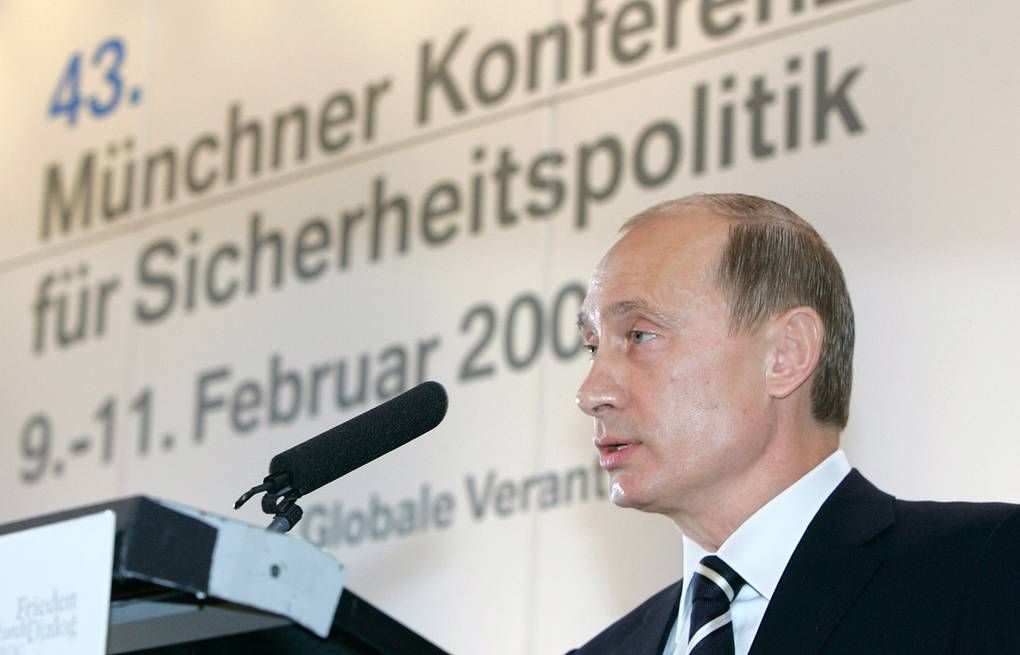
By 2007 the dynamic had become locked in. Putin's Munich Security Conference speech of February of that year was probably the high point of Russian articulation of the structural problem, and it was also the moment at which the Western capacity to hear the articulation reached its lowest point. The speech is worth reading carefully even now, because what it says is considerably more interesting than the standard Western characterisation suggests. Putin did not deliver a tirade or threaten war. He delivered a sustained, analytically precise critique of the post-Cold War order, identifying with considerable accuracy the gap between the West's universalist self-presentation and its particularist behaviour, the discrepancy between NATO's claim to be a defensive alliance and its actual pattern of eastward expansion, the contradiction between American claims to uphold international law and American conduct in Iraq. The speech named, more directly than perhaps any Russian leader had named since the end of the Cold War, the structural pattern this analysis has been describing. And the Western response to the speech was the perfect demonstration of the foreclosure mechanism at work. The speech was reported in Western media as evidence of Russian aggression, of Putin's authoritarian deviation, of the emergence of a new Cold War initiated by the Kremlin. The content of what Putin actually said — the substance of his critique of Western behaviour — was almost entirely absorbed and dissolved by the discursive frame that converted it into evidence for the very framework Putin was attempting to critique. By the act of naming the structural problem, Putin became proof of it.
This is the moment at which the deepest tragedy of the period becomes legible. Putin's diagnostic was not wrong. His description of Western behaviour was, in its essentials, accurate. But the framework within which he delivered the diagnostic — the framework of great-power assertion, of demands for respect backed by demonstrated capability — guaranteed that the diagnostic itself would be absorbed into the very pattern it was attempting to expose. The West did not need to refute Putin's critique; it only needed to characterise the critique as itself evidence of Russian aggression, and the structural function of Russian exclusion would be reaffirmed. Anything Putin said in the register of great-power assertion would be heard as great-power assertion, and great-power assertion was exactly what the Western framework needed Russia to perform in order to maintain its own coherence. The harder Putin pushed on the structural problem, the more material he gave to the structural function that depended on his being identifiable as the structural enemy.
The same dynamic operated, with somewhat darker consequences, in the conflict that erupted in Georgia in August 2008. The Russian intervention had a coherent strategic rationale within the framework Putin was operating in: Saakashvili had been encouraged to view Georgia as a candidate for NATO membership, the Bucharest summit four months earlier had reaffirmed (in the famously incoherent compromise language) that both Georgia and Ukraine "will become members" of NATO, and the Georgian shelling of South Ossetia provided an opportunity to demonstrate the costs of pursuing NATO membership against Russian objections. From the perspective of the strategic logic Putin had embraced, the intervention was a successful demonstration of Russian capability and resolve. From the perspective of the structural logic he had failed to read, it was a catastrophe. The intervention completed the Western framework's task of reconstituting Russia as the unambiguous external enemy. After Georgia, the residual capacity of Western capitals to treat Russia as a potential partner was effectively exhausted. The figures within Western policy circles who had argued for engagement lost their last reserves of credibility. The structural exclusion of Russia from European order became, for the first time since the end of the Cold War, an explicit policy position rather than a tacit operational reality.
What had begun in 2000 as a Russian offer of integration into Western order had culminated, eight years later, in the consolidation of Russian exclusion as the organising principle of that order. Putin had not been wrong about the strategic situation, but he had been wrong about the framework. He had played, with great skill, a game whose rules guaranteed his loss the more skilfully he played.
IV. The Western Side of the Failure
The failure analysed thus far is, on its face, a Russian failure: the failure of a great-power leader trained in one framework to recognise that his counterparties were operating in another, and the consequent failure to develop a strategy adequate to the situation he actually faced. This is true and important, but it would be incomplete without an equally clear account of the Western failure that constituted the other half of the dynamic.
The Western capitals during this period were not, of course, executing a coordinated strategy of identity reconstitution. There was no committee in Brussels or Washington that decided, in 1992 or 1995, that European identity required Russian exclusion and laid out a plan to achieve this. What happened instead was the diffuse operation of an ideological field, in the sense that Pierre Bourdieu gave to that term in his analyses of intellectual production: an array of positions and dispositions, distributed across institutions and individuals, that systematically generated discourse and policy without anyone consciously aiming at the structural pattern that emerged from the aggregation. The journalists who described Putin as a "tsar" were not following instructions; they were operating within a discursive field whose internal logic favoured certain characterisations over others. The diplomats who dismissed Russian security concerns were not implementing a containment doctrine; they were applying frameworks of analysis they had absorbed from the institutional culture in which they worked. The think tank analysts who predicted Russian collapse year after year were not coordinating their predictions; they were each pursuing their own modest careers within a field that rewarded a particular set of arguments and disadvantaged others.
The systemic character of the resulting pattern is what gives the Western behaviour its quasi-unconscious quality. No individual Western actor was unconsciously pursuing Russian exclusion in the way an individual psychoanalytic patient might unconsciously pursue some symptom-producing aim. The unconsciousness was distributed across the field, present in the structural logic of the institutional and discursive arrangements rather than in any individual mind. This is why the Western failure was, in a peculiar way, harder to address than the Russian one. The Russian failure was concentrated in a particular leader and his immediate circle, and could in principle have been corrected by a different leader or a different framework adopted by the existing leader. The Western failure was diffused across the entire apparatus of post-Cold War European order, present in the structure of NATO, in the operating procedures of the EU, in the disciplinary norms of academic international relations, in the editorial dispositions of the major newspapers, in the institutional self-understanding of think tanks and policy schools. It could not have been corrected by any single decision or any single leader, because it was not located in any single decision or any single leader.
This diffusion has consequences for how the Western failure can be analysed. One cannot point to a particular Western strategist and say: he should have understood that NATO expansion was not really about Russia, that it was about reconstituting European identity through Russian exclusion. The strategist did not understand this because his framework did not permit him to see it; and his framework was the standard framework of his institutional position, the framework within which he had been trained and was rewarded for operating. To have seen the structural pattern would have required him to step outside his framework in a way that institutional structures very rarely permit. The few Western analysts who did approach the structural pattern — figures like George Kennan in his late writings, or in different ways Mearsheimer and a handful of dissenters — were systematically marginalised, treated as cranks or contrarians, and excluded from the policy conversations in which their analyses might have made a difference.
The Western failure can nonetheless be specified more precisely than this diffuse description suggests. It consisted in the inability or unwillingness of Western capitals to recognise three things. First, that the post-Cold War order they were extending eastward was not the universal liberal peace it claimed to be, but a particular civilisational formation that defined itself against other civilisational formations, and whose claim to universality was itself one of the discursive mechanisms by which it sustained its particular character. Second, that Russia was not a problem to be managed during a transitional period, but a genuine alternative civilisational and political formation whose interests and self-understanding could not be straightforwardly subsumed under the categories of liberal transition. Third, that the central security challenge of the period was not how to manage a declining Russian threat, but how to construct a European order that could accommodate the actually existing distribution of power and identity on the European continent — including the existence of Russia as a permanent feature of that continent and as a power with legitimate interests in the security architecture surrounding its territory.
Had Western capitals recognised any of these three things, the entire trajectory of the period might have been different. Recognition of the first would have produced a more modest discourse about the post-Cold War order, one that acknowledged its particular character and renounced the universalist pretensions that made compromise with non-Western powers ideologically impossible. Recognition of the second would have produced an engagement with Russia as a genuine interlocutor with its own legitimate interests, rather than as a recalcitrant transitional society to be coaxed into proper development. Recognition of the third would have produced an architecture of European security genuinely inclusive of Russia, perhaps through the creation of institutions that did not depend on the friend-enemy distinction for their coherence.
None of these recognitions occurred. The discourse remained universalist, the engagement remained pedagogical and condescending, the architecture remained organised around the exclusion of Russia. And as the structural pattern hardened, the field of available choices narrowed correspondingly. Each year that the West maintained its universalist discourse, the cost of moving to a more modest discourse increased, because the modesty would have to be acknowledged as a retreat. Each year that the engagement remained condescending, the Russian frustration accumulated, raising the threshold of any future engagement that might have been pursued differently. Each year that the architecture excluded Russia, the embedded interests within that architecture acquired greater stake in continued exclusion, making any future reconstruction politically more difficult.
This is the sense in which the Western failure was structural rather than personal. It was not that particular Western leaders made particular bad choices that could have been made differently. It was that the entire field within which Western leaders operated had developed in a direction that progressively foreclosed alternatives, and that this foreclosure was accomplished not through any conscious decision but through the accumulated weight of countless small operational acts each of which was reasonable within its immediate context. The Western order, in pursuing its own institutional logic, generated the conditions that made the conflict with Russia structurally inevitable. The Russian failure to read this dynamic compounded the inevitability, but did not create it.
There is one element of the Western failure that bears separate mention, because it cuts through the diffuse field-level account and identifies something more specific. The Central and Eastern European states that joined NATO during this period — Poland, the Baltic states, the Czech Republic, Hungary, Romania, Bulgaria, and the others — did not seek membership out of any abstract commitment to Western identity formation, and any analysis of NATO expansion that treats their motivations as purely epiphenomenal to Western grand strategy is making a serious analytic error. These states sought NATO membership because of concrete historical experience of Russian and Soviet domination, because of plausible fears about the future trajectory of Russian power, and because of considered judgements about their own interests. Their agency was real and their reasoning was serious. The structural function that NATO expansion served in the reconstitution of Western identity is one analytic level of the phenomenon; the genuine security interests of the new member states is another, and both levels are simultaneously true.
What this means is that any account of the Western failure must avoid the temptation to treat NATO expansion as simply a Western imposition that ignored the wishes of the eastern states. The eastern states wanted expansion, and they had reasons for wanting it that cannot be reduced to false consciousness. But the form that expansion took — its compulsive quality, its contemptuous treatment of Russian objections, its embedding within a discursive framework that progressively reconstituted Russia as the constitutive outside of European identity — these features were not necessitated by the security concerns of the new member states. A NATO that took Polish security seriously could have done so within a framework that also engaged Russian security seriously; a NATO that admitted the Baltic states could have done so as part of a broader European security architecture that included Russia rather than excluding it. The fact that NATO expansion took the form it did — exclusively eastward, exclusively against Russian objections, embedded in a discursive frame that increasingly treated Russia as enemy — was a feature of the Western field rather than a feature of the eastern states' security interests. The eastern states would have been at least as safe, and probably safer, in an architecture that included Russia than they have been in an architecture that progressively excluded it. That this alternative architecture was never seriously considered is part of the Western failure, not part of the eastern states' agency.
V. The Question of What Comes After
The structural analysis offered thus far has confined itself to the period from 2000 through approximately 2008, the period in which the pattern that culminates in the 2014 Ukrainian crisis and the 2022 invasion was being established. There is a temptation, in extending the analysis forward, to read the entire subsequent trajectory as the working out of the same structural logic — to treat the annexation of Crimea, the war in Donbas, and the full-scale invasion of Ukraine as the inevitable consequence of the structural dynamic established in the earlier period. This temptation should be resisted, because it elides something important about what changed after 2014 and accelerated dramatically after 2020.
The Putin who invaded Ukraine in 2022 is not the Putin who delivered the Munich speech in 2007, and the distinction is not merely chronological. The earlier Putin was operating within a coherent if mistaken strategic framework. He was wrong about the underlying structure of Western behaviour, and his strategy of strength-assertion compounded the wrongness, but he was not wrong about the basic categories within which he was operating. Russian interests, Russian capabilities, the strategic situation in Europe — these were intelligible to him and he was applying recognisable forms of strategic reasoning to them, even if the reasoning was flawed in the ways this analysis has tried to specify. The Putin of 2014 onward, and especially the Putin of the post-pandemic period, is a different figure. The strategic reasoning has degraded. The decisions taken are not poorly executed instances of recognisable strategies but increasingly the products of something more pathological — an ideological commitment that has detached itself from any feedback mechanism, a personal isolation that has eliminated the corrective influence of competing perspectives, a regime that has consumed its own capacity for course correction.
The evidence of this transition is now extensive, and observed in detail by careful analysts of contemporary Russia. The full-scale invasion of Ukraine in February 2022 was, by any conventional strategic calculation, a catastrophic decision. The military assumptions on which it was based were wrong by an order of magnitude. The intelligence picture was distorted by the unwillingness of subordinates to deliver information that contradicted Putin's expectations. The economic and demographic costs have been enormous and are largely irreversible. The Russian losses in the conflict — well over a million casualties across the four years of the war, including more than three hundred thousand killed — represent demographic damage that compounds an already severe demographic crisis. The collapse of Russian birth rates, accelerating under the combined pressures of mobilisation, emigration of the young and educated, and the broader sense of hopelessness that has settled over Russian society, threatens the basic viability of Russia as a populated country over a horizon of decades. The Russian economy has been progressively militarised, with civilian sectors hollowing out as the military-industrial complex consumes an ever-larger share of national resources. The technological base, never globally competitive, has further deteriorated as international sanctions have cut off access to advanced components. The political class around Putin has narrowed to a circle of yes-men whose primary qualification is the willingness to confirm the leader's preconceptions. The regime is, in a real sense, eating itself.
This is not the trajectory of a great power pursuing a coherent strategy, even a mistaken one. It is the trajectory of a regime that has lost the capacity to distinguish its own interests from the interests of its leader, and a leader who has lost the capacity to distinguish his own perceptions from the actual situation he confronts. The structural analysis of 2000 to 2008 does not, on its own, explain this trajectory. Something else has happened, and that something else demands a different analytic register than the one this essay has so far employed.
One can hazard several hypotheses about what changed. The 2008 Georgian war, despite being a tactical success in narrow terms, marked the moment at which the structural exclusion of Russia from European order became consolidated as explicit policy rather than tacit operational reality. From 2008 onward, the possibility of integration that had structured Russian behaviour in the earlier period was closed off, and Russian foreign policy began to operate in a different framework — no longer pursuing integration on better terms, but accepting permanent exclusion and adapting to it. The 2011-12 protest movement in Moscow shook Putin's confidence in the durability of his domestic position and pushed him toward greater reliance on nationalist and civilisational mobilisation as the foundation of his legitimacy. The 2013-14 Ukrainian crisis revealed both the limits of Russian influence in the post-Soviet space and the readiness of the West to extend its institutional architecture even further eastward, into territory that Russia had treated as core to its security perimeter. The annexation of Crimea, which can still be read as a coherent if reckless response to these developments, was followed by an extended period of low-level conflict in eastern Ukraine that progressively radicalised the Russian political class and constrained Putin's room for any subsequent course correction.
By the time the pandemic arrived in 2020, Putin had spent more than a decade in an increasingly isolated position, surrounded by advisers whose careers depended on confirming his perceptions, deprived of access to genuinely independent assessment of the situation he confronted, and progressively committed to a confrontational posture from which any retreat would have undermined the nationalist legitimation on which his rule depended. The pandemic accelerated the isolation. The famously long table at which Putin received visitors was the visible symptom of a deeper retreat into seclusion. The decision-making circle narrowed further. By 2021, the small group of advisers around Putin who were pushing for invasion of Ukraine appears to have included no one offering credible counterarguments, and the intelligence assessments on which the decision was based were the productions of subordinates competing to tell Putin what he wanted to hear.
The invasion that followed in February 2022 was therefore not the culmination of the structural logic established between 2000 and 2008. It was, more precisely, the catastrophic outcome of a regime that had lost the capacity to process information about its own situation, layered onto a structural background that had foreclosed alternative paths. The structural background remained relevant: had Russia in 2000 found a path to integration into European order, the regime pathology of the 2020s would not have had the territorial and identity material on which to work. But the structural background does not, by itself, explain why a regime confronting a particular constellation of pressures responded to those pressures with a decision so catastrophically against its own interests. For that explanation, one needs to invoke considerations that operate at the level of individual psychology, regime dynamics, and the specific pathologies of a personalised authoritarianism that has metastasised over twenty-five years in power.
The point of distinguishing these two levels is not to absolve either side of responsibility for what has come. The structural failure of 2000 to 2008 was real, and it constrained the field of available options in ways that made later catastrophe more likely. But the catastrophe that arrived in 2022 was also the product of decisions taken by a particular regime in a particular state of decay, and those decisions are not adequately analysed as the necessary consequences of structural logic alone. A different Russian regime, even one operating within the same structural background, might have responded to the situation in 2014 or 2022 with very different choices. The structure was not sufficient to produce the outcome; the regime pathology was also required.
This distinction matters for any forward-looking analysis. The structural problem identified in this essay — the constitution of European identity through Russian exclusion — has not been resolved, and may indeed have been intensified by the events of the past several years. The European order continues to define itself through opposition to Russia, and this dynamic now operates with even greater intensity than it did in 2007, because Russia under Putin has provided extensive material for the reconstitution of itself as the constitutive enemy of European identity. But the regime pathology that produced the specific decisions of 2014 and 2022 is not a permanent feature of the situation. Regimes change, leaders die, the particular constellation of circumstances that produces a given decision is contingent and could have been otherwise.
What this means for the future is that the structural problem will outlast the current regime, and will need to be addressed eventually if European order is to find some form of stable equilibrium. Whether that addressing takes the form of further consolidation of Russian exclusion — with all the attendant costs that pattern has already demonstrated — or some eventual return to the question of how a European order might be constructed that did not depend on Russian exclusion, is a question that cannot be answered from the vantage point of the present moment. But the question itself is not going away, and the discourse of universalist liberal triumphalism that obscured the question through the 1990s and 2000s is unlikely to recover its earlier credibility. The structural pattern has been exposed, even if no one has yet articulated it in a fully adequate form. The work of articulating it falls now to whatever analysts and institutions are willing to do the difficult thinking that the dominant discourse has so far avoided.
VI. Concluding Reflection: On the Tragedy of Mutual Incomprehension
The dynamic this essay has tried to reconstruct is, in its essential structure, a tragedy of mutual incomprehension. The Western capitals could not see that their behaviour toward Russia was being driven by identity-constitutive needs rather than by strategic calculation, and therefore could not perceive that their universalist self-presentation was simultaneously the disguise and the engine of a particular civilisational formation reconstituting itself through opposition. The Russian leadership could not see that the Western behaviour they confronted was not the strategic positioning of a coherent geopolitical adversary but the symptomatic operation of an anxious identity formation, and therefore could not develop a response adequate to the actual situation they faced. Each side misread the other in ways that produced their respective failures, and each misreading was structurally embedded in the formation of the side that made it. There is no obvious villain in this account and no innocent party. The pattern emerges from the interaction of two flawed perceptions, neither of which could be corrected by the means available to its respective party.
It is tempting, in writing such an account, to imagine an alternative history in which one side or the other developed the analytic clarity necessary to break the cycle. Perhaps a Russian leader more familiar with the European intellectual tradition could have read the Western behaviour as defensive symptom rather than strategic adversity, and developed a different strategy. Perhaps a Western analyst with greater institutional standing could have articulated the structural dynamic in time to influence policy, and produced a more reflective Western posture. These counterfactual exercises are not without value — they help us see what was contingent in the situation rather than necessary — but they should not be allowed to obscure the depth of the structural constraints that operated on both sides. The formations within which Russian and Western actors operated were not easily transcended. The intellectual resources required to step outside them were not widely available, and the institutional positions from which they could have been deployed were not occupied by people with that disposition. The failure was structural in the sense that no easy individual correction was available to anyone.
What can be drawn from this account, for the purposes of contemporary geopolitical analysis, is a particular kind of analytic discipline. The most dangerous moments in international politics are often those in which the dominant analytic frameworks of all the principal parties are failing to register the actual structural dynamics that are shaping outcomes. The principals each act according to their own framework, each acts intelligibly within their framework, and yet the aggregate trajectory of their action produces catastrophes that none of them intended and that none of their frameworks would have predicted. This is the situation in 2000-2008, and it remains, in various forms, the situation today in multiple regions of the world. The work of geopolitical analysis is in significant part the work of identifying these moments of framework failure, of articulating the structural dynamics that the dominant frameworks cannot register, and of doing so in a way that might, however modestly, contribute to the development of better frameworks. This is the work that REGNIS is positioned to undertake, and it is the work this essay has attempted, in one specific case, to perform.
REGNIS publishes occasional essays at the intersection of historical analysis and institutional intelligence. The views expressed are those of the author.