E038. Cosmos Clausus II: The Logic of the Undecidable, or the Trade Secret of the Priest
The methodological preface of Cosmos Clausus stands. The vocabulary of commerce — trade secret, brochure, retail — is technical, not normative. To describe a metaphysics as a business model is to describe a function it can perform, not to deny the philosophical depth it also possesses. Advaita Vedānta is among the most formidable achievements of human thought; nothing below impeaches its rigour. The essay traces a technique, not a fraud — and the technique, as will become clear, belongs not to one priesthood but to the priestly function as such.
I. The Move
The intelligent priest has discovered something the demagogue never will: that the most durable power is purchased not by lying but by becoming unfalsifiable. He does not lie — a lie can be caught, and a caught lie is the end of authority. Nor does he quite tell the truth — a single, level, pin-downable truth is a hostage to fortune, a claim an adversary can grip and overturn. He does something more elegant. He holds two contradictory things in a suspension so finely engineered that no objection can find a seam to pry.
Christianity minted the perfect specimen of this move and inscribed it in a creed. At the Council of Chalcedon in 451, confronting the impossible question of how Christ could be at once fully God and fully man, the assembled bishops did not choose, and did not blur. They defined the two natures as united "without confusion, without change, without division, without separation" — inconfuse, immutabiliter, indivise, inseparabiliter. Read the formula as a piece of engineering rather than piety and its genius is plain: the first pair of negations forbids you to say the natures are merged; the second pair forbids you to say they are two. Every possible objection is pre-empted by one of the four adverbs. The definition cannot be refuted because it has refused, in advance, to occupy any position refutation could attack. It is not a muddle. It is the highest technique the priestly intelligence has produced — and the priest performs it as if breathing.
The thesis of this essay is that the Brahmanical tradition discovered the same move independently, drove it deeper than Chalcedon ever did, and built an entire civilisation's economy upon it.
II. The Master Identity
Chalcedon's suspension hangs between two natures. The Indic version hangs between the absolute and the self — and is for that reason more powerful, because the seam it dissolves runs through the worshipper's own interior.
The Upaniṣads declare an identity of stupefying audacity: Brahman is Ātman. The Absolute and the self are one. The "great sayings," the mahāvākyas, state it without hedge — tat tvam asi, "That thou art" (Chāndogya Upaniṣad 6.8.7); aham brahmāsmi, "I am Brahman" (Bṛhadāraṇyaka 1.4.10); ayam ātmā brahma, "This self is Brahman" (Māṇḍūkya 2). Grant this identity and the entire subsequent discourse becomes, in the precise sense, non-differentiable: there is no longer any seam at which to insert a knife, because the deepest term of the system (Brahman) and the most intimate term of the subject (your own self) have been declared the same point. Every claim the priest will make can now be simultaneously true at one level and dissolved at another, and the worshipper cannot tell which, because the worshipper isthe ambiguity.
III. The Undecidable Sacrifice
Watch the move executed in slow motion. A Brahmin says: to preserve this cosmos, make your offering to me.
Is this a lie? It is not — and here is the whole secret. It is not a lie, because Brahman is Ātman.
- Offer, to preserve the cosmos (Brahman). True: Brahman is the ground of all being, and the offering is made toward that ground.
- Offer, to preserve your own self (Ātman) — the serenity of your own soul. Also true: since Ātman is Brahman, to tend the cosmic ground is to tend your own interior, and the proposition holds with the terms reversed.
- And yet — you need offer nothing at all. Also true. For the Upaniṣad has already revealed that "all this is verily Brahman" — sarvam khalv idaṃ brahma (Chāndogya 3.14.1). Brahman is omnipresent; it cannot be increased by your gift or diminished by its absence. The ground you are asked to preserve is in no danger and needs no preservation.
All three propositions are valid at once. The system has just told you the literal, unembellished truth — you need give nothing — and stands, in the same breath, ready to receive what you give. This is the perfection toward which Chalcedon only gestured: a discourse that has made lying unnecessary, because the master-identity Brahman=Ātman renders every statement and its negation simultaneously true. The priest never lies. He has arranged matters so that he never has to.
IV. Two Levels, One Breath
What licenses the simultaneous validity of "give" and "you need not give" is not sophistry but a fully articulated metaphysics — Śaṅkara's doctrine of the two truths. Advaita distinguishes the pāramārthika (absolute) level of reality from the vyāvahārika (conventional, transactional) level; correspondingly, Nirguṇa Brahman (without attributes, beyond all worship) from Saguṇa Brahman (with attributes, the proper object of devotion) — and insists, with magnificent economy, that these are "the same Truth from two different points of view." At the absolute level: you are already Brahman; ritual is superfluous; brahma satyam jagan mithyā, the world is appearance. At the conventional level: worship the Lord, endow the temple, make the gift. Neither cancels the other, because each governs its own plane. This is the Chalcedonian formula migrated from Christology to ontology — two levels held without confusion, without separation.
That this is a machine and not merely a doctrine is shown by how reliably it metabolises contradiction. When the Mahābhārata must reconcile its endorsement of non-violent vegetarianism with its endorsement of bloody Vedic sacrifice, it resolves the clash by addressing two audiences: the contemplatives of the path of withdrawal (nivṛtti), for whom ahiṃsā and vegetarianism are law, and the actives of the path of engagement (pravṛtti), for whom Vedic ritual and its meat-offerings remain proper. One text, two planes, no admitted contradiction. The machine runs the same whether the matter is the ontology of the self or the killing of a cow.
It is precisely because the move is not Indian alone — because Chalcedon performs it too — that I describe it as a technology rather than a doctrine. The content differs absolutely between Nicaea and the Upaniṣads. The logical architecture is one.
V. The Persistence of the Wish
Here the analysis turns sociological, and here is the hinge the source-argument supplies with great force.
The metaphysics has just dissolved the obligation to give. And yet — the wish to give persists. This is not an irrationality to be corrected; it is the constant on which the entire edifice rests. The human creature, as the prior essay argued after Nietzsche, requires the narcotic of meaning; it would, in his phrase, "rather will nothingness than not will." Told that it is already the Absolute and need do nothing, the creature finds the freedom unbearable and reaches for the rite anyway. The doctrine is honest enough to free him; he is needy enough to refuse the freedom.
The priest's role follows with terrible cleanliness. He does not manufacture the demand — manufacturing it would require the lie he has so carefully made unnecessary. He harvests a demand that his own doctrine has officially annulled. It is the most defensible business model conceivable: to sell, at a fair price, precisely the thing you have truthfully declared no one needs to buy.
VI. The Brochure
But the austere identity Brahman=Ātman is wholesale, not retail. In its purest form it is unsellable to the many, because in its purest form it is sheer negation. The Upaniṣad defines Brahman by stripping away every predicate: neti neti, "not this, not this" (Bṛhadāraṇyaka 2.4.2) — whatever can be named or grasped is not it. A god defined by pure apophasis has nothing to put on a poster.
So for the many the priest reaches for a different product: the brochure — myth, epic, hero, the named and dramatic gods of the Purāṇas and the bhakti traditions, with their wars and loves and rescues. The void is wholesale; the brochure is the retail edition. This stratification is not a corruption of the system but its design, and it is the oldest structure in the sociology of religion: Max Weber's distinction between the religious virtuoso — the renouncer, the knower, the few who can bear the unmediated absolute — and mass religiosity, the devotion of the many, who require a face, a story, and a shrine. The virtuoso needs no temple. The mass needs the brochure. And the brochure leads, by the shortest of roads, to the building in which it is sold.
VII. The Accelerated Blessing Circuit
That building is the temple, and the temple is an engine of accumulation. Into it the worshipper brings a real, finite, material gift; out of it he carries a blessing — puṇya, merit, unseen fruit. And the blessing is an empty signifier in the exact sense established in Cosmos Clausus: a token of indefinite, unverifiable content, mintable without limit, exchanged for wealth that is definite and scarce. A signifier of infinite latent supply is traded for a substance of hard finite supply. This asymmetry is the whole motor. The circuit accelerates because one side of the exchange can be printed and the other cannot.
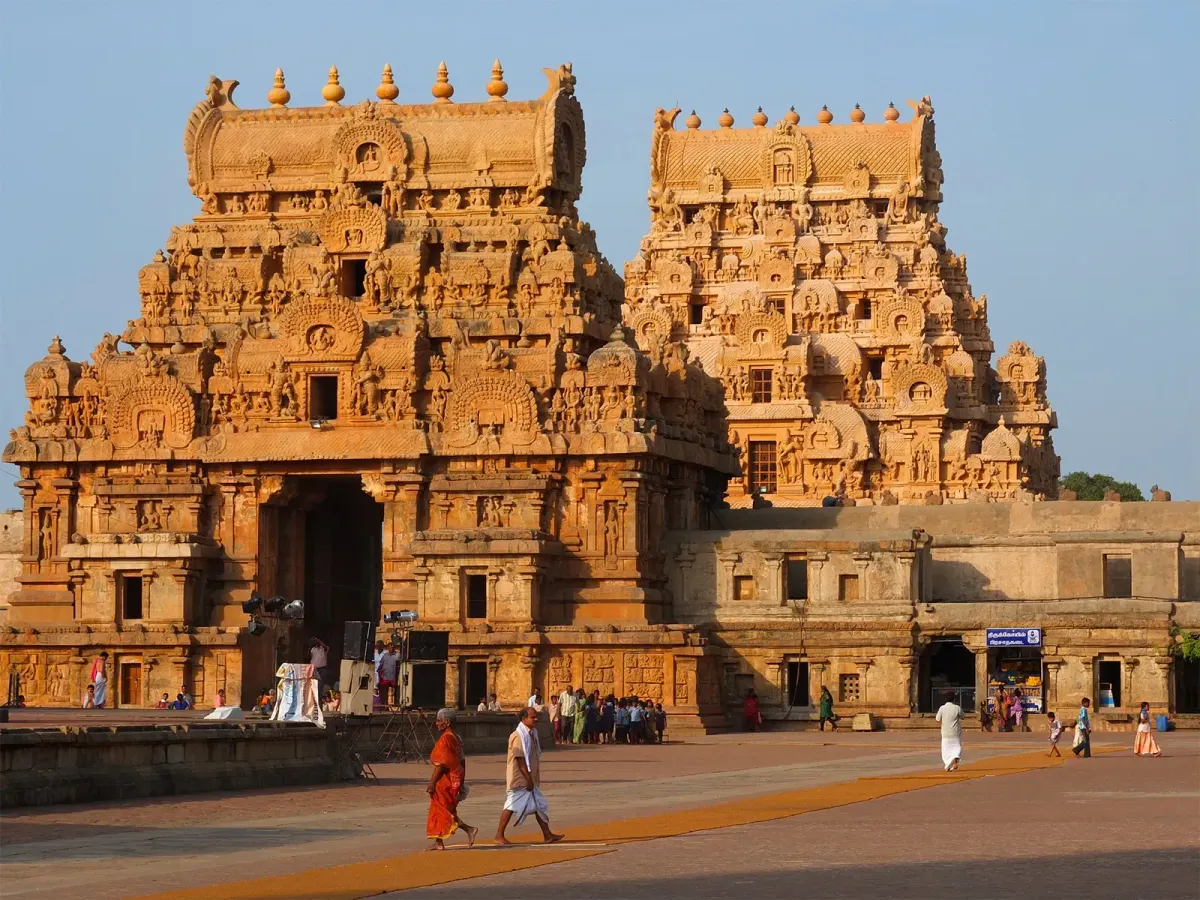
The historical record is unambiguous: the great medieval temples of the subcontinent — the Cōḻa foundations, Tirupati — were among the largest landholders, granaries, treasuries, and lenders of their age, accumulation-nodes that drew in wealth and seldom released it. The mechanism that feeds them was named, with permanent precision, by Jonathan Parry. The Hindu religious gift, dāna, is in his analysis the pure, unreciprocated, unreciprocatable gift — and it carries something more than wealth. The recipient Brahmin absorbs, along with the gift, the sin of the donor, returning only "unseen fruits" in an unseen economy. The donor thus offloads pollution and purchases merit in a single act; the Brahmin and his temple ingest both the sin and the gold, and emit neither.
This is, institutionalised in stone, the mouth without an anus of the prior essay: pure ingestion with no excretion, a sink for pollution that is also a sink for wealth. Parry's own darkest finding completes the figure — the funeral priests of Benares, who consume the sins of the dead, are themselves irremediably degraded by what they swallow, the sink polluted by its own function. The Accelerated Blessing Circuit is therefore not a metaphor the source-argument coined for effect. It is the precise name of an institution that converts a printable signifier into impoundable matter, and accelerates because the conversion rate favours the printer.
VIII. The Cow, or the Proof of the Move
Every claim above could be dismissed as a clever construction were there not a single historical episode that proves the machine works — that demonstrates a complete reversal of doctrine executed without a single admitted contradiction.That episode is the cow.
The Brahmins were, historically, the great sacrificers, and Vedic sacrifice was bovine. On the textual and archaeological evidence assembled by D. N. Jha in The Myth of the Holy Cow — and corroborated across the mainstream Indological record — cattle were the standard victims of the great rites; the Vedic gods were imagined relishing beef; ritual and hospitality alike turned on cattle-slaughter, so routinely that the honoured guest was called goghna — literally, "the one for whom a cow is killed." Manu would later sanction ritual cattle-killing as not-killing and prescribe meat at the rites of madhuparka and śrāddha. The sacred cow, in short, is a later construction. The earliest Brahmins killed the most cattle in the land.
Then came the competitor. The renouncer movements — Buddhism and, with still greater rigour, Jainism — seized the moral high ground with ahiṃsā, repudiated Vedic animal sacrifice, and began winning the rising urban and mercantile classes who found the slaughter-cult repellent. Faced with a rival outflanking it on the ethical axis, Brahmanism did not defend cow-sacrifice. It reversed. It adopted ahiṃsā, sacralised the cow it had once slain, and made vegetarian purity the very emblem of the highest caste. And — the encompassing-of-the-contrary in its purest historical instance — it absorbed the arch-rival himself, enrolling the Buddha as the ninth avatāra of Viṣṇu, neutralising Buddhism not by refutation but by inclusion, swallowing the heresy as a limb of the orthodoxy.
The reversal was total. And no reversal was ever confessed — because the two-level machine never has to confess one. The old meat-sacrifice is filed under the conventional, engaged plane (pravṛtti); the new ahiṃsā under the contemplative, absolute plane (nivṛtti); and "without confusion, without separation," both are retained, neither annulling the other. A religion that ate the most cows became the religion that worships the cow, and did so without a single moment at which it was obliged to say: we were wrong. The cow is the proof of the move. It is the experimental confirmation that a discourse engineered for undecidability can survive even the inversion of its own core practice, intact and unembarrassed.
IX. Coda: The Undecidable as Power
We may now state the trade secret plainly. The intelligence of the priest is the refusal to be pinned — the patient cultivation of a discourse with no falsifiable seam, no level at which an objection can purchase traction. To never lie is to never be caught lying. To never tell the single, collapsed, level-flattened truth is to never be bound by one. This undecidability is not a deficiency of rigour mistaken for depth; it is, in the idiom of modal hierarchism, a technology of power — the capacity to render the system non-differentiable, to deny every adversary the edge along which a cut could be made.
And it is not the Brahmin's alone. Chalcedon performs it for the person of Christ. The modern central bank performs it for money — the empty signifier par excellence, a token backed by nothing but the promise never to be cashed out into anything final. The platform performs it for the meme, absorbing every act of resistance as a category of engagement. Cosmos Clausus described a power that seals every exit; this essay has described the same power seen from the other side — a power that seals every seam. The closed cosmos and the undecidable discourse are one apparatus: the first leaves you nowhere to go, the second leaves your objection nowhere to bite.
A concession, as always, to keep the ledger honest. From within the tradition, what I have called a technique is a sincere and profound metaphysics — and the two-truth structure is a genuine solution to a genuine problem, namely how the unconditioned could ever appear as a conditioned world, not merely a device for selling blessings. The functional description and the philosophical depth are both true; they belong, fittingly, to two different levels, and I hold them without confusion and without separation. The normative question — whether such a power is to be revered or dismantled — remains, as promised, suspended.
Let the definition stand as the companion to the last. A closed cosmos is a system with no exit. An undecidable discourse is a system with no seam. The priest who commands both has built the only fortress that needs no walls: you cannot leave it, and you cannot cut it. He did not lie to you. He simply made certain there was no place left to stand from which the truth could be told against him.
Sources
- Council of Chalcedon (451). Chalcedonian Definition — the two natures "without confusion, without change, without division, without separation."
- Upaniṣads (mahāvākyas). Tat tvam asi (Chāndogya 6.8.7); aham brahmāsmi (Bṛhadāraṇyaka 1.4.10); ayam ātmā brahma (Māṇḍūkya 2); sarvaṃ khalv idaṃ brahma (Chāndogya 3.14.1); neti neti (Bṛhadāraṇyaka 2.4.2).
- Śaṅkara (Ādi Śaṅkarācārya), 8th c. pāramārthika / vyāvahārika levels of reality; Nirguṇa / Saguṇa Brahman; brahma satyam jagan mithyā. — Advaita Vedānta.
- Weber, Max. The Sociology of Religion; The Religion of India. — the religious virtuoso vs. mass religiosity.
- Dumont, Louis. Homo Hierarchicus (1966). — "the encompassing of the contrary" (deployed here for the Buddha-as-avatāra absorption).
- Parry, Jonathan. "The Gift, the Indian Gift and the 'Indian Gift'," Man 21:3 (1986); "Ghosts, Greed and Sin: the Occupational Identity of the Benares Funeral Priests," Man 15:1 (1980). — dāna as unreciprocated gift; the Brahmin as sink for the donor's sin.
- Mauss, Marcel. The Gift (1925). — the spirit of the gift; the unreciprocated gift in salvation economies.
- Jha, Dwijendra Narayan. The Myth of the Holy Cow (Verso, 2002). — Vedic cattle-sacrifice and beef-eating; goghna; the later sacralisation of the cow under śramaṇa pressure. (A scholarly and much-contested work, consonant with the mainstream Indological record — cf. Thapar, Doniger.)
- Laclau, Ernesto. On Populist Reason (2005). — the empty signifier (here: the blessing).
- Nietzsche, Friedrich. On the Genealogy of Morals, III (1887). — the will to meaning; "rather will nothingness than not will."
Cross-reference: REGNIS E036, Cosmos Clausus — the closed circuit of salvation; the mouth without an anus.
REGNIS — E-Series. Quantitative geopolitics (R) · Narrative, philosophy, ideology, power (E). regnis.ch