E040. The Epistemology of Mutual Misrecognition in the American–Iranian Relation
Sapere aude. But the dare conceals a prior question: before one knows the other, one must know how the other knows itself, and how the other knows you. The first is information. The last two are conditions of the first.
I. The Asymmetry Sun Tzu Did Not Say Aloud
The sentence is so worn it has stopped meaning anything. Know the enemy and know yourself; in a hundred battles you will never be in peril (Sun Tzu 84). It is quoted in boardrooms and briefing rooms as a slogan for diligence, as though the counsel were merely to gather more. But the maxim, decompressed, is not one instruction. It is four, and they are not equal.
Two cognitive subjects, self and other, each turned toward two cognitive objects, self and other, generate a two-by-two. The diagonal that the slogan foregrounds is trivial and expensive in unequal measure. Self knowing self (1) is nearly free; it requires only the willingness to look, which is rare but cheap. Self knowing other (2) is what intelligence services are built to buy; it is purchasable with satellites, station chiefs, signals, and a translation budget. The off-diagonal is where the difficulty migrates, and it migrates because it cannot be purchased. Other knowing other (3) — seeing the adversary inside the adversary's own coordinate frame, by the adversary's own logic of value — requires not money but imagination, the discipline of inhabiting a rationality whose utility function is not yours. And other knowing self (4) — seeing yourself as you appear in the adversary's eyes, including how you appear ridiculous, predictable, or weak — requires not imagination but humility, which no appropriations committee can authorize.
This is the asymmetry the maxim swallows. The four quadrants are not four equal labors of "diligence." They are differently priced, and crucially, two of them are not for sale. A great power can saturate quadrant (2) with the largest collection apparatus in human history and remain structurally blind in (3) and (4), because the missing faculties — imaginative coordinate-transformation and self-objectification — are not collection problems. They are problems of a different order, closer to the work of the ethnographer and the analyst of one's own civil religion than to that of the case officer. The CIA's budget cannot buy quadrant (3) any more than a larger telescope can buy a second eye.
There is, further, a law governing the off-diagonal — a law of survival pressure. The weaker party models the stronger with higher resolution than the stronger models the weaker, because the weaker party must, in order to persist. The strong can afford not to look; the weak cannot. This produces a permanent inversion: in any sustained asymmetric relation, the subordinate power's quadrant (4) — its reading of the hegemon — tends to exceed in fidelity the hegemon's quadrant (2) — its reading of the subordinate. The hegemon compensates with volume what it lacks in transformation. It has more data and a single lens. It decodes the other through its own codec, and what returns is a corrupted file that it mistakes for the other.
The American–Iranian relation is the cleanest available specimen of this law, and this essay treats it as one. Not because Iran is exotic — the de-exceptionalizing instinct of this series forbids that move — but precisely because it is not. Both powers, it will be argued, perform the same fundamental gesture before the same fundamental void; they differ in the epistemology with which they perform it. To see this requires first reconstructing Iran in Iran's frame (quadrant 3), then laying the two readings side by side across time (quadrants 1, 2, 4), then returning to the metaphysical floor on which both stand — and finding it absent beneath both.
A note on procedure. The reconstruction in Part II proceeds entirely from Iranian and Iran-sympathetic sources, in Persian and Arabic where the concepts are native, precisely so that the critique in Part V cannot be dismissed as an external projection through an American lens. One does not earn the right to call a foundation empty until one has stood on it in good faith and described it as its builders describe it. That is the methodological meaning of quadrant (3): the critique must be survivable from inside.
II. Iran in Iran's Frame — The Ontology Beneath the Jurisprudence
The Western analyst, working quadrant (2), reads the Islamic Republic as a theocratic state with strategic interests and proceeds to score its behavior against an interest-calculus borrowed from the analyst's own coordinate system. On that scoring, much of Iranian conduct reads as irrational: a nuclear program that invites ruinous sanction, a regional posture that maximizes encirclement, a rhetoric that forecloses the very normalization that would relieve the pressure. The word irrational is the tell. It marks the exact location where quadrant (2) has failed to perform the transformation into quadrant (3), and has instead projected the adversary onto its own axes and read off the residue as madness.
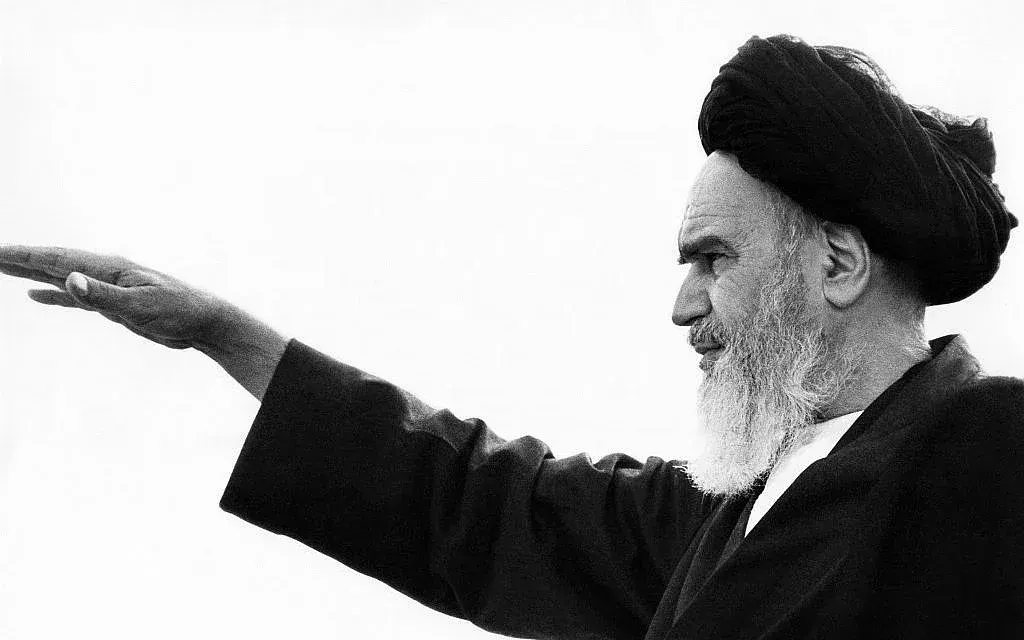
To perform the transformation, one must begin not with the state but with the cosmology, because in the founder's own self-understanding the state is a deduction from the cosmology, not a vehicle that merely wears it. Khomeini was not, in the first instance, a politician who acquired a theology. He was a scholar of ‘irfān — Shi‘i gnosis — and of the ḥikmattradition of Mullā Ṣadrā, who acquired a politics as a corollary. This is not hagiography; it is the scholarly consensus, including among scholars sympathetic to the tradition. Emad Bazzi, writing in the Journal of the Contemporary Study of Islam, argues that Khomeini's political theory is legitimated "on the basis of gnostic and metaphysical notions" rather than on merely "normative-legal reasoning" (Bazzi 115). The jurisprudence is the visible exoteric shell; the load-bearing structure is ontological.
The structure runs as follows, and it must be given in its own terms. In the cosmogony of Ibn ‘Arabī, which Khomeini absorbed through his master Shāhābādī and elaborated in his own gnostic treatises — the Miṣbāḥ al-Hidāya and the Glosses on the Bezels of Wisdom — God in His essence is "an unknown and unknowable mystery," and the cosmos is the field of His self-manifestation through emanation (Bazzi 118). The primordial stage, Aḥadiyyah, the sheer Unity, is named in the gnostic lexicon by a series of designations that should arrest any reader of this series: the Hidden Treasure, the Mystery of Mysteries, the Vanishing Phoenix (Bazzi 119–20). These are not decorative epithets. They are names for that which cannot be configured — the point at which determination fails, where the absolute fullness of Being and the sheer nothing become, as a matter of cognitive access, indistinguishable. The tradition is naming, in its own idiom, the bad sector.
And here is the hinge. The tradition does not merely name the void; it appoints a mediator across it. The figure of the Insān al-Kāmil, the Perfect Man, is precisely the one who spans the unspannable. William Chittick, the foremost Anglophone authority on Ibn ‘Arabī and the source Bazzi leans on, describes the Perfect Man's cosmic function without flinching: he is "the intermediary who fills the gap between Absolute Being and absolute nothingness," whose "cosmic function is everything because in effect he is identical with the cosmos" (Chittick 30; qtd. in Bazzi 121). Read that twice. The Perfect Man fills the gap between Absolute Being and absolute nothingness. The very gap this series has spent thirty-nine essays insisting cannot be filled — because there is nothing there to fill, no null set beneath the empty room — is, in this system, occupied. And it is occupied by a human station.
The political deduction is now almost mechanical, and Khomeini drew it explicitly. Wilāya — the sainthood or initiatory authority achieved through proximity to God along the mystical ascent — is, in Khomeini's gloss, the esoteric content of khilāfa, deputyship and vicegerency (Bazzi 121). The nearer the wayfarer draws to the unfillable point, the more deputyship he is "invested with" (Bazzi 120). The mystic completes the fourth of Mullā Ṣadrā's journeys — annihilation in God (fanā’), then subsistence through God (baqā’) — and, in the canonical formula, "comes back" to guide the community (Bazzi 121). Governance, on this account, is not the mystic's ambition. It is his return leg. He has emptied himself at the void; he returns clothed in what he found there; and the clothing is authority.
From inside, therefore, nothing is irrational. The Islamic Republic is the institutional precipitate of a man who claimed to have reached the point of indistinction and to govern not by his own will — which was annihilated — but as the conduit of what lies beyond it. Khomeini said as much in the sharpest form available, correcting his successor Khamenei late in life: the government's authority "is a branch of the absolute wilāya of the Messenger of Allah," taking precedence "over all secondary precepts like prayers, fasting, and pilgrimage" (Khomeini, Ṣaḥīfeh-ye Nūr 20: 170; qtd. in Bazzi 123). The state does not serve the ritual law; it outranks it, because it descends from a higher station on the arc. To this worldview, an external threat is not a contingent nuisance to be negotiated away. It is constitutive: the regime's legitimacy is the perpetual demonstration of a sacred order under siege by a profane one, and the siege is therefore, at the level of legitimation, functional. The analyst who scores Iranian behavior as self-defeating has simply failed to notice that the utility function maximizes the survival of a theological claim, for which strategic encirclement can be an input rather than a cost.
This is quadrant (3), reconstructed in good faith and in the tradition's own vocabulary. The siege is fuel. The "irrationality" was the analyst's projection all along.
III. The Time-Series of Two Readings — 1953 to the War
With quadrant (3) established, the diachronic comparison can be laid down. At each node, two readings run in parallel: what the United States saw through quadrant (2) — Iran rendered in American coordinates — and what Iran saw through quadrant (4) — America read with the high resolution of the party that must survive it. The resolution gap is the datum.
1953 — Mosaddegh. The American reading: a Cold War tile. A nationalist premier nationalizes Anglo-Iranian Oil; the lens in Washington resolves this as a Soviet-adjacent threat to the containment perimeter, and the Eisenhower administration authorizes the coup that restores the Shah (Abrahamian, Coup 1–6). The act is, in the American frame, a tactical success — quick, cheap, deniable. The Iranian reading, accumulating, is of a different order: it records that the United States will dispose of an elected Iranian government when oil and posture require it, and it files this as a stable parameter of American behavior, not a one-off. The asymmetry is already visible. To Washington 1953 was an operation; to the Iranian memory it became an axiom. One side closed the file; the other made it foundational.
1953–1979 — The Shah as American Mirror. For a quarter-century the United States reads Iran through the Pahlavi state — the second quadrant collapsed into a single informant. The Shah is modernizing, secularizing, arming; therefore Iran is modernizing, secularizing, arming. The lens cannot see what it has no informant for, and it has no informant in the seminary. Khomeini's gnostic-political fusion is incubating in Najaf in exactly these years; his lectures on the Guardianship of the Jurist are delivered in 1970; the cassettes circulate. American collection, oriented entirely toward the court, registers none of it. This is not a failure of volume. It is a failure of aperture — the structural blindness of a quadrant (2) that has outsourced its perception of the other to the other's most Westernized stratum.
1979 — The Revolution and the Hostages. The rupture exposes the blindness retroactively. The United States is taken by surprise not because data were scarce but because the lens had no category for a clerical mass movement led by a metaphysician. Then the seizure of the embassy, fifty-two Americans held four hundred forty-four days (Houghton 1–10). In the American frame this reads as lawlessness, as terrorism, as the violation of the most basic diplomatic norm — and it is all of those in that frame. But quadrant (3) sees something the American frame cannot: the hostage-taking as a legitimation event, a public and theological demonstration that the new order will not be governed by the profane covenants of the system that produced 1953. The embassy was named the "den of spies"; the act re-enacts, in the regime's self-narration, the casting-out of the false order. What Washington reads as criminality, Tehran performs as liturgy. Neither reading is "wrong" within its frame; the point is that the American frame cannot access the second reading, while the Iranian frame can access both — it knows perfectly well that it is breaking American law, and breaks it as the message.
1980–1988 — The War and the American Tilt. Iraq invades; the war grinds for eight years. Beginning in 1982 the United States extends intelligence, economic credit, and material assistance to Saddam Hussein, including a tilt that persisted through the regime's use of chemical weapons (Bryce; Battle). The American frame justifies this as balance-of-power maintenance — denying Iran a victory that would destabilize the Gulf, a textbook realist calculation in the Morgenthau–Waltz mold of states as "unitary, rational actors" maximizing relative power and survival (Morgenthau 4–17; Waltz 91–92). The Iranian reading absorbs the tilt as confirmation of the 1953 axiom at civilizational scale: the profane hegemon will arm even a secular Ba‘athist invader against the sacred order. And here the asymmetry reaches its operational payoff. Iran, reading America through quadrant (4), understands the American scoring rubric — it knows which behaviors Washington files under "irrational" and will therefore discount as improbable — and it learns to operate in the gaps of that rubric. The regime's longevity is in part the longevity of a player who has memorized the opponent's model of itself and moves where the opponent's model has marked the board empty.
The pattern across the nodes is monotone. The American quadrant (2) is data-rich and transformation-poor: maximal collection, single codec, recurrent surprise. The Iranian quadrant (4) is data-poorer and transformation-rich: less collection, but a working model of the adversary including a working model of the adversary's model of Iran. The weaker party's recursive read outperforms the stronger party's direct read. Sun Tzu's off-diagonal, priced exactly as predicted.
IV. What Iran Sees When It Sees Itself
Quadrant (3) was reconstructed as ontology in Part II; it must now be completed as self-image, because a regime governs not only by its metaphysics but by the story it tells itself about its metaphysics. And the Islamic Republic's self-image contains a structural feature that the strategic literature persistently underdescribes: the regime requires the void to remain occupied and besieged in order to function.
Recall the architecture. Legitimacy descends from proximity to the unfillable point; the walī-ye faqīh governs as the highest available station on the arc of ascent in the Imam's occultation. But occultation (ghaybah) is itself the permanent deferral of the one who could truly fill the gap — the Hidden Imam, absent until the End of Time (Bazzi 117; Sachedina 1–28). The jurist therefore rules in the interval of an absence, as guardian over a community awaiting a return that does not come. This is the regime's deepest self-understanding: it is the custodian of a sacred placeholder. Its authority is the authority of the one who tends the empty throne and forbids anyone else to sit on it.
From this self-image two things follow that quadrant (2) reliably misses. First, the regime cannot normalize without dissolving, because normalization would convert a sacred custodianship into an ordinary state, and an ordinary state has no claim on the arc. The theological premium is paid precisely by not becoming Switzerland. Second, the external enemy is load-bearing in the most literal sense: the besieged sacred order is the regime's standing proof that the profane world is what the cosmology said it was. America, in Iran's self-image, is not merely an adversary. It is evidence. The Great Satan is a theological necessity before it is a strategic one — the term Satan (Shayṭān) names not a state to be defeated but the tempter whose perpetual presence confirms the drama of fidelity. A regime that needs its enemy as proof will manufacture the enemy's hostility when it wanes, because the alternative to hostility is not peace but desacralization.
This is the most uncomfortable finding for the American frame, and it must be stated without flinching and without contempt: within Iran's coordinate system, the behaviors Washington files as self-defeating are legitimacy-producing, and the relief Washington imagines it could offer — normalization, integration, the lifting of the siege — reads from inside as an existential solvent. One does not negotiate away another's foundation by offering them comfort. The good-faith reconstruction is complete here, and it is damning of the American read, not yet of the Iranian one. Quadrant (3), fully extended, shows an internally coherent system that the hegemon has been mis-scoring for seventy years.
It would be the easy ending — the fashionable ending — to stop here, with the lesson that America should learn empathy, perform the coordinate-transformation, and read Iran charitably. That lesson is correct and insufficient. It is insufficient because it leaves the Iranian foundation unexamined, treating quadrant (3) as a sanctuary one visits and respectfully departs. But the discipline of this series does not grant sanctuary to any foundation, including the ones it has just defended in good faith. Having stood on the floor and described it faithfully, we are now obligated to look down.
V. The Same Void, Two Gestures, Two Epistemologies
Return to the founding image of this series, stated in E039 and presupposed here. Open a door: the room is empty, and there is no "room itself," no null set beneath waiting to be emptied. Open another: the doorway is filled flush, a wall, and again no null set beneath. Absolute nothing and absolute everything are scandalous not because they are mysterious but because they are indistinguishable — they cannot be configured, there is no bit to read, the sector returns the same garbage at both ends. This is not a mystical claim. It is the limit-structure of determination itself: meaning runs on differences, differences require a floor, and the floor — the point of absolute determination or its absence — is precisely what cannot be determined. Every system of meaning rests on a sector it cannot itself read. That is the bad sector, and it is constitutive, not defective. It is the boot sector, not the error.
Now place the two powers before it.
The Iranian gesture is subtractive. This is what makes it formidable and what makes it, finally, a confidence trick of unrivaled sophistication. The crude road to authority over the void is additive — the pharaoh, the divinized emperor, the man who says I am a god and inflates himself into the gap. That road is brittle; everyone can see the inflation, and the claim is refuted by the obvious humanity of the claimant. Khomeini's road is the opposite and incomparably stronger. He does not add himself to the gap. He subtracts himself — fanā’, annihilation, the dissolution of the self at the point of indistinction — and claims that into the vacated place there entered not himself but God, whose conduit he now merely is (baqā’). The deputyship is presented as the residue of a self-erasure. "I do not govern," the structure says; "I was annihilated, and the absolute wilāya governs through me." Observe the genius of it: the gesture is unfalsifiable from outside, because the standard accusation — you crave power — is pre-answered by the claim of annihilated selfhood. The very movement of emptying becomes the alibi. Subtractive divinization wears the mask of humility over the face of absolute authority. It fills by emptying. It passes through zero to license infinity. It is, structurally, more dangerous than the pharaoh, because the pharaoh can be seen and this cannot.
But the gesture has a floor, and the floor is the question the tradition cannot survive. Into the vacated place there entered — what? The bad sector has nothing in it to enter. There is no occupant available for the throne the mystic clears, because the throne stands over a sector that returns no bit. Khomeini performed, let us grant for argument, a genuine fanā’ — a real annihilation of the empirical self. The structure then asserts that baqā’ clothes the emptied wayfarer in the divine attributes, that he "comes back" bearing what he met. But he met indistinction. He met the point that cannot be configured. What clothes him on the return is therefore not the divine; it is the unfilled gap itself, renamed. And the hand that fills the renamed gap — that tends the empty throne, that forbids others to sit, that issues edicts outranking prayer and fasting — is, when the theology is subtracted, simply his own. The vicegerency of an Absent Imam over an unreadable sector is a custodianship of a placeholder by a placeholder. Khomeini's own attempt at indifferentiation, as E039 named it, succeeds only as theatre: he reached the indistinct point and then re-differentiated himself out of it as its sovereign, manufacturing the supreme distinction — ruler over ruled — out of the very place where distinction fails. This is not contradiction. It is the mechanism. It is the most refined available method of drawing earthly rent from the bad sector: not by claiming the void exists and billing for access (the Platonic road), nor by selling the comparison of voids (the perennialist road), but by erasing oneself into the void and re-emerging as its registered proprietor. The subtraction is real; the occupant is fictional; the rent is collected in the currency of a state.
So far the easy reading would let the essay end as anti-Iranian polemic dressed in metaphysics. It cannot. Because the second power performs the same gesture, and the de-exceptionalizing discipline of this series requires that it be said with equal force.
The American gesture is also a filling of the bad sector — but additive, and differently masked. American power, too, stands over an unreadable floor and names an occupant. The occupant is named the rational actor, the universal, the self-evident. Where Khomeini fills the gap with an annihilated self conducting the divine, the American civil religion fills it with a procedural absolute: the conviction that beneath the particular and the contingent there lies a universal rationality — a human nature that, freed of distortion, wants what the American wants, scores as the American scores, and converges on the American settlement. This is the metaphysics that produces the analyst's word irrational as a verdict on Iran. The verdict is not a strategic observation. It is a theological one: it presupposes that there is a universal floor of rationality, that the American occupies it, and that deviation from the American score is therefore deviation from the floor itself — madness, fanaticism, the irrational. The doctrine that the United States is "inherently superior, unique, and has a special mission in the world" is not a foreign-policy preference; it is a civil-religious filling of the same void, the redeemer nationstanding where the Perfect Man stands, the universal where the divine conduit stands (Bellah 1–21).
And the American floor is as absent as the Iranian one. There is no universal rationality waiting beneath the contingent to vindicate the American score; "rationality" is a function of a utility function, and utility functions are not universal but placed — historically, culturally, theologically placed. The Iranian utility function that maximizes the survival of a theological claim is not less rational than the American one that maximizes relative power and procedural integration; it is differently floored. When the American calls the Iranian irrational, he is performing the precise move Plato performed and E039 named: concealing the indistinguishability, smuggling his own projection in as the structure of truth, mistaking the light behind his own eyelids for the sun. American exceptionalism is subtractive of others and additive of self: it empties the adversary of native rationality ("irrational regime") and fills the resulting vacancy with its own image ("they would converge on us if undistorted"). It, too, erases and re-occupies. It, too, tends an empty throne — the throne of the universal — and forbids others to name it differently.
Here is the epistemological difference, and it is the whole of the matter. The two gestures are structurally identical — each fills the unfillable with a renamed projection and collects authority as rent — but they fail differently, and they fail in their respective quadrants. The Iranian gesture is self-aware at the floor and blind at the perimeter: the tradition knows, in its apophatic depths, that the central point is the Mystery of Mysteries, the Vanishing Phoenix, the unsayable — its via negativa is sophisticated about the void's unconfigurability — yet it converts that very sophistication into an alibi for the most concrete worldly authority, and it cannot see itself doing so. It has a deep quadrant (1), a profound self-knowledge of its own metaphysical situation, weaponized into a blindness about its own power-operation. The American gesture is the mirror inversion: blind at the floor and competent at the perimeter. It has no apophatic depth at all — it does not know its universal is a projection, it takes "rationality" as transparent and floorless-in-the-good-sense, as simply given — and this metaphysical naivety at the boot sector is exactly what disables quadrants (3) and (4). Because it cannot see that its own floor is a contingent filling, it cannot grant that the other's floor is a different filling rather than a failure to reach the American one. The American's quadrant (2) is corrupted at the source by an unexamined quadrant (1): it cannot read Iran in Iran's frame because it does not believe in frames, only in the frame, the universal, the floor it mistakes for bedrock.
So the relation is not, at depth, a contest between a rational power and a fanatical one. It is a contest between two fillings of the same void, conducted by two epistemologies of self-ignorance. The Iranian knows the void is unsayable and lies about who occupies it. The American does not know there is a void and therefore cannot conceive that he, too, has filled it. The first is the lie of the sophisticated apophatic; the second is the blindness of the naïve cataphatic. And the strategic catastrophe of the relation follows directly: the sophisticated party can model the naïve one (quadrant 4, high resolution — it knows the American believes in a universal and exploits the belief), while the naïve party cannot model the sophisticated one (quadrant 3, failed — it cannot grant the Iranian a coherent alternative floor and so files coherence as madness). The asymmetry of resolution that Part III tracked empirically is, at bottom, an asymmetry of metaphysical self-awareness. Iran reads America better because Iran knows that floors are filled. America reads Iran worse because America thinks its floor is the ground.
VI. Coda — The Phoenix and the Universal
There is no occupant in the gap. Not the divine conduit of the annihilated jurist; not the universal rationality of the redeemer nation. The bad sector returns the same garbage at both ends, and both powers have built cathedrals over it — one apophatic and self-aware and lying, one cataphatic and naïve and blind — and both collect rent in the currency of states and the coin of the dead. To see this is not to counsel a plague on both houses; that would be its own cheap gesture, a third evasion. It is to specify, precisely, the shape of the misrecognition: not that one party is rational and the other mad, but that both have filled the unfillable and only one of them knows it.
The policy corollary is austere and offers no comfort. The United States cannot read Iran correctly by collecting more, because its blindness is not in quadrant (2) but in the unexamined quadrant (1) that corrupts it. It would have to perform the one operation no appropriations committee can fund: to discover that the rational actor is its Vanishing Phoenix — its own name for the unfillable point, its own projection mistaken for the floor. Only a power that knew its universal was a filling could grant that another's particular was a different filling rather than a failed approximation of the universal. Only such a power could inhabit quadrant (3). And a power capable of that self-knowledge would, in acquiring it, cease to be the thing it is.
So the two stand before the same door, each having walked through it and furnished the empty room with a god — the one a god of subtraction, the other a god of the universal — and each mistaking its furniture for what was always an unconfigurable void. Sapere aude: dare to know. The dare, fully decompressed, is to know that you have furnished the void, and to know what you used. Neither dares it. That is the relation. That is, more or less, the size of it.
Goodbye.
Works Cited
Abrahamian, Ervand. The Coup: 1953, the CIA, and the Roots of Modern U.S.–Iranian Relations. New Press, 2013.
Battle, Joyce, editor. "Shaking Hands with Saddam Hussein: The U.S. Tilt toward Iraq, 1980–1984." National Security Archive Electronic Briefing Book No. 82, George Washington University, 2003.
Bazzi, Emad. "The Mystic as a Political Leader: The Impact of ‘Irfān on Imam Khomeini's Political Doctrine." Journal of the Contemporary Study of Islam, vol. 3, no. 2, 2022, pp. 115–25.
Bellah, Robert N. "Civil Religion in America." Dædalus, vol. 96, no. 1, 1967, pp. 1–21.
Bryce, Robert. "The U.S. Tilt toward Iraq." Cross-Border Studies, 1991.
Chittick, William C. The Sufi Path of Knowledge: Ibn al-‘Arabī's Metaphysics of Imagination. State University of New York Press, 1989.
Houghton, David Patrick. US Foreign Policy and the Iran Hostage Crisis. Cambridge University Press, 2001.
Khomeini, Ruhollah. Ṣaḥīfeh-ye Nūr. Vol. 20, Sāzmān-e Asnād wa Madārik-e Inqilāb-e Islāmī, 1990.
———. Ḥukūmat-e Islāmī: Wilāyat-e Faqīh. Mu’assasa-ye Tanẓīm wa Nashr-e Āthār-e Imām Khomeinī, n.d.
Morgenthau, Hans J. Politics Among Nations: The Struggle for Power and Peace. 7th ed., revised by Kenneth W. Thompson and W. David Clinton, McGraw-Hill, 2006.
Sachedina, Abdulaziz Abdulhussein. The Just Ruler in Shi‘ite Islam: The Comprehensive Authority of the Jurist in Imamite Jurisprudence. Oxford University Press, 1988.
Sun Tzu. The Art of War. Translated by Samuel B. Griffith, Oxford University Press, 1963.
Waltz, Kenneth N. Theory of International Politics. McGraw-Hill, 1979.