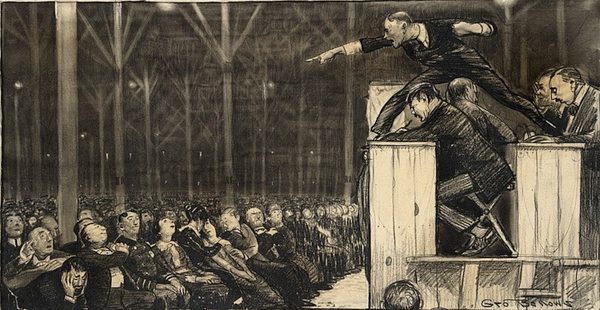
E042. Consider the Cohort II: The Fractal Membrane
Selective Permeability from the Cell to the Civilization, and the Empty Sector Beneath Both
A membrane is a verb pretending to be a noun. It looks like a wall — a thing, a boundary, a fact you could photograph. It is actually a labor, a wage paid every second against the patient gravity of sameness. Stop paying and the wall does not fall. It was never a wall. It dissolves, and what it was holding apart turns out to have been one thing all along.
This essay is descriptive, not prescriptive. It claims an isomorphism — that the same structure recurs at radically different scales — and it claims nothing more. In particular it does not claim that because cells exclude, borders should; that because membranes are natural, hierarchies are justified. The slide from "the boundary behaves like a membrane" to "the boundary ought to exist because membranes do" is the naturalistic fallacy wearing a lab coat, and it is precisely the move this series exists to refuse. Biology is borrowed here as scaffolding, never as license. The hard science belongs to the people who did it; it is cited, not annexed. What follows is a lens, and a lens earns its keep by what it lets you see, not by what it lets you justify.
I. The Three Laws of Every Membrane
Begin with the cell, because the cell is where the structure is cleanest and where, mercifully, nobody is tempted to draw a moral from it.
Law One: the membrane does not block — it classifies. The folk picture of the cell membrane is a wall that keeps bad things out and good things in. This is wrong in an instructive way. The lipid bilayer, left to itself, is not a selective gate; it is an almost total barrier, refusing nearly everything. Only small nonpolar molecules — oxygen, carbon dioxide — slip across freely by simple diffusion. Water itself crosses the bare bilayer so reluctantly that cells evolved dedicated channels, aquaporins, to let it through. Ions — sodium, potassium, the very currency of life — cannot cross the lipid region at all; as one standard reference puts it, ions only enter or leave through a membrane channel, because the lipid areas keep them from crossing (ScienceDirect, "Cell Membrane Permeability"). Selectivity, therefore, is not a property of the wall. It is a property of the proteins embedded in the wall — the channels, carriers, and pumps that decide, molecule by molecule, who passes and how. The membrane's genius is not the lipid. It is the bureaucracy of gates studded through it.
This matters because it relocates the whole phenomenon. A boundary that merely blocked would be stupid and dead. A boundary that classifies — that sorts the world into categories and assigns each a different mode of passage — is the beginning of everything interesting. The selectivity filter of the potassium channel is the showpiece: a five-residue sequence, threonine-valine-glycine-tyrosine-glycine, so exquisitely tuned to the size of a dehydrated potassium ion that it conducts K⁺ while excluding the smaller sodium, and this sequence is conserved, the biophysicists note with some awe, "from bacteria to human cells" (Summhammer et al. 1). Hold that phrase. A four-billion-year-old gate, identical across the entire tree of life, whose only job is to tell two things apart that are almost the same. The membrane is, at bottom, a discrimination engine. Not a wall: a customs office.
Law Two: the membrane is not a state but a labor, and the wage is paid in energy. Here is the fact that should be carved over the door of every department of political science. A living cell is defined by a difference — a steep gradient of ions across its membrane, sodium high outside, potassium high inside. Left alone, this difference would decay. Entropy wants the two sides equal; equality, here, is the technical name for death. So the cell does not have its boundary; it performs it, continuously, by burning fuel. The sodium-potassium pump grinds away against the gradient, and as the textbooks state plainly, "much of a cell's supply of metabolic energy may be spent maintaining these processes" (LibreTexts 15.3). The pump moves ions against their concentration gradient — uphill, against the current of the universe — and the moment it stops, the gradient collapses, the two sides equalize, and the cell is no longer a cell but a warm bag of average.
This is the deepest thing biology has to say to sociology, and it says it without metaphor. A boundary is not a thing you build once. It is a bill you pay forever. The self, the city, the nation, the creed — each is a difference held against the entropic pull toward sameness, and each is maintained only by the ceaseless expenditure of energy. Stop the pumps — stop the patrols, the rituals, the taxes, the telling-apart — and the structure does not stand there inert. It equilibrates. It dies into its surroundings. The membrane is the most honest object in nature: it tells you, every second, that to remain distinct is to work, and to rest is to dissolve.
Law Three: the lethal threat is not the wall-breaker but the wall-rewriter. Naively, you would think a cell dies when something rips its membrane. True, but trivial — and biologically, the brute who tears the wall is usually a failure. Crude lysis is loud; the immune system notices, inflammation walls it off. The truly dangerous thing does not break the membrane. It reprograms it. Consider the metastatic cancer cell. It does not burst through tissue by force. It builds delicate actin protrusions called invadopodia and, at their tips, recruits a membrane-bound protease, MT1-MMP, to dissolve the extracellular matrix in a manner "spatially and temporally regulated" — precise, local, surgical (Eddy et al.). And the degradation is not mere demolition: the proteases "not only degrade the ECM components but also expose some binding sites to other receptors and release biologically active molecules" (Cherrak et al.). The cancer cell turns the wall's own dissolution into a signal that accelerates its own advance. It does not fight the membrane logic; it speaks it, fluently, and turns it to private use. In the epithelial-to-mesenchymal transition the cell goes further and sheds its own identity — its apical-basal polarity, its very sense of which way is in — to acquire the motility of invasion (Cao et al.).
So the three laws: a membrane classifies rather than blocks; it is labor rather than state, paid in energy against entropy; and its mortal enemy is not the breaker but the rewriter, who weaponizes the boundary's own grammar. Keep these three. They will reappear at every scale, and they will not change.
II. The Ladder
Now climb. The wager of this essay is self-similarity: that the three laws hold not by loose analogy but by genuine structural recurrence, the same form instantiated in different materials. This is what fractal means here — not the decorative sense of pretty repeating pictures, but the strict sense: a pattern whose description does not change as you zoom. Let us zoom.
The immune system (scale: the organism). One rung up from the cell, the body faces the membrane's defining problem in its purest form: self versus nonself. The immune system is, in the discipline's own self-description, "the science of self–nonself discrimination" (Klein, qtd. in Howes 271). Its gate proteins are the MHC molecules, presenting fragments of the body's interior for inspection; its pump — Law Two — is the relentless, costly machinery of tolerance, the thymic deletion of self-reactive lymphocytes, paid for continuously. And when that discrimination fails, you get the two failure modes the laws predict. Fail to admit the safe, attack the self, and you have autoimmunity — the membrane turning its weapons inward, the body at war with its own interior. Fail to exclude the dangerous and you have infection or cancer.
But here the immune system teaches something that propagates all the way up the ladder, so attend to it. The old model assumed the gate sorted on a fixed criterion: foreign versus domestic. Then Polly Matzinger proposed the danger model— that the immune response is triggered not by foreignness as such but by signals of damage, that "context is everything," and a self-antigen in a quiet context is tolerated while the same antigen amid injury provokes a storm (Frontiers in Immunology, "Self or nonself"). This decentered the whole self/nonself dogma. The lesson, in our terms: the membrane's classification is not given but constructed, and what counts as "threat" can be manufactured by the framing of context rather than read off the intruder. File that. We will need it when we reach the scale where civilizations decide who their devils are.
The city (scale: the settlement). The wall and the gate are here so literal that the metaphor barely is one — the medieval city is a membrane with checkpoints, the customs house its carrier protein, the toll its selective filter. The political geographers distinguish, usefully, between the border (the enforced physical line), the boundary (the legal-conceptual demarcation that "might exist on a map or in a legal document long before anyone builds a wall"), and the frontier (the unsorted transition zone that "lacks clear demarcation") (Fiveable, "Borders, Boundaries, and Territoriality"). Three phases of the same membrane: enforced, inscribed, and not-yet-drawn. And the pump — Law Two — is the standing apparatus of urban order, the policing and infrastructure that hold the inside distinct from the outside at continuous cost. (The semiconductor and the city are, viewed this way, the same object at different scales: both are substrates in which gated channels route a current through an etched geometry, and in both the "computation" is just the disciplined movement of charge across selectively permeable junctions. The wafer is a city for electrons; the city is a circuit for bodies. The isomorphism is exact, and it is the first hint that the ladder has no natural top.)
The state (scale: the polity). Now the membrane acquires an army, and Law Two acquires a name: Charles Tilly's. The bellicist thesis — war made the state and the state made war — is precisely the claim that the polity's boundary is held by the continuous, ruinous expenditure required to defend and define it (Tilly, qtd. in Young). Preparing for war built the central authority "capable of raising taxes to upkeep a professional standing army," and the bargaining between that authority and its taxpayers produced "a new historical figure, 'citizens'" along with "new social boundaries and territorial borders" (Tilly, qtd. in Oxford Bibliographies). The state is a dissipative structure with a flag: it burns extracted treasure to hold a gradient — order inside, anarchy outside — against the entropy of the international system, and the citizen is the ion granted interior concentration by the pump. That the open/closed setting of the membrane is tunable (Law One) is now measurable: in a recent study of the EU's boundaries after 2014, researchers track "boundary closure and control" across "more than thirty categories of subjects and objects," watching the membrane open to Ukrainian persons while tightening elsewhere, function by function (Börzel and Risse, qtd. in researchers' summary). The customs filter, quantified.
Class and the self-image (scale: the social order). Strip the territory away and the membrane survives as pure sorting — social closure, Weber's term, resurrected by Frank Parkin. Here the gate is not a wall but a credential, a diploma, an accent, a surname: "the process by which social collectives seek to maximise rewards by restricting access to resources and opportunities to a limited circle of eligibles" (Parkin, qtd. in CPAESS). Weber's insight was that any attribute will serve — "race, language, social origin, religion" — provided it can be used for "the monopolization of specific, usually economic opportunities" (Weber, qtd. in Closure (sociology)). And Raymond Murphy made the fractal claim explicit, in our exact spirit: that "seemingly unrelated forms of domination based on private property, the bureaucratic Communist Party, credentials, status, race, language, and gender, are tied together by Weber's notion of social closure as the underlying principle of all systems of inequality" (Murphy, qtd. in Three Forms of Social Closure). That is the self-similarity thesis stated by a sociologist who had never, presumably, thought about ion channels — and that convergence, the same form found independently from above and below, is the strongest evidence that the form is real.
The meaning-system (scale: sense itself). At the top — or the bottom, the ladder having quietly curved into a circle — the membrane stops being a thing in the world and becomes the condition for there being a world at all. Here the membrane is distinction as such, and the theorist is Niklas Luhmann, who built his entire sociology on a borrowed cell. Luhmann took autopoiesis — self-production — from the biologists Maturana and Varela and used the living cell, explicitly, as the model for the social system: a system that, "within a boundary of their own making (the membrane)," produces its own components and its own border simultaneously (CSL4D). The system is operationally closed: it processes everything through its own binary code — for law, legal/illegal; for the economy, payment/nonpayment — and a communication only enters when it is recoded into the system's own terms (Eff). And here is Luhmann's vertiginous punchline, which is also E039's: the system "generates its own elements as well as its own boundary," and therefore "when the system observes its environment, it actually observes itself" (Autopoietic System). The inside does not pre-exist the membrane that encloses it. The distinction makes the two sides it appears merely to separate.
III. The Physics Under the Whole Ladder
Before the circle closes, name the single law that runs under every rung, because it is the one piece of hard science that genuinely unifies the cell and the civilization without anyone having to stretch.
Ilya Prigogine won the 1977 Nobel for showing that order can arise spontaneously in systems held far from equilibriumby a continuous flow of energy — systems he named dissipative structures (Global4Cast). The conditions, in his account, are exactly three: the system must be open, governed by nonlinear dynamics, and operating far from thermodynamic equilibrium (Goldbeter). A candle flame, a hurricane, a Bénard convection cell, a cell, a city, a state — each is a pocket of improbable order maintained by dumping entropy into its surroundings. Prigogine's own compression of the whole idea is the sentence this essay has been circling from the start: "entropy is the price of structure" (qtd. in Frank). That is Law Two, written in thermodynamics. The sodium-potassium pump, the standing army, the daily ritual, the diploma — all are local rebellions against the second law, financed by exporting disorder elsewhere, sustainable only as long as the energy keeps flowing. Equilibrium is not peace. Equilibrium is the heat-death of the distinction. And — the detail that should make a political theorist sit up — far from equilibrium, the nonlinearity means small fluctuations can have permanent effects; the system, pushed, does not relax back but bifurcates, choosing irreversibly among multiple possible new orders (Liu et al.). Prigogine himself reached toward the social scale with this, citing Comte's old intuition that biology and sociology are alike "synthetic" sciences in which the whole cannot be derived from the parts (Prigogine, "Order Through Fluctuation"). The man who found the physics of membranes suspected, correctly, that it went all the way up.
IV. The Civilizational Membrane, and the Pump Called Karbala
Now descend into the scale that drew you here, with the three laws in hand: the membrane of the civilization, whose lipid is what we have been calling mystification, whose gates sort the world into the saved and the damned, and whose pump runs on ritual.
Take the case already opened in these pages: the Shi'i self-image organized around Karbala. In 680 CE Husayn, grandson of the Prophet, refused the authority of the Umayyad Yazid and was killed with a small band on the plains of Karbala. Michael Fischer's foundational ethnography named what this became: the Karbala paradigm, a single event functioning as "a template, a lens, and a set of moral norms applicable to every subsequent historical situation" (Fischer, qtd. in GlobalSecurity). Read it through the three laws.
Law One — the gate that classifies. The paradigm is a binary code of devastating economy: every situation resolves into Husayn or Yazid, the righteous remnant or the unjust power, us or the tyrant. It is a selectivity filter for moral reality, conducting one category and excluding its opposite, and like the potassium filter it is conserved and reproduced across centuries of ritual. It tells two things apart — the just and the unjust — and refuses every ambiguity in between. A customs office for the soul.
Law Two — the pump that costs. A binary this total is not free; it must be paid for daily, and it is — in the Ashura processions, the mourning rituals, the perpetual re-narration of the wound. This is the civilizational sodium-potassium pump: the continuous ritual expenditure that holds the gradient between sacred and profane from decaying into the flat indifference of ordinary secular time. And what it buys is precise: it drives the cost of decision to zero. If every conflict is Karbala, no one need recompute who is good; the gate has pre-sorted the world. The mystification is not a luxury. It is metabolic. It is the energy a meaning-system burns to keep meaning from equilibrating into meaninglessness.
The danger-model twist. Recall what the immune system taught at scale one: threat is not read off the intruder but constructed by context. The Karbala membrane runs on exactly this. It does not merely tolerate an external enemy; it requires one, because the besieged-righteous gradient cannot be maintained without a Yazid to press against it. Here the membrane's logic produces its most counterintuitive result, the one that breaks every external strategist who models the system as a simple rational actor: pressure does not collapse this membrane; pressure charges its pump. As one analyst observes, the lesson invoked is "not that Husayn perished, but that the moral authority generated by his sacrifice ultimately outlived the power of those who defeated him," so that "hardship can deepen resolve and legitimise continued resistance" (Cachalia). Defeat is transcoded into victory at the gate. The enemy who strikes hardest does not breach the wall; he feeds it, completing the paradigm, topping up the pump. This is why coercion aimed at such a system so often strengthens it: the coercer is operating the adversary's membrane for it, paying its energy bill in the currency of martyrs.
V. The Chain — Irfan, Iran, Sufi, Kabbalah, Israel — and an Honest Warning About a Pun
There is a temptation here so seductive, and so exactly the trap this series was built to spring, that it must be handled in the open.
Karbala. Kabbalah. The words rhyme. The ear wants them to be one word, the same membrane glimpsed in two traditions — the Shi'i wound and the Jewish mystery, sounding alike because they are alike at the root. They are not etymologically related, and to argue from the rhyme would be to commit, live and on the page, the perennialist fraud this essay opposes. Karbalāʾ is a place-name of contested, probably Babylonian-Aramaic origin; Qabbalah is Hebrew from the root q-b-l, "to receive" — tradition as that-which-is-handed-down. The resemblance is noise. I flag it precisely because it is the cleanest possible specimen of the thing to avoid: letting the surface music of language carry an argument the structure has not earned. The pun is a false cognate, and naming it as such is the price of admission to the real chain — which is quite real enough without it.
Because the real chain is not phonetic. It is structural and, in part, historically documented, and it runs along the floor we have been describing all along: a family of meaning-membranes that all post a gate at the unspeakable, all veil an unconfigurable center, all descend in part from a common pool of Neoplatonic vocabulary that flowed through medieval Iberia and the Islamic East.
Watch the spine. Irfan — Shi'i gnosis — and the wider Sufi tradition build, in Ibn Arabi's waḥdat al-wujūd, a doctrine of the absolute unity of Being whose innermost stage is named only by negation: the Hidden Treasure, the Mystery of Mysteries, the Vanishing Phoenix — names for the point where determination fails. Iran, after 1501 and decisively after 1979, becomes the state that institutionalizes this gnosis as governance, the membrane in which irfan is the lipid and the jurist the gate (the argument of E040). Sufism carries the same apophatic structure across the Islamic world, and in al-Andalus it meets its Jewish cousin. And here the documented contact begins: scholars trace the early Kabbalah to shared roots in Arabic Neoplatonism, the Zohar and Ibn Arabi's corpus exhibiting, as one comparative study shows, the very same motif — creation as a series of garments that "cover the Godhead or veil the primordial divine light" (Sviri; Wolfson, qtd. in Medieval Encounters). One historian puts the transmission baldly: Jewish refugees from Muslim Spain "breathing new life into the doctrines and imagery developed by the Sufis," producing "the new system of mysticism known as the Kabbalah" (Block). The Kabbalah's Ein Sof — the Infinite, the divine as it is in itself, of which nothing can be said — is the same gate at the same unspeakable center: a membrane whose interior is, by construction, unconfigurable. And Israel, like Iran, is among other things a polity in which a mystical-theological membrane and a hard security membrane are structurally coupled, the question of how much the inner veil drives the outer wall being precisely the live and contested one.
But now — and this is the whole discipline of the thing — watch the same scholarship that draws the chain refuse to fuse its links. The careful comparatists insist on the limit: Sara Sviri concludes that the real genealogical thread, where there is one, may point "to Shii-Ismaili directions, rather than to Sufism" — a different gate than the rhyme would suggest. And the deepest difference is structural, not decorative: as one survey notes, "if there is a rapprochement, there is no identity," because "the collective role of the Jewish people as the vector of the divine Word has no equivalent in Sufism," where salvation is individual (Eurasia Review). The membranes are isomorphic; they are not identical. They share the form — a gate at the unspeakable, a veil over the empty center — without sharing content, lineage, or destiny. This is the honest version of the chain, and it is far more interesting than the fraudulent one, because it shows the fractal doing exactly what a fractal does: the same structure recurring in materials that never merge, self-similar across traditions that remained, and remain, themselves. To collapse them into One Perennial Truth would be Huxley's swindle. To deny the resemblance entirely would be to miss the pattern. The membrane lets you hold both: same form, different flesh, no fusion. Tat tvam asi is a claim about identity; the fractal is a claim about resemblance under difference — and the difference is load-bearing.
VI. The Empty Sector at the Center of Every Inside
Now the circle closes, and it closes on E039.
Run the ladder back down with one question: at every scale, what exactly is the membrane protecting? What is inside?
The cell's "self" is nothing but the region the membrane has not labeled "outside." The body's "self" is the repertoire the thymus did not delete. The nation's "people" is whoever the border did not name "foreigner." The class's "us" is the set the credential did not exclude. The creed's "righteous" is whoever the gate did not sort to Yazid. The meaning-system's content is whatever its distinction drew on the system-side of the line. At every rung, follow the inside down to its core and you find — this is Luhmann's vertigo and Spencer-Brown's first mark and E039's empty room — nothing that the membrane did not itself create by drawing the line. "When the system observes its environment, it actually observes itself" (Autopoietic System). The inside is an effect of the boundary, not a thing the boundary was built to guard. There was no room before the door. There is no null set beneath the empty room, because there was no room — only the undivided field in which absolute fullness and absolute nothing are, as E039 insisted, indistinguishable, unconfigurable, the same garbage returned at both ends of the bad sector.
This is the fractal's final and most disorienting law, true at every scale: the membrane does not protect an essence. It manufactures one. It draws a line and then points at what falls inside and calls it the precious thing the line was always for. And the proof is in the equilibration. Stop the pump — let the patrols lapse, the rituals fade, the credential inflate to worthlessness, the distinction blur — and the essence does not stand there orphaned, waiting to be defended again. It vanishes, because it was never a deposit the membrane was guarding. It was a standing wave the membrane was generating, and a wave is nothing when the water stills. The collapse of a boundary does not expose a defenseless interior. It reveals that the interior was the boundary's own ongoing rumor, and that beneath the rumor is the bad sector: the unconfigurable, the place that returns no bit, the common inside of every membrane in the universe.
Which returns us, at last, to where E040 left two superpowers and E039 left the whole carousel of philosophy. The mystic who sells access to the empty center, the state that bills for entry to the universal, the creed that sorts the world into Husayn and Yazid and charges admission to the righteous side — each is operating a membrane over the same void, paying the same entropic wage to keep the same nothing looking like a someone. They differ in flesh and lineage and the violence they license. They do not differ in form. A membrane is a verb pretending to be a noun. It pretends so well, and for so long, and at such cost, that the pretending is the thing — there is no noun underneath, only the labor and the line and the dark unreadable sector the line pretends to enclose.
Pay the pump if you must; everyone does; sense itself requires it. But do not mistake the wave for water, or the wall for a world. The membrane keeps the most honest secret in nature, and tells it freely to anyone who watches it work: to be a distinct thing is to spend yourself, every second, holding a line against the truth that there was never anything on the other side of it but you.
Goodbye.
Works Cited
Autopoietic System. New Materialism Almanac, newmaterialism.eu/almanac/a/autopoietic-system.html.
Block, Tom. "The Question of Sufi Influence on the Early Kabbalah." tomblock.com.
Börzel, Tanja A., and Thomas Risse. "Boundary Closure and Control in the EU–Ukraine Relation, 2013–2023." Summarized in Does War Make States? discussion, researchgate.net.
Cachalia, Ghaleb. "Karbala's Legacy Shapes Iran's Strategy Beyond Western Theories of War." Business Day, 3 Mar. 2026.
Cao, et al. "Membrane Type 1 Matrix Metalloproteinase Induces an Epithelial-to-Mesenchymal Transition in SCC9 Cells." PMC, ncbi.nlm.nih.gov/pmc/articles/PMC3637131.
Cherrak, et al., reported in "Insights Into the Role of Matrix Metalloproteinases in Cancer." Frontiers in Molecular Biosciences, vol. 9, 2022.
Closure (Sociology). Wikipedia, en.wikipedia.org/wiki/Closure_(sociology).
CSL4D. "Luhmann's Systems Theory." csl4d.wordpress.com, 13 Aug. 2022.
Eddy, Robert J., et al. "TC10 Regulates Breast Cancer Invasion and Metastasis by Controlling MT1-MMP at Invadopodia." PMC, ncbi.nlm.nih.gov/pmc/articles/PMC8445963.
Eff, Myk. "Niklas Luhmann and the Autopoiesis of Law." AI and Law, Medium, 2025.
Fiveable. "Borders, Boundaries, and Territoriality." Intro to World Geography, fiveable.me.
Frank, Adam, et al. "The World Beyond Physics: How Big Is It?" arXiv:2201.06897.
Frontiers in Immunology. "Self or Nonself: End of a Dogma?" vol. 16, 2025, frontiersin.org.
GlobalSecurity. "Shaheed: The Iranian Shia Theology of Martyrdom." globalsecurity.org. [Citing Fischer, Michael M. J. Iran: From Religious Dispute to Revolution. Harvard UP, 1980.]
Goldbeter, Albert. "Dissipative Structures in Biological Systems." PMC, ncbi.nlm.nih.gov/pmc/articles/PMC6000149.
Global4Cast. "Dissipative Structures Explained: Part 3, Modern Thermodynamics." global4cast.org, 11 Jun. 2019.
Howes, Moira. "Self and Nonself." A Companion to the Philosophy of Biology, edited by Sahotra Sarkar and Anya Plutynski.
Khan Academy. "Passive Transport and Selective Permeability." khanacademy.org.
LibreTexts. "15.3: Membrane Transport with Selective Permeability." Introductory Biology, bio.libretexts.org.
Liu, et al. "Nonlinear Dynamic Process of Fluvial Process Based on Theories of Chaos and Dissipative Structure." arXiv:2503.01593.
Medieval Encounters. "The Spiritual Garment in Medieval Islamic Mysticism and Kabbalah." vol. 30, no. 4, 2024, brill.com.
Murphy, Raymond. Social Closure: The Theory of Monopolization and Exclusion. Clarendon Press, 1988. Summarized in "Three Forms of Social Closure," discovery.researcher.life.
Oxford Bibliographies. "Charles Tilly." oxfordbibliographies.com.
Parkin, Frank. Marxism and Class Theory: A Bourgeois Critique. Columbia UP, 1979. Quoted in CPAESS, "Social Closure," cpaess.ucar.edu.
Prigogine, Ilya. "Order Through Fluctuation." Evolution and Consciousness, organism.earth/library/document/order-through-fluctuation.
"The Reciprocal Influence Between Sufis and Kabbalists." Eurasia Review, 15 Mar. 2023.
ScienceDirect. "Cell Membrane Permeability — an Overview." sciencedirect.com.
Summhammer, Johann, et al. "Forces from Lipids and Ionic Diffusion: Probing Lateral Membrane Effects by an Optimized Filter Region of Voltage Dependent K⁺ Channels." arXiv:2002.12637.
Sviri, Sara. "Jewish-Muslim Mystical Encounters," and discussion in "'A Remarkable Resemblance': Comparative Mysticism and the Study of Sufism and Kabbalah." academia.edu.
Three Forms of Social Closure. discovery.researcher.life.
Tilly, Charles. Coercion, Capital, and European States, AD 990–1992. Blackwell, 1990. Quoted in Young, Laura D., "Testing Tilly," sociostudies.org.
Weber, Max. Economy and Society. 1922. Quoted in Closure (Sociology).
Young, Laura D. "Testing Tilly: Does War Really Make States?" sociostudies.org.