E045. There is Something II: Gravity Without a Center
Being the Continuation of the Second Sojourn of Alfred North Whitehead, O.M., in Which He Quits the Company of the Possessed for the Company of the Knowing, Overhears Three Professors of Columbia University Lament the Age While Maintaining It, Recalls the Cranks and Forgeries of His Own Century, and Discovers—Comprising Five Reasons, One Espresso, and No Remedy Whatsoever—Why Nothing at All Will Be Done.
"It is difficult to get a man to understand something, when his salary depends upon his not understanding it."—Sinclair (109)
I. The Morning After
The trouble with the previous day, Whitehead decided over a cup of coffee the size of a christening font, was that he had been treating symptoms.
He had spent it among the possessed—the financier who saw geometry in the noise, the prophet who saw a hand behind the geometry, the gentle coders who had found the face of God in the spaces between the letters—and he had done, he thought, some modest good. He had loosened a thread here and there. He had offered doubt as a kindness rather than a weapon, which is the only form in which doubt is ever accepted. But on the long walk home over the black water it had occurred to him, with the particular cold clarity that arrives only at the far end of bridges, that the possessed were not the disease. They were the rash. They were what the disease looked like on the surface of a body, at the cheap and visible end of things. And if one wished to understand a fever, one did not interview the rash. One went looking for the metabolism that produced it.
So this morning he had gone uptown, to the long green spine of Manhattan where the great university sat, to find the people who were supposed to know better—and who, he suspected, did.
He found them where the educated of the city now did their thinking, which was not in libraries or in the groves of any academy but in a franchise of a coffee company, a vast and global concern that had perfected the sale of a single emotion: the feeling of being in a Viennese café in 1910 without any of the inconvenient particularity of an actual place. The chairs were designed to suggest belonging. The music was selected to suggest discernment. Whitehead, who had known real cafés, recognized the establishment at once for what it was: not a place but a representation of a place, a model of a third place erected on the ruins of the thing it modeled. He found this so perfect an overture to his theme that he very nearly laughed. He ordered, after some difficulty, a drink whose name was four words long and contained no noun he recognized, and he sat down to listen.
The three at the next table did not notice him. Old men of a certain stillness become furniture, which is among the few genuine compensations of the condition.
II. The Three at the Next Table
They were professors. He knew it within a sentence, the way one knows weather. There was a media scholar—Hale, the others called her—who studied, she was saying, "the architecture of platform attention." There was a political scientist, a heavy genial man named Okafor who spoke in the cadence of a person accustomed to being recorded. And there was an economist, the quietest of the three, a woman named Adler who stirred a coffee she did not drink and watched the other two the way a surgeon watches an argument about anatomy.
And they were lamenting the age.
"It's the epistemics," Hale was saying. "There's no shared reality anymore. People believe the most extraordinary things—the codes, the numerology, the cabals. My undergraduates can't tell a study from a rumor. We've raised a generation of pattern-matchers with no filter."
"Anti-intellectualism," Okafor agreed, comfortably. "Hofstadter saw it coming in '63. The paranoid style. Except now it has broadband."
"And nobody trusts the experts," said Hale. "We do the work, we publish the findings, and some man in a basement with a webcam outdraws us a thousand to one."
Whitehead, behind his absurd four-word drink, felt a small warmth kindle in his chest. Here, he thought, at last—the physicians. People who could see the rash for a rash, who knew the difference between a study and a rumor, who had given their lives to the unglamorous labor of finding out. He had spent yesterday among people who were wrong. It was a relief beyond expression to sit near people who were right.
He should, he later reflected, have known better. He had, after all, written a whole philosophy warning against exactly the comfort of arriving too soon at the simple version of a thing.
Because then the conversation turned, as conversations among the candid eventually do, from the world to the self—from what is wrong with the age to what one is, personally, doing in it. And what they were doing in it, Whitehead discovered over the next twenty minutes, was running the machine they were lamenting.
III. The Turn
It came out casually, the way the most damning things do, in the register of shop-talk rather than confession.
Hale, it emerged, was on retainer. "The platform" had a trust-and-safety advisory board, and she sat on it, and twice a year she flew to California to review what she called, without apparent irony, "the engagement architecture." She knew it intimately. She could describe it the way a cathedral architect describes a flying buttress, with love. There was a behavioral designer named Eyal who had codified the whole thing—a four-beat loop, she explained to Okafor, who was only half-listening: a trigger, an action, a variable reward, and an investment, repeated until the behavior burns itself into the nervous system below the level of choice (Eyal). The genius of it, she said, the part her own students never grasped, was the variability. A reward that came every time was a light switch and bored you; a reward that came unpredictably was a slot machine and owned you. The feed was a slot machine. She had helped, in her small advisory way, to file its teeth.
"And the outrage?" Okafor asked, idly. "Civic integrity still chewing on that?"
"The outrage isn't a bug." Hale said it with the flat fluency of a thing said many times. "That's what the journalists never understand. Nobody in the building wants people radicalized. It's just that engagement is the metric, and outrage is the most engaging thing there is, and the metric is the business. You'd have to redesign the revenue model to fix it, and you can't redesign the revenue model, because the revenue model is the company." She sipped. "So you file the teeth and you keep the dog."
Whitehead set down his drink very gently.
The economist, Adler, spoke for the first time, and what she said was worse, because it was sadder. "It's the same with us. I sign off on the models." She turned her cup a quarter-turn. "Everyone in the building knows the models are wrong. The representative agent is a fiction. The assumptions misplace concreteness at planetary scale—we take a tidy abstraction and lay it over a living country and then act surprised when the country bleeds through the lines. There's a marvelous book about it, the Scott book, about how the state learns to see only what its grid can read, and starves everything the grid can't (Scott)." She said it the way one recites a thing one has made peace with. "But the institution runs on the model. The conditionalities are written in the model's language. There's no procedure for 'the map is wrong.' There's only the map. So we ship the map, and we call the bleeding an externality, and we go to lunch."
"You could say something," Whitehead thought, and was alarmed to find he had nearly said it aloud.
"And why would I?" Adler went on, to Okafor, not to the old man she hadn't seen. "Who would I say it to? The public can't read the model. Explaining its wrongness to them would take a semester they won't sit for, and at the end they'd trust us less, not more, and the next man in my chair would be someone who believes the model, which is worse than someone who knows it's a model. There's no constituency for 'it's complicated.' There's no reason to explain. There's not even a mechanism to explain." She finally drank. "So I don't."
And Okafor—Okafor, who was the most likable of them, who laughed easily and tipped well and was, Whitehead would have sworn, a fundamentally decent man—delivered the line that made the old philosopher close his eyes.
"At least you two are honest about it. I manufacture the villains." He grinned, and it was a tired grin, not a cruel one. "You know Tetlock. Twenty years of data, the confident experts forecast about as well as a dart-throwing chimpanzee, and the more confident they are, the worse and the more famous (Tetlock). And do you know which ones get booked? Not the careful ones. Not the 'it's emergent, it's structural, no single actor is responsible, here are six interacting variables' ones. Nobody books that. They book the man who can name the villain in one clean sentence and point. So when the producer calls, I give them the villain. The Davos man. The deep state. The globalists. Whichever cartoon the segment needs." He spread his hands. "I know it's a cartoon. I have a chapter on why it's a cartoon. But the cartoon is the product, and if I don't supply it, the next guy does, and he won't have read the chapter."
The three of them sat with that for a moment, in the manufactured warmth of the manufactured café, three brilliant people who had diagnosed the disease with perfect accuracy and then described, one by one, their salaried positions inside its bloodstream.
It was at this point that Alfred North Whitehead, who had a horror of rudeness exceeded only by his horror of letting a true thing go unsaid, leaned over from the next table and begged their pardon.
IV. The Old Man Joins In
He had expected, he realized later, to argue. That was the shape his whole second life had taken so far: a courteous old ghost arriving with a peer-reviewed paper and a gentle question, loosening the certainty of the certain. He had a paper ready. He always did.
But there was nothing to loosen. That was the horror of it, dawning slowly as they made room for him with the easy graciousness of the academically secure. With the financier, he had had an error to correct. With the prophet, a wound to name. With the coders, a generative tradition to rescue from its parasite. Here there was no error. They were right about everything. Hale was right about the engagement loop; she had helped build the citations. Adler was right about the models; she had written some of them. Okafor was right about the villains; he had the data on why villains sell, and he sold them anyway. They had all the doubt. They had more doubt than he did, and better-sourced. And it had changed nothing whatever, because doubt, he now understood, was not the active ingredient. He had spent a day administering a cure to people who were not suffering from its absence.
"You believe," he said slowly, "that this is new. That you are living through some unprecedented collapse of shared reality. The—what did you call it—the post-truth condition."
"Aren't we?" said Hale.
"My dear, I should like to tell you about my century." And here, despite everything, the old man's eyes recovered a little of their light, because if there was one thing he could offer this table it was not an argument but a memory, and memory is the one citation the present cannot easily refute.
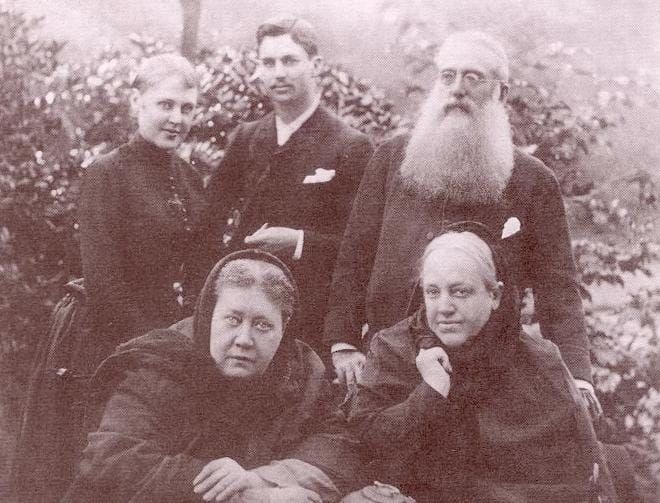
"I was a young man at Cambridge," he said, "in the great age of the codes and the cabals—your age's grandmother, you understand, with all the same features and worse hats. There was a remarkable woman named Blavatsky who had built an entire cosmos: secret Masters in the Himalayas, hidden root-races, lost continents, letters that materialized from the ether onto the ceiling. Theosophy, it was called. It had everything your coders have—the hidden text behind the text, the ancient wisdom, the infinite interpretive depth—and it swept up some of the finest minds of the day. The Society for Psychical Research sent a young Cambridge graduate, Hodgson, to investigate, and he came back and reported, with magnificent Victorian finality, that the lady was 'one of the most accomplished, ingenious, and interesting impostors in history' (Hodgson 207). Trap-doors. A dummy head, if you can believe it, to simulate the astral visits of the Masters. Sliding panels through which the celestial letters were posted by entirely terrestrial hands." He smiled. "Though I should add, in fairness, for I try to be fair even to the debunkers—a document examiner named Harrison re-opened the Hodgson report a century later and found it shockingly one-sided, willing to use any scrap against her and to ignore any scrap for her (Harrison). The skeptics, too, have their conatus. Even the exposure wanted to be a better story than the truth."
Okafor laughed. Adler did not.
"And the eminent men," Whitehead went on, "oh, the eminent men. Crookes—a chemist of the first rank, discovered an element, and he sat in darkened rooms holding hands with a medium and certifying her ectoplasm. Conan Doyle, who invented the most rational detective in literature, believed to his dying day in some photographs of paper fairies that children had taken in a garden. There was a Huxley—Aldous, grandson of Darwin's own bulldog, the man who coined the word agnostic—and the grandson spent his later years writing of the Perennial Philosophy and the unity of all mysticisms (Huxley). The skepticism, you understand, does not breed true. You cannot inherit it. Each generation's brightest must discover, privately and usually too late, that intelligence is not an immunity. It is, if anything, a better engine for elaborate self-deception, because it can build a more beautiful cathedral to live inside."
"So nothing's new," said Hale, a little defensively. "Cranks have always been with us. That's almost comforting."
"No," said Whitehead, and the lightness went out of his voice, and the table felt the temperature change. "Because I have not yet told you the other kind. The cranks in the drawing rooms were a comedy. But my century also produced a forgery that was not a comedy, and I want you to attend to it very closely, because it is the most exact mirror of your codes that history has ever made, and it is the reason I cannot find your situation amusing."
He told them about the Protocols.
How a fabricated document had appeared, purporting to be the minutes of a secret council of Jews plotting to seize the world. How it had everything the conspiracists craved—the hidden hand, the master plan, the explanation of every misfortune in a single intending agent. How it spread across continents and was printed by the million, pressed into circulation in America by one of the richest industrialists alive. And how it had been exposed—this was the part he wanted them to feel—in precisely the manner of the Bible codes he had spent yesterday dismantling. A correspondent for the Times of London, Graves, had simply laid the Protocols side by side with an obscure French political satire of 1864, Joly's dialogue between Machiavelli and Montesquieu, a book that mentioned no Jews at all, and shown that the forgery had been plagiarized from it, passage after passage, in the same order (Graves). The hidden cabal was a literary theft. The secret minutes were a copied novel. It was the cleanest debunking imaginable, published in the most respectable place imaginable, proven by the most elementary method imaginable—two texts, side by side, anyone could check.
"And it changed nothing," said Whitehead, very quietly. "The proof was perfect and it changed nothing, because the people who needed the document did not need it to be true. They needed it to be useful, and a forgery is fully as useful as a fact, sometimes more so, because a fact has the inconvenient habit of resisting your purposes and a forgery never does. I watched a continent reason its way, through that document and others like it, toward the largest crime in the history of the species. I died in 1947"—he said it simply, and three professors of a great university went very still—"with the photographs of where it ended fresh enough that I have never since been able to regard a conspiracy theory as a parlor game. They are not parlor games. They are the metabolism of a thing that occasionally, when it fuses with power, eats people."
The café played its discerning music. The espresso machine exhaled.
"But here," Whitehead said, turning to them now with something that was almost tenderness, "is the difference between my century and yours, and it is the only thing I came uptown to say. The men who believed Blavatsky were fooled.Crookes was fooled. Doyle was fooled. They were credulous, and credulity is a sin, but it is an innocent sin—the sin of wanting the world to be more enchanted than it is. You three are not fooled. You have read the Hodgson report. You wrotethe Hodgson report. And you sit on the board of the séance, and you file the medium's teeth, and you supply the producer his villain, and you ship the map you know is wrong—not because you believe, but because your salary depends on your not acting upon what you perfectly understand. My century's disease was credulity. Yours is something for which I do not think you have yet found the name. It is lucidity without consequence. It is knowing, exactly and citably, and proceeding anyway. I would almost rather you were fooled. A fooled man can be unfooled. I have no idea at all what one does with you."
V. The Five Reasons, or Gravity Without a Center
He did not say the rest of it to them. There was no point; they would only have agreed, and cited a source for their agreement. He said it to himself, later, walking the long green spine of the island back down toward the harbor, assembling out of the morning a diagnosis he suspected would take him the rest of his second death to complete.
Why does it hold? That was the question. Not why are people deceived—he had answered that yesterday, with patternicity and agenticity and the hunger for control. The new question was harder and worse. Why, when the people best equipped to drain the swamp are paid to live in it, does anyone expect the swamp to drain? Why does the whole vast machine persist, when so many of its keepers can describe its workings in perfect, despairing detail?
He found, walking, that the answer came in five parts, and that the five parts were really one.
It held, first, because it paid. This was the oldest reason and the least interesting and the most decisive. Sinclair had said it a century ago and it had not improved with age: a man will not understand what his income requires him not to understand (Sinclair 109)—and the bleak modern amendment was that he need not even fail to understand; he need only fail to act, which is easier, and leaves the conscience an alibi. The engagement economy was not a conspiracy to enrage; it was a business that had discovered, the way water discovers the sea, that rage was the cheapest fuel available, and had simply flowed downhill toward it.
It held, second, because the truth was boring. He had thought this a moralist's complaint until the morning's talk reminded him it was now an empirical finding. Three researchers had traced a hundred and twenty-six thousand stories across the new networks and found that falsehood spread farther, faster, and deeper than truth in every category they measured—and that the engine of the difference was novelty, that lies traveled because they were new and surprising, while the truth, being mostly a matter of slow and complex and familiar things, simply could not compete for the one resource that mattered, which was a human being's startled attention (Vosoughi, Roy, and Aral 1146). The truth's great defect, in an economy of attention, was that it had usually already happened. It was not the system's villainy that promoted the lie. It was the lie's superior fitness.
It held, third, because the city was an illusion, and had organized itself around the illusion's maintenance. This was the deepest of his own themes wearing a new coat. A Frenchman of the prior century had named it the spectacle—the condition in which the representation of life detaches from life and becomes the realer of the two, in which one no longer lives a thing but watches the image of the thing, and prefers the image (Debord). The whole island ran on it. The café that was an image of a café; the pundit who was an image of an expert; the price that was an image of a value; the feed that was an image of a friendship. It was misplaced concreteness no longer as a private error but as a civilization—an entire order built upon mistaking the map for the country, and then paving over the country so that only the map remained to be lived in. One could not loosen this with a thread of doubt. The doubt, too, had been mapped, and turned into content.
It held, fourth, because it was alive. This was the reason that frightened him most, because it was the reason that made it unanswerable. He had spent his philosophical life arguing that the universe was not a machine but an organism—a process, a living advance of occasions, related at every point (Whitehead, Process 18). And here was the cruel joke at the bottom of his own metaphysics: the thing he was looking at was alive in exactly his sense, and that was precisely why it could not be defeated. A living system, the biologists of this century had shown, is one that produces and maintains itself—an autopoietic thing, generating its own components, repairing its own boundary, metabolizing its environment into more of itself (Maturana and Varela). The media-political-financial organism was such a thing. The conspiracy theories were not a sickness in it; they were a secretion of it, a metabolic product, food and waste at once. The outrage was nutrient. And—he had felt the chill of this even as he rose from their table—the organism could eat its own antibodies. Even now, he did not doubt, some young person in that café had filmed the strange old Englishman lecturing three professors, and it would be cut into a clip, and captioned PHILOSOPHER DESTROYS COLUMBIA ELITES, and it would engage, and the engagement would feed the very thing he had stood up to indict. His critique was not poison to the organism. It was lunch.
And it held, fifth and last, because life is contradiction. He had taught this, too, and now it turned in his hand like a knife held by the blade. A living thing was not a logical thing; it did not resolve its tensions, it held them, it advanced precisely by carrying forward the unreconciled. The professors at the table were not hypocrites to be exposed; they were the organism's contradiction made flesh—knowing and complicit, lucid and captured, the diagnosis and the disease housed in one decent tired person who tipped well. To demand that they resolve the contradiction was to demand that they stop being alive. The system did not run despite the contradiction at its heart. It ran on it. The conatus of each part—each person, each institution, each quarterly metric, striving with perfect local rationality to persevere in its own small being (Spinoza, Ethics III, prop. 6)—summed, without anyone intending it, without any hand upon any string, into a gravity that held the whole dark structure in its orbit.
And that, he saw at last, stopping on the bridge in the failing light, was the final inversion, the thing his conspiracist of yesterday had gotten exactly backwards. The poor man in the basement had been searching for the hand on the strings, the secret council, the Protocols. He had committed the error of agency—the conviction that so vast and cruel an order must have an author. But there was no author. There was no council. The thing was so much worse than a conspiracy, because a conspiracy at least has a center, and a center can be exposed, indicted, deposed. This had no center. It was the emergent sum of ten million conatuses each doing the locally sensible thing, a propaganda function with no propagandist, filtered into being by structure rather than by command (Herman and Chomsky)—and you cannot depose a structure. You cannot put an equilibrium on trial. There was no villain to manufacture, which is exactly why Okafor had to keep manufacturing one: the audience could bear a guilty man far more easily than it could bear the truth, which was that the catastrophe was nobody's fault and therefore everybody's, the weather of a system in which each of us, persevering reasonably in our own small being, became a single quiet vector in a gravity that crushes.
VI. Coda: No Remedy
The bridge ended. The city took him back, alive and lit and indifferent, and he had, for the first time in either of his lives, no paper to offer.
Yesterday he had been able to end on a kindness—seek your simplicity and then distrust it; hold the model loosely; the willingness to be wrong is the whole of the difference. It had been true and it had been enough, because the possessed had an error, and an error can be loved out of a person. But the professors had no error. You cannot prescribe doubt to people drowning in it. You cannot ask a man to act on a truth when the truth is precisely that acting is not, for him, structurally available—when the next chair holds someone worse, when the metric is the business, when the map is the institution, when even your indictment is metabolized into the organism's lunch before you have finished delivering it. He had come uptown looking for physicians and found, instead, the most lucid carriers of the disease, and lucidity was no longer the cure. It might even be the most stable form of the infection: the version that no longer suffers, and therefore no longer seeks relief.
So what was left? He turned it over, an old dead man on a living street, and found, with some surprise, that he was not in despair—because despair, too, is a kind of misplaced concreteness, the error of mistaking a model of a closed future for the open and unfinished thing the future actually is.
Here was the one card his metaphysics still held, and he played it gently, to no one, against the lights. A machine cannot become other than it is; it can only run or break. But he had spent his life insisting that this was not a machine—that it was an organism, a process, a living advance—and the thing about a living thing, the only hopeful thing, is that it is never finished. It is never closed. Conatus is not destiny; it is only the present tendency of a thing, and a process is exactly that which can take up its past and add to it something that was not there before. The very aliveness that made the structure impossible to defeat by exposure was the same aliveness that kept it, in principle and forever, unsettled—able, at any actual occasion, to prehend its situation and become, by some margin however small, otherwise. The gravity had no center to attack. But it also had no floor to rest on. It had to be re-created, every day, by every vector, by every reasonable person persevering reasonably in their own small being—which meant that it was not a fact about the world but a decision the world was making, over and over, and a decision that is made over and over is a decision that can, over and over, be made differently.
This was not a remedy. He was honest enough, even with himself, even now, to refuse himself the comfort of a remedy. It was only the difference between a tragedy and a fate, which is the difference between a thing that is merely very hard and a thing that is sealed—and he had built his whole long thought on the conviction that nothing real is ever sealed.
The professors, he supposed, were even now finishing their coffees, gathering their bags, returning to the boards and the models and the producers' calls, each persevering, each lucid, each sorry, each contributing their small honest vector to the gravity that held. He did not blame them. One does not blame the parts of an organism for being alive. He only wished, walking down into the harbor light where a green number was still climbing and falling in an empty tower and meaning nothing and being, again and unbearably, beautiful—he only wished that someone would tell them, since they already knew everything else, the one thing they seemed to have forgotten: that the system they so accurately despaired of was not a law of nature pressing down on them from outside. It was them. It was the running total of their own perfectly reasonable mornings. And a total that is summed fresh each day is the one kind of prison whose wall is also, if enough of its bricks should ever happen to lean the other way at once, a door.
He had no expectation that they would. Conatus is heavy, and gravity is patient, and the café was warm, and the truth was, as ever, so very boring.
But it was, he reminded himself, an open question—which is the only kind of question a living universe permits, and the only kind worth a philosopher's second life. He turned up his collar against a wind that meant nothing, and went on into the city, which was alive, and contradictory, and terrible, and not yet finished, and therefore not yet lost.
Works Cited
Debord, Guy. The Society of the Spectacle. 1967. Translated by Donald Nicholson-Smith, Zone Books, 1994.
Eyal, Nir. Hooked: How to Build Habit-Forming Products. Portfolio, 2014.
Graves, Philip. "The Truth About 'The Protocols': A Literary Forgery." The Times (London), 16–18 Aug. 1921.
Harrison, Vernon. "J'Accuse: An Examination of the Hodgson Report of 1885." Journal of the Society for Psychical Research, vol. 53, 1986, pp. 286–310.
Herman, Edward S., and Noam Chomsky. Manufacturing Consent: The Political Economy of the Mass Media. Pantheon, 1988.
Hodgson, Richard, et al. "Report of the Committee Appointed to Investigate Phenomena Connected with the Theosophical Society." Proceedings of the Society for Psychical Research, vol. 3, 1885, pp. 201–400.
Huxley, Aldous. The Perennial Philosophy. Harper & Brothers, 1945.
Maturana, Humberto R., and Francisco J. Varela. Autopoiesis and Cognition: The Realization of the Living. D. Reidel, 1980.
Scott, James C. Seeing Like a State: How Certain Schemes to Improve the Human Condition Have Failed. Yale UP, 1998.
Sinclair, Upton. I, Candidate for Governor: And How I Got Licked. 1934. U of California P, 1994.
Spinoza, Baruch. Ethics. 1677. Translated by Edwin Curley, Penguin, 1996.
Tetlock, Philip E. Expert Political Judgment: How Good Is It? How Can We Know? Princeton UP, 2005.
Vosoughi, Soroush, Deb Roy, and Sinan Aral. "The Spread of True and False News Online." Science, vol. 359, no. 6380, 2018, pp. 1146–51.
Whitehead, Alfred North. Process and Reality: An Essay in Cosmology. 1929. Corrected ed., edited by David Ray Griffin and Donald W. Sherburne, Free Press, 1978.
---. Science and the Modern World. 1925. Free Press, 1967.