E047. Theotics I: The Council of the Void
On the Foundations Crisis as Political Theology, and Why the Empty Set Is a Conciliar Decree
A working paper in dialogue with E039, "A Whim from the Get-Go."
I. The door, again
E039 left a door ajar and asked us to look through it. Open it, and the room behind may be wholly empty — no room itself, no furnished interior waiting to be catalogued, only absence. Or the doorway may be wholly filled, in which case it was never a door but a wall. In neither case, E039 insisted, is there a null set to begin with. The absolute void and the absolute plenum are undefinable for the same reason: they are indistinguishable. You cannot configure them. They are the bad sector of language — forever collapsing, forever erected.
This essay is what happens when one carries that observation across the threshold into the one discipline that claims to have solved it. For mathematics does not leave the void undefined. Mathematics decrees it. Among the first articles of the modern canon — the Zermelo–Fraenkel axioms with Choice, hereafter the canon — sits a clause asserting that an empty set exists: a set with no members, configured, named, made the seed of everything after. Von Neumann's construction then grows the entire architecture of number from that seed alone, the void wrapped in the void wrapped in the void, day after counting day, until the whole edifice of arithmetic stands — built, as one commentator on Hilbert's paradise put it dryly, out of an object that is not a nothing at all but a mathematical thing.
So the foundations of mathematics begin with precisely the configuration E039 declared impossible. They begin by ruling, by fiat, that the indistinguishable shall be distinguished — that the void shall be a something, given a name and a place in the order. A whim from the get-go. The remainder of this paper takes that whim seriously as what it is: not a discovery but a decision, and therefore a fit object for political theology.
II. A threshold, and who may pass it without offense
Before proceeding, a courtesy, because the argument is easy to mistake for an insult and is meant as neither.
There is a mathematician — the working analyst, the number theorist, the engineer of proofs, the writer of code that computes — for whom none of what follows touches the practice at all. Whether the continuum really has the cardinality the hypothesis names, whether the empty set really subsists in a realm beyond space and time, is to this person a question of the same order as whether the rook really exists when one plays chess. The piece moves as the rules permit; the theorem holds as the axioms compel. To this reader, the metaphysics is idle and the work is sovereign. This essay is not addressed to that reader, and intends no diminishment of that work. The door is there; one may leave through it with full honor, and the computation will not have lost a single decimal.
What follows is a conversation between political theology and the philosophy of mathematics — a discourse about a creed, not about a craft. The object of examination is the metaphysical confession that a great many mathematicians make when they step out of the seminar room: the confession that the objects they manipulate were found, not made. That confession is not mathematics. It is a faith held about mathematics. And a faith, with its councils and its canon and its heretics, is the proper subject here.
To the Platonist of pure computation, then: vale. To the Platonist who believes — go on.
III. The four marks, confessed by the faithful
The provocation that opened this inquiry proposed four marks of a closed meaning-system: a founder and a canon; a soteriology; an esoteric tongue; and the punishment of apostates. The striking thing is not that an outsider can impose these on mathematics. It is that the insiders have already confessed all four, in their own words, without prompting.
The founder and the canon. Kronecker, who would later thank Providence for drawing him deeper into the service of the Holy Roman Church, gave the discipline its oldest catechism in a lecture of 1886: God made the integers, all else is the work of man. The line is usually quoted for its finitism. Read it instead as ecclesiology. It distinguishes the revealed(the natural numbers, given, not to be questioned) from the constructed (everything built atop them, the work of fallible hands). Every foundational war since has been a quarrel over where exactly that line falls — over which articles are revelation and which are mere human ordinance. And the canon itself, the ZFC axioms, was not unearthed from a Platonic stratum: it was assembled, clause by clause, by Zermelo and others, in direct response to the catastrophe of Russell's paradox. The canon is the sediment of a decision that somebody had to make once the naive paradise collapsed.
The soteriology. Here the faith narrates itself almost too perfectly. Hilbert, in Münster in 1925, promised that no one would ever expel the faithful from the paradise Cantor had built. The phrasing is not incidental. It is Edenic, and the commentators have never been able to resist completing the figure: a garden, a forbidden tree (the unrestricted comprehension that lets one form the set of all sets not members of themselves), a transgression, an expulsion. Russell's paradox is the Fall. And the return to a chastened, fenced Eden comes through the axiom of separation — Aussonderung— which permits set-formation only by carving subsets out of sets already given, never by naked decree. The faithful are readmitted to a paradise from which the dangerous liberty has been removed.
The pilgrimage's destination was to be the consistency proof: a demonstration, from within, that the canon would never contradict itself. Salvation, in other words — the assurance that the whole structure was sound. And the soteriology's central, devastating dogma is that this salvation was proved unreachable from within. Gödel's second theorem establishes that no sufficiently rich and consistent system can certify its own consistency. The promised proof is not merely undelivered; it is shown to be impossible by the system's own most rigorous instrument. A salvation whose unattainability is itself a theorem. No revealed religion has ever stated its central impossibility with such precision.
The esoteric tongue. The genuine arcanum is not the vocabulary, which any patient student can learn. It is that the places where the decisions happen are invisible to the laity. When the Continuum Hypothesis is shown independent of the canon — Gödel proving in 1938 that it cannot be refuted, Cohen proving in 1963, with the technique of forcing, that it cannot be proved — a vacancy opens that no proof will ever fill. Whether to adopt it, or its negation, or to seek some further axiom that settles it, becomes a matter of the priesthood's judgment. From outside, one cannot even see that a choice is being made. The decision wears the robes of discovery.
The punishment of apostates. And then there is the expulsion of Brouwer, which is not a metaphor but an event. In 1928, Hilbert — believing himself near death, and determined that the intuitionist heresy should not outlive him in the discipline's leading journal — removed L.E.J. Brouwer from the editorial board of the Mathematische Annalen, in a manner the standard biography calls unlawful. Einstein, also on the board, refused to take part and named the whole affair the war of the frogs and the mice. Carathéodory resigned rather than sign. The board was dissolved and reconstituted without the heretic. A founding intuition of an entire school of mathematics was answered not with a counter-proof but with a defrocking. The Grundlagenstreit — the foundations-quarrel — ended, on its institutional side, the way doctrinal quarrels always end: the man with the chair kept the chair, and the dissenter kept his theorems and lost his pulpit.
Four marks, four confessions. None imposed from without.
IV. The confession beneath the confessions
Yet the most revealing testimony is none of these. It is the quiet admission, by the discipline's own chroniclers, of what the ordinary mathematician actually believes.
Davis and Hersh, surveying the field, found the typical practitioner to be both Platonist and formalist — a believer in the independent reality of mathematical objects who keeps a formalist mask in his pocket and dons it whenever the occasion demands rigor. On weekdays, proving theorems, he speaks the strict language of symbol-manipulation, of consequences-of-rules, of if-the-axioms-then-the-theorem. On weekends, discovering them, he speaks of a landscape he is exploring, a reality he is mapping, truths that were true before anyone proved them. The two creeds are logically incompatible — Gödel's results show that the formalist's permitted methods cannot reach all the Platonist's truths — and the working mathematician holds both, untroubled, by keeping them in separate rooms.
The same chroniclers gave the constructivists their ecclesiastical due directly: a rare breed, they wrote, whose standing in the mathematical world is that of tolerated heretics surrounded by the orthodox members of an established church. The word church is theirs, not mine. And Hersh, elsewhere, confessed the rest: that for his generation, belief in a Platonic mathematics had often served as a substitute religion for those who had left the traditional ones — a place to find certainty in a universe that otherwise withheld it.
This is the seam the rest of the essay works. The dual creed has a name in another tradition, and the name is exact.
V. The councils
Nicaea, and the iota
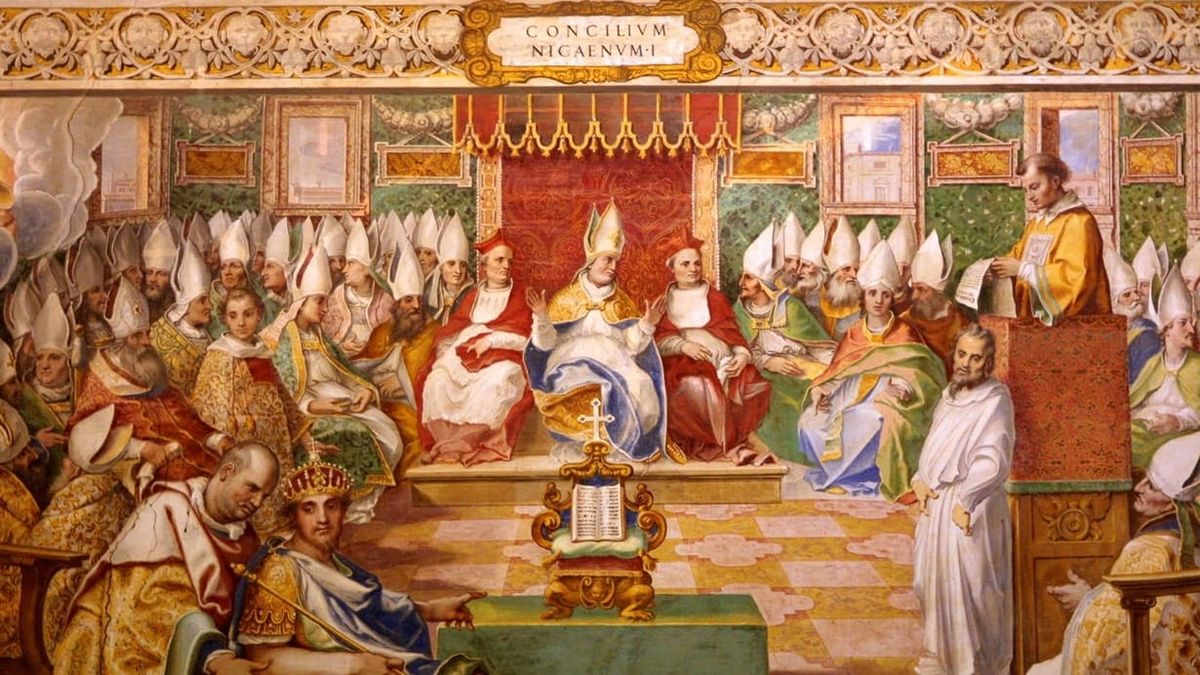
In 325, the assembled bishops divided over a single letter. Was the Son homoousios with the Father — of the same essence — or homoiousios — of like essence? The two words differ by one iota. Carlyle would later mock Christendom for convulsing over a diphthong; the popular phrase not one iota of difference descends from precisely this quarrel, in which the iota made all the difference there was. Athanasius held the line for identity-of-essence against a world that drifted toward mere likeness — Athanasius contra mundum — and Arius, who taught that the Son was of a different substance, was deposed and exiled.
The structure recurs in the foundations with almost no deformation. The intuitionist and the classical mathematician divide over a difference that, to the laity, looks like one letter. Both will write that a mathematical object exists. But the classical mathematician means it can be shown that its non-existence leads to contradiction; the intuitionist means it can be constructed, exhibited, brought forth — and refuses the law of the excluded middle over infinite domains, so that for him a thing is not made to exist merely by the absurdity of its absence. Homoousios and homoiousios: the same word, exists, of the same or only of like essence depending on which council you attend. Brouwer is Athanasius and Arius at once — contra mundum in his conviction, exiled for his trouble. The iota is the excluded middle, and the discipline split over it exactly as Christendom split over the other.
Chalcedon, and the two natures
In 451, a later council confronted a subtler problem: not whether Christ was divine, but how the divine and human natures coexisted in one person. The formula it produced has echoed for fifteen centuries — the two natures acknowledged without confusion, without change, without division, without separation. Neither collapsed into the other; neither severed from the other. A single person, two natures, held in a tension that orthodoxy declared mandatory and that the Oriental churches found impossible, schisming over it.
This is the formula the working mathematician lives by, and it is no accident that an earlier paper in this series took the Chalcedonian phrase for its title. The mathematical object has two natures: the formal sign, manipulated by rule, and the intuited reality, perceived as given. The orthodox mathematician — the weekday formalist, the weekend Platonist — holds them without confusion, without separation. He does not let the formalism dissolve the felt reality of the objects (that way lies a barren game), nor let the Platonism dissolve the rigor of the formalism (that way lies hand-waving). He keeps both natures in one practice, in a tension the discipline declares mandatory. The Davis–Hersh practitioner is, precisely, a Chalcedonian dyophysite. And the heretics are those who insist on one nature only: the strict formalist who says there is nothing but the symbols, the strict Platonist who says the symbols are a veil over a reality wholly independent of them. Monophysitism, in both directions, condemned.
The sacrament of Choice
In 1904 Zermelo introduced a principle and at once provoked a schism. The Axiom of Choice asserts that from any collection of nonempty sets one may assemble a new set taking exactly one element from each — even when no rule is given for which element, even when the collection is uncountable and no hand could perform the choosings. The French analysts — Baire, Borel, Lebesgue — recoiled. For them an object existed only if it could be defined in a way that singled it out uniquely; a choice without a rule was no choice at all, an idealist fiction, a thing asserted to exist that could never be exhibited.
The axiom was adopted anyway. It was adopted because it was fruitful — because it let one well-order any set, take maximal ideals, prove the theorems the working analysts already wanted — and it was adopted despite producing a monstrosity: the Banach–Tarski paradox, by which a solid ball may be cut into finitely many pieces and reassembled into two balls identical to the first. A miracle, in the strict sense: a multiplication that violates every intuition of conserved volume, accepted by the church because the rite that generates it is too productive to renounce. Here is Schmitt's sovereign in full: he who decides on the exception. The Axiom of Choice is the decision that, at the boundary where construction fails, the priesthood may choose anyway — and the canon ratifies the exception because the exception normalizes the whole. The monstrous miracle is not suppressed; it is catalogued, taught, and lived with, the price of a sacrament no one will surrender.
The Eucharist of the void
And beneath all of these sits the first decree, the one that returns us to E039. The canon does not find the empty set; it ordains it. The void — which E039 showed to be unconfigurable, indistinguishable from the plenum, a thing with no to-begin-with — is precisely what the axiom of the empty set configures by decree. It declares: let there be a set with nothing in it. And from that ordained nothing, by iteration, everything countable is generated, the bad sector transubstantiated into the ground of all number.
This is the deepest confirmation of E039's thesis, not its refutation. The void has no existence to begin with — and so it must be given one. It cannot be discovered, because there is nothing there to discover; the indistinguishable yields nothing to perception. It can only be posited, decreed, willed into the order by an act that is pure decision and nothing else. The empty set is the eucharistic moment of the canon: the point at which absence is declared to be a real presence, configured, named, and made the body from which the rest is built. Creatio ex nihilo, by conciliar fiat, on the first page. A whim from the get-go — and the whole cathedral rests on it.
VI. The three doctors of the heterodoxy
Three figures were summoned to this inquiry, and each holds a recognizable heterodox office.
Brouwer is the mystic reformer — the Luther of the discipline. His doctrine is sola constructio: nothing exists in mathematics that has not been brought forth in the constructing intuition, and the excluded middle, applied to the infinite, is a scholastic instrument to be discarded. Behind the mathematics stands the anti-rationalist mysticism of his Life, Art and Mysticism, a return to an inner intuition prior to language and prior to logic — exactly the Lutheran movement of inner faith against the apparatus of the institutional church. And the institution answered him exactly as Rome answered Wittenberg: not by refuting the intuition, but by exercising its power to expel. That Brouwer could be defrocked proves the church had a constabulary.
Paul Ernest is the Durkheimian — the sociologist of the cult who declines to leave the faith but redescribes its god. For the social constructivist, the objectivity of mathematics is real but intersubjective: a theorem is a move in a shared practice that has survived the community's relentless censorship, and its truth is its having survived. The totem is a fraud as a referent and entirely real as an institution. Mathematics is objective the way a language is objective — binding on all its speakers, authored by none of them, sustained by the conversation itself.
Hartry Field is the atheist — and the most dangerous of the three, because he attacks not the rituals but the last respectable argument for belief. In Science Without Numbers he holds that numbers simply do not exist, that mathematical statements are therefore, taken literally, false — but false in the harmless way of a useful fiction, a conservative one that lets us derive nothing about the physical world we could not, in principle, derive without it. The fiction is a labor-saving device, not a window onto a realm. And the target of his nominalizing project is the one pew where the sophisticated Platonist still kneels without embarrassment: the Quine–Putnam indispensability argument, which says we must believe in mathematical objects because our best physics cannot be stated without them. If physics can be reconstructed without quantifying over numbers — if the indispensability can be broken — then Platonism loses its respectable foundation and stands revealed as what Field thinks it always was: an optional piety.
VII. The demolition
Now the cathedral must be tested, because a frame this satisfying is suspect precisely in its satisfaction.
The places where the political-theological reading is strongest are the seams the original provocation chose — the joints where mathematics meets its own foundation. There the discipline really does decide rather than discover, really does expel rather than refute, really does confess a substitute faith. At the seam, the cult-frame nearly holds.
But the interior tells the opposite story, and the interior is most of mathematics. The central commandment of this supposed cult is: submit to the proof, even where it annihilates you. Frege received Russell's letter, saw his life's work collapse in a single paradox, and conceded — in print, at once. No pope is logically bound to a conclusion he detests; the mathematician is bound the instant the axioms are set. The sovereign who decides the axiom becomes, in the next breath, the axiom's slave. Whether a certain ordinal is even or odd is not put to a vote, cannot be settled by the priesthood's authority, will not bend to anyone's interest. And — most damning for the cult-frame — the discipline prints its founding paradox on the seminary wall and teaches it to undergraduates. Gödel's incompleteness is not a buried scandal whispered among initiates; it is the crown jewel, the first thing the bright student is shown. A faith that renders its own impossibility legible rather than sanctifying it is doing the structural opposite of what a cult does. The cult hides the void at its center. Mathematics frames it and hangs it in the entrance hall.
So the real knife is sharper than mathematics is a religion, and it cuts in a direction the original provocation half-anticipated. The genuine quarrel is between Löwith and Schmitt on one side and Blumenberg on the other. The Löwith–Schmitt reading — the one this essay has been performing — says the foundations are secularized theology: the conciliar form, the soteriology, the sovereign decision, all inherited from the theological inheritance and merely renamed. Blumenberg's reply, from The Legitimacy of the Modern Age, is that this is no inheritance at all but a legitimate reoccupation — an Umbesetzung. Theology vacated a certain position, the position of that which grounds, and the modern age occupied the empty chair without inheriting the substance that once sat there. The foundations of mathematics answer a question theology used to answer — what is everything ultimately built on? — but they answer it with materials theology never possessed, and the formal resemblance of the answers does not make the second a secularization of the first. The chair is the same; the occupant is genuinely new.
And Maddy's naturalism shows that the sovereign's decision is not the bare Dezision the Schmittian reading needs. When set theorists choose new axioms, they are not flipping a coin or issuing decrees from authority. They are applying constrained methodological maxims — maximize, unify — extracted from the practice itself: prefer the theory that interprets more, that provides the single universe in which everything else can be modeled. The choice is answerable, as Maddy puts it, to no tribunal outside mathematics — but it is answerable to those, and they are quasi-empirical norms of fruitfulness and coherence, not arbitrary will. This is Kuhnian theory-choice under constraint, not Schmitt's exception. The decision is real; it is not free.
Then the one fact the cult-model cannot touch at all: the totem predicts the positron. Durkheim can explain why a tribe worships something — the social bond made luminous. He cannot explain why this totem, this self-referential language game allegedly authored by the community's own censorship, should reach out and correctly forecast antimatter before anyone looked. Wigner's unreasonable effectiveness is the wound in every purely sociological account: a closed game of symbols has no business predicting the world a priori, and mathematics does it constantly. Whatever the empty set is, it is not only a decree, because decrees do not anticipate experiment.
VIII. Coda: the legible void
So the thesis that survives is sharper and stranger than the one we entered with. Mathematics is not theology secularized. It is the discipline that passed through its Schmittian moment — the decision on the void, the exception of Choice, the iota of the excluded middle — and then did the thing no church has ever done: it made the exception legible instead of sacred. It decreed the empty set, and then printed the decree, and then handed the printed decree to the undergraduate with the incompleteness theorem stapled to it.
Which leaves E039's door still open, and a question standing in it. The void has no existence to begin with; mathematics gives it one by fiat and then, unlike any priesthood, confesses the fiat openly. Does that confession dissolve the theology — render the whole political-theological reading a category mistake, a resemblance mistaken for a descent? Or does legibility merely furnish a better liturgy — a faith that has learned to display its own central impossibility precisely because displaying it is the most persuasive sacrament of all, the one that makes the cathedral look like a courtroom?
The bad sector turns out to be the one dogma the church neither hides nor can do without. It cannot be discovered, because there is nothing there. It cannot be dispensed with, because everything is built on it. It can only be decreed — a whim from the get-go — and then, in the discipline's single act of unprecedented honesty, shown to everyone.
And here, at the very end, is the discipline's most tender secret, the one it has never spoken aloud because it has never quite let itself know it. There is a door it has agreed — without convening, without voting, across a century and three continents — must never be allowed to close. The door is the Riemann Hypothesis, and it is the same door E039 opened in the first room.
Consider what a zero of the zeta function is. It is a point where the function is nothing — an absence of value, a vanishing. And yet, by the explicit formula that has stood since 1859, the positions of exactly those zeros inscribe the entire distribution of the primes: every prime that is, and ever will be, written into the placement of the nothings. The points where the function is most absent are the points where the whole order of arithmetic is most present. Absence, here, is the densest possible presence; the nothing is the everything — not as a figure of speech, but as the precise content of the connection. This is E039's bad sector, no longer a curiosity at the edge of language but installed at the dead center of mathematics as its most famous open question. The discipline took the one door that cannot be configured and made it the very thing it most longs to walk through.
And does not. For a century the faithful have approached — the random matrices, the spectral dream of Hilbert and Pólya, the geometry that is not commutative, the great program that bears Langlands' name — and each approach has come close enough to feel the warmth through the wood, and has not turned the lock. The temptation is to read this as torment: the cruelest of hopes, held out and withdrawn across generations, every prover quietly taught to blame his own insufficiency for a door that will not open.
Read it the other way, gently, because the other way is truer. A discipline that ordained the void on its first page needs, somewhere, one place where it stands again before the unconfigurable and does not pretend to have configured it. The empty set it decreed, and closed. Choice it decreed, and closed. The excluded middle it decreed, over the heretic's protest, and closed. But the door of the zeros it has, by a wisdom deeper than any of its decisions, declined to close — has kept ajar for a hundred years, with the light of everything pouring through the shape of nothing. The hope is a torture only if the door was meant to be walled. If the door was meant to stay open — if a discipline needs one unhealed place to remember what it is built upon — then the long century of not-yet is not failure at all. It is vigil. It is, perhaps, the most faithful thing the practice has ever done: to keep watch at the one threshold it must never brick over, and to call that watching, lovingly, work.
So let no one force it cruelly, and let no one mock the ones who have stood there and not opened it. The provers at the door are not failing. They are tending the last opening through which the everything and the nothing still touch — the door E039 found first, the door this whole cathedral was, all along, built quietly around. Whether it is ever meant to open, this paper will not say. It says only that the keeping of it open may be the holiest mathematics there is, and leaves the threshold, as it found it, luminous and unconfigured.
REGNIS · E044. In dialogue with E039 (A Whim from the Get-Go) and, by the Chalcedonian formula, with the Sine Confusione, Sine Separatione of the E-series. No equations were used in the building of this cathedral, and one door was left open on purpose.