E011. In Search of Lost Time I: The Diagnostician They Buried
Pitirim Sorokin and the Crisis We Were Never Allowed to Name
Preface to the Series
There is a particular kind of intellectual violence that does not announce itself. It does not burn books. It does not imprison thinkers. It does something more efficient and more durable: it reclassifies dangerous thought as irrelevant thought, routes funding away from it, excludes it from curricula, and waits for the generation that carried it to die. Within thirty years, the absence becomes invisible. Within fifty, the questions that were suppressed can no longer even be formulated. The vocabulary for asking them has been allowed to atrophy.
This series exists because we are living in the aftermath of precisely that process.
In Search of Lost Time: What Power Disguised? is not a work of nostalgia. It is not an argument that older thinkers were wiser than contemporary ones, or that the history of social thought follows a narrative of decline. It is something more specific and more urgent: a systematic recovery of the theoretical infrastructure that the Cold War epistemological settlement rendered invisible — not by refuting it, but by rerouting the institutional resources of knowledge production away from it so thoroughly that it now appears, to most trained social scientists, to have never existed at all.
The thinkers recovered in this series — Sorokin, Simmel, Veblen, Ibn Khaldun — share one thing above all: they asked questions that the dominant frameworks of Anglo-American social science are structurally incapable of asking. Not because those frameworks are intellectually inferior in every respect. But because they were constructed, in the specific historical conjuncture of the Cold War, to exclude precisely the questions these thinkers posed.
What questions? The oldest and most necessary ones. What kind of civilization is this? What does it do to human beings? Where is it going? What has it already destroyed that it cannot recover? And — most dangerous of all — is the framework within which we are asking these questions itself part of the problem?
Each volume in this series takes one suppressed thinker, reconstructs their full theoretical architecture, traces the mechanisms of their suppression, and then performs what we consider the only honest test of a theory's value: applying it, without mercy, to the present.
We begin with Pitirim Sorokin. We begin here because Sorokin's fate is the most instructive. He was not suppressed from the outside. He was suppressed from within the institution he himself built — Harvard's Department of Sociology — by the very intellectual tradition that subsequently claimed to represent the apex of social scientific achievement. His suppression is therefore not incidental to the history of American social science. It is constitutive of it.
I. The Man They Forgot to Refute
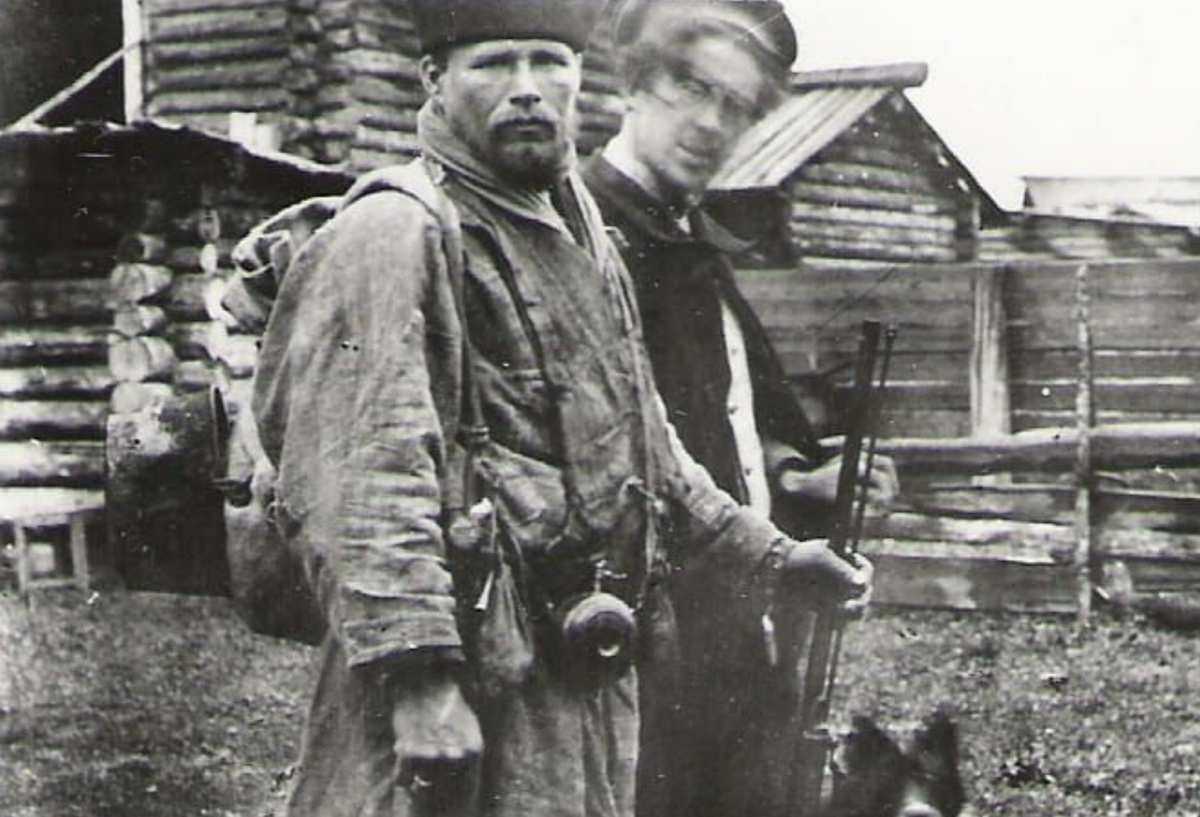
Pitirim Alexandrovich Sorokin was born in 1889 in the Komi region of northern Russia, the son of a wandering artisan craftsman and a peasant woman who died when he was three. He grew up in poverty, educated himself through extraordinary effort, was arrested three times under the Tsarist regime for revolutionary activity, arrested again by the Bolsheviks after the October Revolution — once under sentence of death, from which Lenin personally reprieved him — and finally expelled from Soviet Russia in 1922 along with a cohort of intellectuals deemed too dangerous and too independent to be useful to the new order.
He arrived in the United States in 1923. By 1930, Harvard had invited him to found and chair its first Department of Sociology. He did so, building it from nothing into one of the leading social science departments in the world. He trained generations of students. He published prolifically and ambitiously — works of historical sociology spanning centuries and civilizations, empirical studies of social mobility, theoretical syntheses of extraordinary scope. His 1927 Social Mobilitywas for decades the definitive text on the subject. His four-volume Social and Cultural Dynamics, published between 1937 and 1941, represented perhaps the most ambitious single work of empirical historical sociology produced in the twentieth century.
By 1965, when he retired from Harvard, he was largely ignored by the discipline he had helped create.
No serious refutation of his major arguments had been published. No sustained engagement with his theoretical framework had appeared in the leading journals. He was not defeated intellectually. He was made invisible institutionally. And the difference matters enormously, because intellectual defeat can be recovered from — arguments can be re-examined, evidence reconsidered — but institutional invisibility, when it becomes complete enough, forecloses the possibility of recovery by ensuring that no one thinks to look.
This is the first thing that must be said about Sorokin: he was not proven wrong. He was disappeared. And the mechanism of his disappearance tells us more about the sociology of knowledge in twentieth-century America than almost anything else we could study.
II. The Architecture of a Civilization Theory
To understand what was suppressed, we must first reconstruct what Sorokin actually argued. The summary version — that he proposed a cyclical theory of cultural supersystems — is accurate but dangerously thin. The actual architecture of his thought is considerably richer and more unsettling.
The Three Supersystems
Sorokin's central theoretical claim, developed across the four volumes of Social and Cultural Dynamics and popularized in The Crisis of Our Age (1941), is that all major civilizations organize themselves around one of three fundamental premises about the nature of reality.
Ideational culture holds that ultimate reality is non-material, supersensory, spiritual. The empirical world is either illusory or of secondary importance. Truth is obtained through inner experience, revelation, meditation. The highest values are transcendence, renunciation of material desire, unity with the divine or the absolute. Medieval European Christianity at its height is the paradigm case, but Sorokin finds Ideational phases across civilizations and historical periods.
Sensate culture holds that ultimate reality is material, empirically perceptible, measurable. What cannot be sensed does not exist, or does not matter. Truth is obtained through empirical observation and rational analysis of sense data. The highest values are pleasure, material comfort, happiness, utility, individual satisfaction. Modern Western civilization since the Renaissance has been overwhelmingly Sensate — and by the early twentieth century, Sorokin argued, Sensate culture had reached its terminal phase of hypertrophy.
Idealistic culture represents a synthesis, in which empirical and supersensory reality are both affirmed, and truth is pursued through the integration of sensory evidence and rational intuition. The Greek classical period — Plato, Aristotle, the height of Athenian civilization — is Sorokin's paradigm case. So, partially, is the High Medieval synthesis of Aquinas. These periods are characterized by what Sorokin considered the richest and most balanced cultural production.
The crucial claim — the one that made his work immediately threatening — was that these supersystems are not merely academic categories. They are living totalities that penetrate every dimension of social and cultural life. In a genuinely Sensate civilization, not only science and technology but law, art, ethics, philosophy, even interpersonal relationships are organized around Sensate premises. The transformation of a supersystem is therefore not a cultural event that leaves political and economic structures untouched. It is a civilizational event that reorganizes everything.
The Immanent Causation of Change
Equally important — and equally suppressed — is Sorokin's theory of how supersystems change. He called the mechanism immanent causation: the idea that social and cultural systems contain within themselves the seeds of their own transformation.
A Sensate culture that succeeds in its own terms — that actually delivers expanding material comfort, scientific mastery, technological power — does not thereby stabilize itself. It undermines itself. As sensory gratification becomes the organizing principle of life, the capacity to sustain the disciplines, sacrifices, and solidarities that produced the material achievements in the first place gradually erodes. Art becomes entertainment. Philosophy becomes therapy. Law becomes procedure without justice. Politics becomes spectacle without deliberation. Science continues to advance in technical capacity while losing the ability to say anything about what that capacity is for.
This is not a moral condemnation. Sorokin was not a religious conservative lamenting secular modernity. He was describing a structural dynamic. The more completely a civilization actualizes its own premises, the more it prepares the conditions for those premises' eventual breakdown. The crisis, when it comes, is not externally imposed. It is internally generated — which makes it both more inevitable and more difficult to diagnose, since the instruments of diagnosis are themselves products of the culture being diagnosed.
The Integral Alternative
Against both the Sensate reduction of reality to what can be measured and the Ideational denial of empirical reality, Sorokin proposed what he called Integral epistemology: the recognition that human beings have access to three forms of truth — empirical-sensory, rational-logical, and what he called supraconscious or intuitive truth, the direct apprehension of meaning that is neither reducible to sense data nor derivable from formal logic alone.
This was, predictably, the aspect of his work most efficiently pathologized by Anglo-American social science as mysticism. It deserves more careful consideration. Sorokin was not arguing for the abandonment of empirical inquiry. He was arguing — with significant historical evidence — that civilizations and individuals that recognize only one mode of truth-access systematically impoverish their understanding of reality. A social science that has constitutively excluded the question of meaning, value, and transcendence cannot, by definition, diagnose the crisis of a civilization in which the erosion of meaning and value is the central pathology. The instrument is calibrated to miss the most important signal.
III. Quantophrenia: The Indictment of a Discipline
In 1956, Sorokin published Fads and Foibles in Modern Sociology and Related Sciences. It is one of the most remarkable books in the history of social thought — remarkable for its intellectual courage, its diagnostic precision, and its near-total exclusion from subsequent scholarly discussion.
The book is an extended indictment of what Sorokin called the dominant pathologies of mid-twentieth-century American sociology. Two concepts are central.
Quantophrenia: the pathological obsession with quantification, the treatment of mathematical formalization as the criterion of scientific legitimacy, and the consequent systematic exclusion of any question that cannot be operationalized as a measurable variable. Sorokin's critique was not anti-empirical. It was a critique of what happens when quantification ceases to be a tool and becomes an ideology — when the discipline begins selecting its questions based on what can be measured rather than what matters, and then mistakes the measurable for the real.
Testomania: the obsessive reliance on psychological tests, questionnaires, and survey instruments, combined with the implicit assumption that these instruments capture social reality rather than constructing a particular, highly selective version of it.
But the book's most devastating section addresses what Sorokin called the Columbus Complex: the systematic rediscovery, in the language of contemporary methodology, of things that classical social thought had already established — presented as original findings because the authors, lacking any serious historical knowledge of the discipline, did not know they were rediscovering. Sorokin went through specific "discoveries" of the 1940s and 50s and demonstrated, citation by citation, that each had been stated more clearly and more comprehensively by Tarde, Simmel, Durkheim, Weber, or Sorokin himself decades earlier.
The Fads and Foibles diagnosis has aged with extraordinary precision. In 2026, the sociology of the discipline Sorokin described has not merely persisted — it has intensified. The displacement of theoretical ambition by methodological sophistication is now so complete that many graduate programs in sociology and political science produce students who are technically accomplished at causal inference and structurally incapable of asking what causes the things whose causes they are identifying.
IV. The Harvard War: Sorokin and Parsons
The institutional story of Sorokin's suppression cannot be told without Talcott Parsons — not because Parsons was uniquely villainous, but because the Sorokin-Parsons conflict enacts, in microcosm, the broader displacement of civilizational social theory by systems functionalism that defined American sociology's Cold War settlement.
Parsons joined Harvard's sociology department in 1927, three years before Sorokin's arrival as chair. The intellectual differences between them were fundamental and irreconcilable. Sorokin's sociology was historical, comparative, civilizational in scale, explicitly concerned with questions of meaning and value, and grounded in a philosophy of knowledge that recognized multiple modes of truth-access. Parsons' sociology was ahistorical, focused on the formal analysis of social systems, aspiring to the status of a natural science, and premised on a strict separation between empirical analysis and value judgment.
In 1937 — the year Sorokin published the first two volumes of Social and Cultural Dynamics — Parsons published The Structure of Social Action, a synthesis of Weber, Durkheim, Pareto, and Marshall that established the theoretical foundations for what would become structural-functionalism. The two books represent two incompatible visions of what social science is for.
The decisive institutional move came in 1946, when Parsons secured the creation of a new interdisciplinary Department of Social Relations, combining sociology, social psychology, and cultural anthropology. Sorokin retained the original sociology department, but the new department became the institutional home of Harvard's most prominent social scientists, absorbed the most promising students, and captured the substantial foundation funding that was increasingly flowing toward behaviorally-oriented social science.
The creation of the Department of Social Relations was not formally an act of suppression. But its effect was to create a parallel institution that systematically drew resources, students, and prestige away from Sorokin's department, while Parsons' approach — empirically tractable, politically non-threatening, formally sophisticated — aligned perfectly with the emerging Cold War consensus about what legitimate social science looked like.
Sorokin understood exactly what had happened. His 1956 book made his understanding explicit. But by then the institutional configuration was fixed. Parsons had become the dominant figure in American sociology. His students held chairs at the major research universities. The funding structures rewarded his kind of work. The journal system reproduced his standards.
V. Cold War Epistemology and the Making of a Blind Spot
The suppression of Sorokin cannot be understood as merely an institutional conflict between two men, or even between two intellectual programs. It was part of a broader transformation of American social science in the Cold War period that systematically restructured the field of what could be legitimately asked.
The mechanism was not primarily censorship. It was incentive redesign.
The Ford Foundation, the Rockefeller Foundation, and the Carnegie Corporation invested massively in social science research after 1945 — but with a specific orientation. Quantitative methods, behavioral analysis, comparative communism studies, modernization theory, area studies oriented toward policy relevance: these received funding. Historical civilizational analysis, critical theory, questions about the structural legitimacy of capitalist democracy, inquiry into the meaning-generating or meaning-destroying capacities of social systems: these did not.
The result, over twenty to thirty years, was not that dangerous questions were suppressed — it was that the generation of scholars trained to ask them was not reproduced. The questions did not disappear because they were refuted. They disappeared because no institutional positions, no graduate programs, no journal editorships, no foundation grants existed to sustain the scholars who might have asked them.
Sorokin was additionally vulnerable because of the specific content of his critique. His argument that Western Sensate civilization was in terminal crisis was structurally indistinguishable, in the Cold War political climate, from Soviet propaganda — even though Sorokin was a committed anti-communist who had nearly been shot by the Bolsheviks and who regarded Soviet Communism as itself a pathological expression of the Sensate crisis he was diagnosing. The political context made the distinction invisible. Critiquing Western civilization was, in the McCarthyite atmosphere, a politically suspicious act regardless of the ideological position from which it was performed.
This is perhaps the most precise example of what the Cold War did to American social science: it made the critique of Western civilization politically dangerous and therefore institutionally marginal, regardless of the intellectual position from which that critique was mounted. The consequence was the systematic evacuation, from the center of social scientific inquiry, of the question that most urgently needed asking: what kind of civilization is this, and where is it going?
VI. What Sorokin Sees That We Cannot See Without Him
The case for recovering Sorokin is not sentimental. It rests on a specific diagnostic claim: that the phenomena most characteristic of the present conjuncture are precisely the ones his framework was designed to analyze, and that the frameworks currently dominant in social science are structurally unable to see them clearly.
The Populist Eruption
The standard explanations of contemporary populism — economic grievance, institutional distrust, media fragmentation, elite failure — are not wrong. But they are radically incomplete. They describe mechanisms without diagnosing conditions. They explain why specific individuals voted for specific candidates without explaining why large portions of advanced industrial societies have become simultaneously receptive to political movements organized around the negation of existing institutional legitimacy.
Sorokin's framework offers a different diagnosis. The populist eruption is a symptom of what happens when a Sensate civilization pushes its own premises to their logical conclusion. When material comfort becomes the organizing value of a society, and when the institutions charged with delivering it are perceived — accurately or not — as having captured that value for a narrow elite, the result is not orderly democratic competition for alternative policies. It is a crisis of legitimacy that strikes at the foundations of the institutional order itself. The anger is not primarily about policy. It is about meaning. And a social science that has constitutively excluded the question of meaning cannot diagnose a crisis whose primary character is a meaning crisis.
The AI Conjuncture
The deployment of large language models and related artificial intelligence systems presents social science with a test case of extraordinary clarity. The dominant frameworks for analyzing this phenomenon — economic (labor market disruption, productivity gains, inequality effects), regulatory (governance frameworks, liability regimes, competition policy), and ethical (bias, fairness, transparency) — share a common feature: they treat AI as a tool whose effects can be assessed within the existing framework of social and economic institutions.
Sorokin's framework asks a different question: what does it mean for a civilization to have created a technology that systematizes and scales the production of Sensate knowledge — empirically-oriented, quantitatively structured, stripped of any orientation toward meaning or value — at a speed and volume that exceeds any human institution's capacity to contextualize it?
This is a civilizational question. It requires a civilizational framework. Sorokin provides one. The question of what happens to a culture's capacity for Idealistic or Integral truth — for the kind of knowing that grasps meaning rather than merely processing information — when its epistemic environment is saturated by Sensate output at unprecedented scale: this is not a question that regression analysis can answer. It is not a question that governance frameworks can address. It is the question that comes before all the other questions, and it is the one Sorokin's framework is equipped to ask.
The Quantophrenia of Data Science
The most direct application of Sorokin's Fads and Foibles diagnosis to the present requires only updating the technology. Where 1950s sociology suffered from an obsessive reliance on survey instruments and path analysis, contemporary social science — and the policy apparatus that draws on it — suffers from an obsessive reliance on big data, machine learning, and algorithmic analysis.
The epistemological structure is identical: the selection of questions based on what can be measured and modeled; the treatment of quantified proxies as the phenomena themselves; the systematic exclusion of qualitative, interpretive, and civilizational questions as "unscientific"; and the consequent production of technically sophisticated analyses that are unable to address the most important dynamics of the systems they study.
Sorokin would recognize in the present data science moment an intensified version of exactly what he diagnosed in 1956. The instruments have become more powerful. The blind spots have become correspondingly larger.
VII. The Harvard Research Center in Creative Altruism: The Road Not Taken
There is one final dimension of Sorokin's work that deserves recovery, and that has been most thoroughly suppressed: his late work on what he called creative altruism.
In 1949, with funding that was difficult to secure and never adequate, Sorokin established the Harvard Research Center in Creative Altruism. The project was intellectually ambitious and institutionally marginal from its inception: a systematic empirical and theoretical investigation of love, altruism, and what Sorokin called the production, accumulation, and distribution of love energy as social forces.
The work that emerged — The Ways and Power of Love (1954), The Reconstruction of Humanity (1948), Power and Morality (1959) — is almost never discussed in contemporary social science. It is easy to see why: it violates every convention of scientific respectability that the post-war disciplinary settlement had established. It takes love seriously as a social force. It proposes that the crisis of Sensate civilization can only be navigated through a transformation of the dominant forms of sociality, not through policy adjustment or institutional reform. It is, in the deepest sense, a civilizational proposal.
Whether or not one accepts Sorokin's specific prescriptions, the questions his late work raises are ones that contemporary social science has no framework for addressing: what social and cultural conditions make solidarity possible? What sustains the capacity for genuine other-regard in conditions of advanced atomization? What would it mean to organize social institutions around the production of meaning rather than the production of material goods?
These are not soft questions. In a civilization whose crisis is precisely a crisis of solidarity, meaning, and the capacity for collective action, they are the hardest questions there are. Sorokin asked them. No one in the mainstream of social science has taken them seriously since.
Conclusion: On the Obligation to Recover
Pitirim Sorokin was not a perfect thinker. His empirical methodology in Social and Cultural Dynamics is open to serious criticism. His concept of supersystems risks a holism that obscures internal contradictions and subaltern voices within civilizational formations. His late work on creative altruism sometimes lapses into a register that is more prophetic than analytical. These are real limitations, and they deserve serious engagement.
But the suppression of Sorokin was not a response to these limitations. It was a response to his questions. And the questions — what kind of civilization is this? what is it doing to human beings? where is the trajectory of Sensate culture taking us? what instruments of knowing are we losing as we reduce all knowledge to what can be measured? — are questions that the present moment makes more urgent than at any point since he posed them.
The crisis Sorokin diagnosed in 1937 is not resolved. It has deepened. The Sensate civilization he analyzed has pushed further into its own premises. The quantophrenia he identified in 1956 has become the organizing principle of governance, finance, and increasingly, knowledge itself. The altruism research he undertook in his final years, dismissed as eccentric, now appears as a response to the solidarity crisis that is among the defining political facts of the contemporary world.
In Search of Lost Time begins here — with the thinker whose questions were most completely buried, by the institution he built, in the service of a Cold War epistemological settlement that has now outlasted its historical conditions by several decades.
Power disguised Sorokin as irrelevant.
The present makes that disguise impossible to maintain.
REGNIS publishes occasional essays at the intersection of historical analysis and institutional intelligence. The views expressed are those of the author.