E004. The Grammar of Power II: What the Seer Can Unsee
On Representation, Display, and the Optic Animal
There is a structural dishonesty at the centre of political theory that the discipline has managed, with considerable ingenuity, to avoid confronting. Political actors do not represent reality. They display versions of it — versions shaped by the desires, collective and structural, that produce the display in the first place. The Continental tradition understood this. From Saussure's demonstration that the sign is arbitrary, through Derrida's proof that writing supplements rather than mirrors speech, through Lacan's account of the mirror stage as the founding misrecognition of the self, the philosophical groundwork has been laid for over a century. What it has not done is follow the argument where it most urgently leads: into power.
Power does not represent. Power displays. And display operates not through the epistemological register of truth and accuracy but through the libidinal register of attraction, compulsion, and desire. A political leader is not a mirror held up to a people. A leader is a fracture of the fractal — one fragment extracted from the irreducible complexity of a population and presented as though it were the whole, selected not for accuracy but for displayability, for its capacity to circulate through the existing infrastructure of attention and activate the projections that infrastructure was built to enable. Debord saw this: the spectacle is not a distortion of political reality but the form political reality takes when display becomes its primary medium. Between the complexity of a people and the figure who stands before a camera claiming to embody it, the relation is not correspondence. It is production.
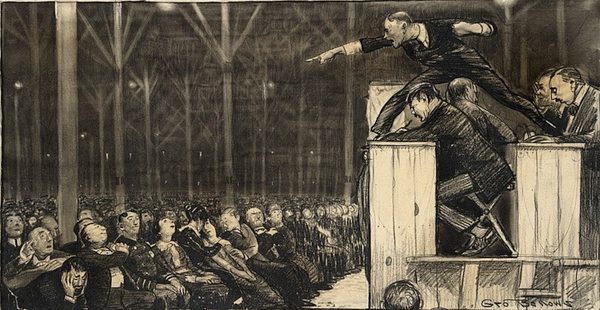
The production is libidinal. Freud's foundational claim — that human behaviour is structured by energies prior to rational deliberation and irreducible to it — applies to political attachment with a precision that political science has found professionally inconvenient to acknowledge. Bataille, extending Freud into the register of sovereignty, argued that eroticism and political authority share a common structure: both involve an expenditure that exceeds utility, a transgression of the limits that the productive economy imposes. The crowd before the charismatic figure is not merely persuaded. It is aroused — in a register that includes but exceeds the sexual, a register of dissolution, of individual boundaries temporarily suspended in the collective that the figure makes possible. Trump clarifies this by being a limiting case: a politician who stripped away almost everything that political display normally retains as cover, whose authority depended not on the cover but on the stripping.
The conventional analysis asks what he represents — which grievances, which demographics, which fractal fragment. This is the wrong question. The right question is why this particular display activated the libidinal economy it activated when other projections of ostensibly similar content had not. The answer is in the display itself: a directness that bypassed epistemological evaluation entirely, that generated the friend/enemy distinction not through argument but through visceral attraction and repulsion, in the body of the viewer, before reflection was possible. Good or bad, nauseous or soothing, he was displayed at play. The play was the point.
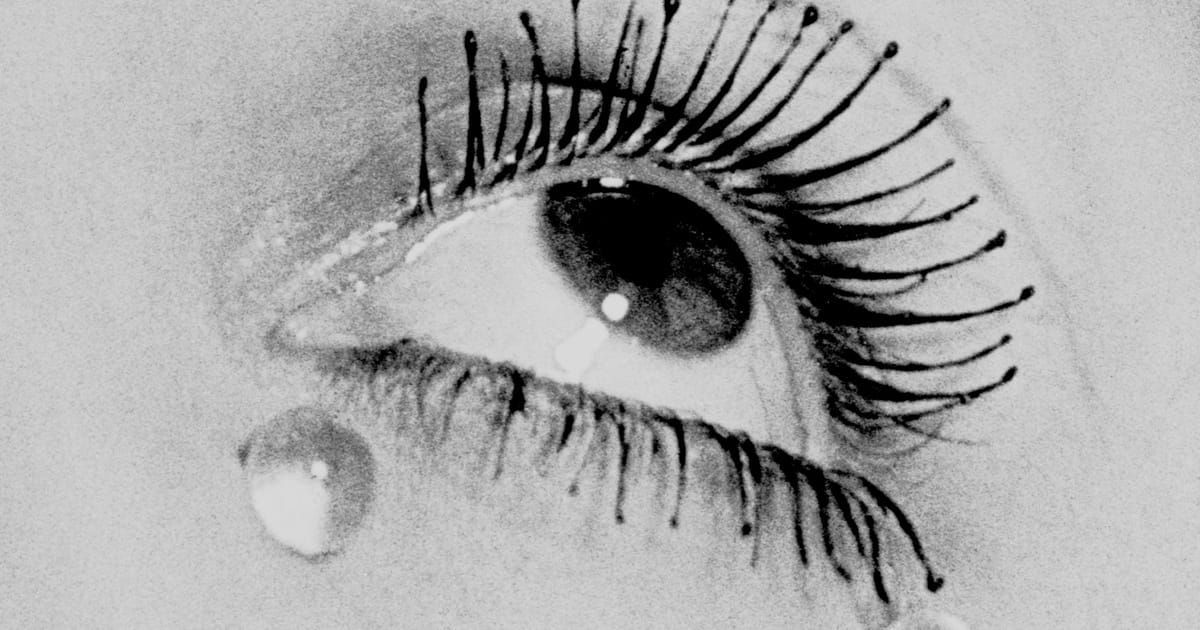
We are optic animals — not metaphorically but neurologically, our cortexes overwhelmingly organised around the processing of visual information. What we call reality is, to a degree philosophy has consistently underestimated, what we see. And what we see is produced: by the organs that do the seeing, by the cultures that train those organs, and increasingly by the infrastructures that determine what is available to be seen. Plato's prisoners do not experience the cave as a constraint. The shadows are reality, because the architecture of confinement makes it impossible to turn around.
The contemporary infrastructure of political display is a cave of extraordinary sophistication — one that does not merely select which shadows to project but progressively shapes the optical apparatus of those watching, producing through repetition and algorithmic curation a perceptual world in which certain things become visible by habit and others become unthinkable by default. Anderson understood the generative dimension of this: the nation is an imagined community not because it is fictional but because the infrastructure of print capitalism constituted it, producing the community through the projection rather than describing a community that pre-existed the projection.
The same structure, operating through incomparably more powerful infrastructure, constitutes the political communities of the present. What the algorithm shows is not a mirror of existing preference. It is a generative act. Which leaves a final question, the most uncomfortable one: if projection is constitutive of political attachment, and if the same libidinal structure underlies love — if what I love, in loving you, is partly a construction my desire assembled from the material you offer — then the distinction between loving something and loving yourself in the presence of it cannot be definitively established. The question can be asked. It cannot be answered. And if it cannot be answered in the intimate register, it cannot be answered in the political one either. We see what we are allowed to see. Whether knowing this changes what we see is, perhaps, the political question of the present.
REGNIS publishes occasional essays at the intersection of historical analysis and institutional intelligence. The views expressed are those of the author.