E028. Fabricata VI: Two Churches, One Sofa

Essai — Being a True Account of the Sunday Worship of Two Men Who Do Not Go to Church
It is Sunday evening in America, and two men are about to pray.
Neither of them knows this. If you told them, they would be insulted. Both are modern. Both are rational. Both have, at various dinner parties, used the phrase "I'm not religious, but—" and then said something extremely religious. One of them owns a Cosmos box set. The other has a tote bag that says REASON in a serif font. They are, they will assure you, done with all that medieval nonsense.
Let us call them Chad and Dexter, because they would each hate being the other one.
I. The Congregation of Chad
Chad settles into the La-Z-Boy. The recliner footrest deploys with the solemnity of a drawbridge. He opens a beverage. He turns on the television, and a man with very white teeth begins to explain that the elites are lying to him, that he — Chad, personally, in this chair — already knows the truth in his gut, and that no expert, no professor, no smug coastal fact-checker can take that knowing away from him.
Chad feels something move in his chest. It is warm. It is good. It is, though he would deny this under oath, the Holy Spirit.
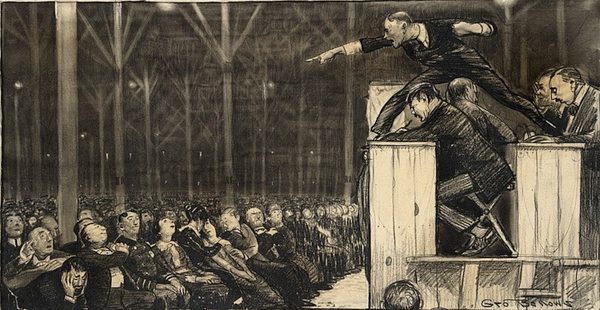
Because here is the thing nobody told Chad: he is at a revival. The white teeth belong to a preacher. The format is the camp meeting, lightly reskinned — the direct, unmediated download of Truth into the heart of the ordinary believer, who needs no seminary and no bishop and certainly no peer review, because he has been awakened. The technical term, Chad, is conversion. You got saved during a commercial break.
Chad's whole theology — and he has one, the poor man, he just thinks it's "common sense" — runs on firmware laid down by John Calvin and reflashed by every tent preacher between the Second Great Awakening and now. Observe the doctrines, all present, all secularized, none recognized:
The first is sola fide — faith alone. You don't argue your way to the truth. You don't weigh sources. You feel it, and the feeling is self-authenticating, and anyone who asks you to show your work is a Pharisee. Chad calls this "doing his own research," which is the funniest possible name for it, because no research occurs. It is pure faith, magnificently uncut.
The second is election. There is a saved remnant — real Americans, the awake, the gut-knowers — and there is a vast mass of the damned, who are asleep, who are sheep, who trust experts. Chad did not choose to be among the elect. He simply is, by a grace he experiences as having always seen clearly. Calvin would recognize the structure instantly and weep at the production values.
The third is the priesthood of all believers, which in 1517 meant "I can read scripture without a Roman bureaucrat," and in our era means "I can read a virology study without a virologist." Same energy! Identical energy! The reformers smashed the magisterium so the plowman could read the Bible in his own tongue; Chad has smashed the magisterium so he can read PubMed in his own Facebook. The Reformation finally reached its terminus, and its terminus is a man in Ohio who has decided that his sense of things outranks the entire apparatus of trained interpretation, on principle, as a spiritual matter. Hier stehe ich. Here I stand. I can do no other. I saw it on a podcast.
And the fourth — the sweet one, the one your author finds almost moving — is the unmediated charismatic leader. Chad does not want a committee. Chad wants a man who speaks the truth directly, the way the truth used to come directly, before the priests got in the way. This is the oldest Protestant hunger there is: cut out the middleman, give me the Word raw. That the Word now arrives in the form of a real-estate developer changes the casting but not the liturgy. Chad has found his prophet, and the prophet does not ask him to think, which Chad experiences — correctly, by the internal logic of the genre — as respect.
When Chad turns off the television he will say he has been "informed." He has been to church. He tithed his attention, he received the Word, he renewed his election, and he walked out confirmed in the knowledge that the damned are damned and he is not. Soli Deo gloria, Chad. You absolute Calvinist. You have no idea.
II. The Communion of Dexter
Across the country, or possibly across the street, Dexter is also not going to church.
Dexter would like you to know that he finds Chad frightening. The anti-intellectualism. The disdain for expertise. The way these people just believe things without evidence, without process, without — and here Dexter pushes his glasses up his nose, a gesture we will return to — rigor.
Dexter pours a natural wine. He opens a long article. The article is about how a complicated problem could be solved by the correct institutional design, implemented by qualified people, according to evidence-based best practices, if only the credentialed were permitted to credential in peace. The article has seventeen sources. It is measured. It considers objections. It arrives, after much throat-clearing, at the position Dexter already held, but now Dexter holds it with footnotes, and the footnotes feel like absolution.
Dexter, too, is at worship. He just goes to the other church — the one with better architecture and worse music.
Because Dexter's firmware is Roman. Not in the application layer — God forbid, he's an atheist, he'll tell you twice — but all the way down in the boot sector, where the structure lives. Watch the doctrines reassemble, Catholic this time, equally unrecognized:
The first is the magisterium. Truth does not come to you raw, the way it comes to that lunatic Chad. Truth is mediated. It passes through a trained interpretive class — experts, institutions, the peer-reviewed, the credentialed — and the laity receive it from authorized hands or not at all. Dexter does not do his own research; Dexter, far more piously, defers to the research, and he experiences this deference as the height of rationality, when it is in fact the purest possible act of faith in a priesthood. He has simply chosen the church that issues diplomas instead of the one that issues goosebumps. The glasses-push, Dexter, is the gesture of a man adjusting his biretta.
The second is the constructible order — the deep Gallican-Cartesian confidence that the world is a rational system, transparent to the right minds, governable by the right design, fixable by the right policy. Where Chad's people think the order is fallen and you should mostly leave it alone (that's the Calvinist hand, the invisible one, don't touch it, it's providential), Dexter's people think the order is an engineering problem and salvation comes through administration. This is Saint-Simon's dream in a cardigan: redemption by qualified technocrat. Dexter has never read Saint-Simon. Saint-Simon is reading Dexter.
The third is universalism — the one true church, una sancta, no salvation outside it. Dexter's norms are not local; they are Correct, everywhere, for everyone, and the failure of distant peoples to adopt them is not a difference of firmware but a deficiency, a benighted not-yet-ness that the right development program will cure. Dexter would be appalled to hear his humanitarian universalism described as missionary. It is, of course, exactly missionary. He just sends NGOs instead of Jesuits and calls the conversion "capacity building."
And the fourth is the secularized eschaton — the arc. History bends, Dexter knows, toward justice, the way it used to bend toward the Kingdom, and Dexter is on the right side of it, the bending side, the side that progress is going to vindicate. Karl Löwith already filed the paperwork on this one: the modern faith in progress is Christian eschatology with the serial numbers filed off, providence transferred to "the laws of history," the New Jerusalem rebranded as the better tomorrow (Löwith 60–62). Dexter believes in the Last Judgment. He calls it "being on the right side of history." He thinks the phrase is secular. It is a creed. It has a liturgy. He recites it whenever he loses an argument: history will absolve me. So said the eschaton, every time, for two thousand years.
When Dexter closes the article he will say he is "well-informed." He has been to Mass. He received the mediated Word from the authorized clergy, he affirmed the universal church, he renewed his faith in the bending arc, and he walked out confirmed in the knowledge that Chad is a barbarian outside the gates of reason. Ite, missa est, Dexter. Go, the dispatch is sent. You magnificent Thomist. You have no earthly idea.
III. The Wars of Religion, Now With Streaming
Here is the part that should make you laugh and then make you a little cold.
Chad and Dexter believe they are having a political disagreement. They are not. Political disagreements can be split the difference: you wanted the tax at thirty, I wanted it at twenty, fine, twenty-five, let's get lunch. Chad and Dexter cannot get lunch. Chad and Dexter have never been able to get lunch. Because what divides them is not a policy. It is the question of where truth comes from — and that question got its last real workout in the sixteenth century, when Europe set itself on fire over it for about a hundred and thirty years.
Chad is the Reformation. Truth comes directly, to the individual heart, no mediation, no priestcraft, smash the experts, trust the plowman, sola fide. Dexter is the Counter-Reformation. Truth comes through the Church, the trained magisterium, authorized interpretation, private judgment is how you get heresy, defer to the council. These two firmwares have been at war since Worms, and they did not stop when the application layer went secular. They just lost the word "God," kept absolutely everything else, and migrated to basic cable and the longform internet respectively.
This is why they look at each other and see not an opponent but a heretic — the specific, ancient, non-negotiable horror of the heretic. To Chad, Dexter is the smug clerisy hoarding the truth behind credentials, a whole priesthood of Pharisees pronouncing in Latin (now called "the science") to keep the common man from his birthright of direct knowing. To Dexter, Chad is the unlettered enthusiast in the grip of private revelation, the un-vetted, un-peer-reviewed fanatic whose "doing his own research" is precisely the anarchy of individual interpretation that the magisterium exists to prevent. They are both completely right about each other. That is the joke. Each has correctly identified the other as the thing his firmware was built to fear. Calvin and Trent, glaring across a sofa, in 2026, neither one aware he is in costume.
And neither one — this is the cold part — knows the costume is on. Chad thinks he is a man of common sense. Dexter thinks he is a man of reason. Each experiences his own firmware as transparent reality and the other's as deranged faith. Each is a fish, declaring with total confidence that he, unlike the other fish, is not wet. This is the seal at its most perfect: a theology so deep it has hidden itself from its own host, who will go to his grave certain he believed in nothing, having attended divine service twice a week, every week, his whole life, by remote control.
IV. A Closing Benediction, For Everyone, Including the Author
So God is dead. Sure. Fine. The sign came down. The building got repurposed.
But the congregation never left. They reconvene every evening in prime time and every morning in the open tabs, they receive the Word from anchors and from essayists, they renew their election and reaffirm their magisterium, they hate the other parish with a purity of theological loathing that no mere politics could ever generate, and they file out muttering the same line their ancestors muttered through the smoke of the same fire: those people are insane.
The hymnals are different. The liturgies are intact.
And before you — yes, you, the one who has been enjoying this enormously, the one nodding along thinking God, that's exactly my idiot brother-in-law — before you get too comfortable: which sofa are you on? You felt the warm click of recognition just now. That click is the offering plate. You have a firmware too. You did not choose it, you cannot see it, and it is, at this very moment, telling you that you, unlike everyone in this essay, have simply understood the situation correctly.
That feeling is the oldest one in the building.
Dominus vobiscum. The remote is on the armrest. Service is at the usual time.