E033. In luce celatum II: The Tenant of the Interglacial
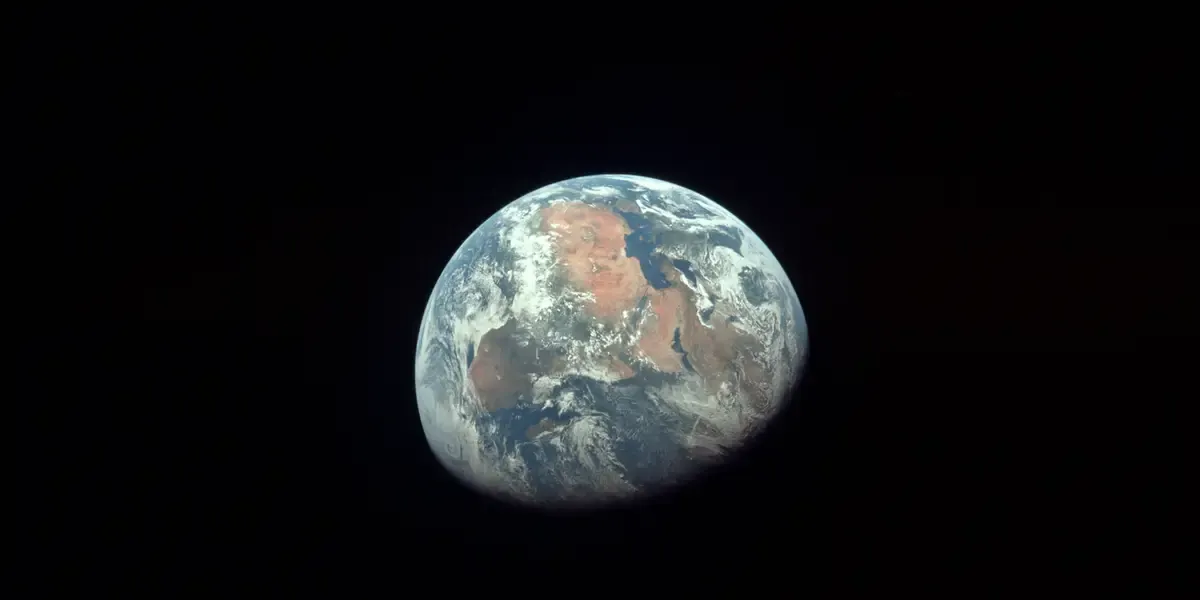
On the Smallness of Man and the Improbable Mercy of a Quiet Sky
"Such abrupt changes have been absent during the few key millennia when agriculture and industry have arisen." — Richard B. Alley, Proceedings of the National Academy of Sciences (2000)
"…the permanent forces that operate upon the human will and weigh upon it without its knowledge, guiding it along certain paths." — Lucien Febvre, on Braudel's Mediterranean
Prelude: The Question Asked from the Wrong Height
Every civilisation tells itself a story about why it exists, and the story is almost always the same. It is a story of ascent — of a creature that was once cold and frightened and few, who by the slow accumulation of cunning lifted itself out of the dark, lit fires, raised cities, split the atom, and at last taught sand to think. It is a flattering story, and like most flattering stories it is told from a particular height: the height of the summit, looking down. From up there the climb looks like an achievement of the climber. The mountain is not even visible. The mountain is simply the ground, the obvious and unremarkable floor on which the impressive business of climbing took place.
This monograph proposes that we have been asking the question of our own existence from the wrong height — from the summit, where the mountain disappears. It proposes that we descend, and look back, and see the mountain for what it is: not a floor but a gift, and a recent one, and a fragile one, and one that was very nearly never given. The argument is not a sentimental one, though it will end in something close to reverence. It is built, plank by plank, from the hardest evidence the earth keeps of itself — the rings of trees, the gas trapped in ten-thousand-year-old ice, the pollen lying in lake-beds, the bones of crops. And it arrives at a conclusion that ought to be the first thing every civilisation learns about itself and is instead, almost universally, the last: that we are not the authors of our condition but its tenants; that the lease is astonishingly short; and that the quiet of the sky under which everything we call history occurred is not the normal weather of this planet but a rare and possibly fleeting exception, inside which we were, for a moment, permitted to build.
To see this, we must first do the one thing a summit-dweller never does. We must widen the frame of time until the summit shrinks to a speck — and watch what happens to "the obvious" when we do.
I. The Frame, and What Vanishes Inside It
Take the whole tenure of our kind upon the earth — call it, conservatively, three hundred thousand years for anatomically modern humans, longer still for the genus that made tools and tended fire. Lay that span out as a single day, midnight to midnight.
For twenty-three hours and some fifty-odd minutes of that day, there is no agriculture. No city. No writing. No state. No surplus, no granary, no priesthood, no army, no coin. There are people — fully us, with our brains and our grief and our gods and our astonishing hands — and they hunt, and they gather, and they bury their dead with flowers, and they cross open ocean to reach Australia tens of thousands of years before any pyramid is dreamed. They are not stupid. They are not waiting. They are simply living in a world that will not let them build the thing we call civilisation, no matter how clever they are.
Only in the last seven or eight minutes before midnight does farming appear. Cities arrive in the last three minutes. The whole of recorded history — Sumer to Rome to now — occupies the final ninety seconds. The fossil-fuel age, the thing that made everything we now mistake for normal, is the last quarter-second. The large language model that may be reading these words back to someone is a flicker too brief to mark on the dial.
This is the first humbling, and it is purely arithmetical, and it admits no argument. Everything we mean by "the human world" is a rounding error at the end of the human story. The default condition of our species — the thing we did for ninety-nine and a half percent of our existence — is not the world of harvests and clocks and standing armies. It is the older, wilder, hungrier world that came before, and to which, the geological record is at pains to remind us, there is nothing to prevent our return.
But arithmetic only tells us that civilisation is recent. It does not tell us why it waited so long, or why it came when it did. For that we must leave the calendar and read the ice.
II. The Hostile Aeon
For most of the last hundred thousand years, the sky was not quiet. It was violent — not in the manner of a single storm but in the manner of a climate that could not keep still, that lurched between states the way a fevered sleeper throws off and gathers up the blankets, again and again, across human lifetimes.
The record is written in the long cores drilled from the Greenland ice, and it is unambiguous. Across the last glacial period the climate convulsed through a series of abrupt oscillations — the Dansgaard–Oeschger events, named for the two men who first read them in the ice — in which temperatures over the North Atlantic could vault by as much as eight to ten degrees within a few decades, and then, over centuries, sink back.[^1] There were at least two dozen such lurches between roughly 110,000 and 15,000 years ago.[^2] The earth would warm toward something near interglacial conditions in the space of a single human generation, hold for a while, and slide back into the cold. To live through it was to inherit a world your grandparents would not recognise and bequeath one your grandchildren would not either.
And it was not only unstable. It was poor. The glacial atmosphere held far less carbon dioxide — on the order of 180 to 200 parts per million, against the 270-odd of the age that followed and the 400-plus of our own polluted present.[^3] This matters more than it may seem, because carbon dioxide is the raw material of photosynthesis, and at glacial concentrations the world's plants were, quite literally, starving for it. Controlled experiments growing modern plants at glacial CO₂ find that the biomass of the common C₃ plants — which is to say nearly all the grasses that would one day become our grain — falls by roughly half compared with their growth at modern levels, and at the very lowest glacial concentrations can collapse by as much as ninety percent.[^4] The wild ancestors of wheat and barley, grown at glacial pressures, choke and dwindle.[^5]
Set these two facts beside each other and a verdict assembles itself. The glacial world was dry, low in carbon, and savagely unstable on the very timescales over which a farming society must plan. You cannot sow against a climate that may turn on you within the decade. You cannot store against a harvest that the next lurch will erase. You cannot found a city on a food supply that the sky can revoke in a generation. And so — this is the quiet thunderclap at the centre of the argument — three archaeologists, surveying the ice-core and ocean-core evidence at the turn of this century, were driven to a conclusion as stark as it is liberating: that agriculture was not merely difficult under last-glacial conditions but very probably impossible — and that what changed was not us, but the weather of the world.[^6]
Hold that thought against the flattering story of ascent. For ninety thousand years, brilliant, fully modern human beings did not invent farming. Not because they lacked the wit. Because the planet had locked the door.
III. The Door Opens
And then, with a suddenness that still unsettles the scientists who measure it, the planet unlocked the door.
The transition was not gentle. The last cold snap of the ice age, the Younger Dryas, ended in one of the most violent warmings in the entire record — and "violent" is the literal word. The Greenland cores show local temperatures rising by as much as ten degrees within a single decade, a step so steep that Milankovitch's slow orbital arithmetic cannot begin to explain it.[^7] Richard Alley, reading the central Greenland ice, described the close of the Younger Dryas as a step-warming achieved in a handful of years, the climate vaulting into its new state across the span of a single childhood.[^8] Around 11,700 years ago, the lurching stopped. The blankets settled. The earth exhaled.
What followed is the strangest and most precious fact about our epoch, and it is so close to us that we cannot see it. The Holocene — our interglacial, the warm quiet age in which every harvest and every city and every word of every scripture has occurred — is abnormally, almost suspiciously, stable. The same Dansgaard–Oeschger machinery that threw the glacial world about by eight and ten degrees still operates in the Holocene, but its swings have been an order of magnitude smaller, leaving our age, in the dry phrasing of the paleoclimatologists, "distinctively and abnormally quiescent" by comparison with everything that came before.[^9] Alley put the same point with a historian's chill: the great abrupt changes that fill the rest of the record have been absent during precisely the few thousand years in which agriculture and industry arose.[^10] The civilisation-building millennia and the quiet-sky millennia are the same millennia. This is not coincidence. It is condition.
And the world that opened was not only calmer. It was richer. As the ice withdrew, atmospheric carbon dioxide climbed from its starved glacial floor toward 270 parts per million, and the plants of the earth, fed at last, grew.[^11] The door that opened was a door of both stability and plenty — a quiet sky over a greening ground.
Through that door, almost at once, walked agriculture — and here is the detail that turns a regional accident into a planetary verdict. Farming was not invented once, by one clever people, and carried abroad. It was invented again and again, independently, by peoples who had never met, across the world, within the same brief Holocene window: in the Fertile Crescent, along the rivers of China, in the highlands of New Guinea, in Mesoamerica, in the Andes, in eastern North America, in sub-Saharan Africa.[^12] When a single result appears independently in a dozen isolated laboratories at once, the scientist does not credit the genius of each laboratory. He looks for the common variable that changed in all of them at the same moment. The common variable was the sky. One planet had altered its climate, and on every continent the same long-suppressed human possibility — to settle, to sow, to store — sprang up at once, like seeds that had been waiting in dry ground for the rain.[^13]
We did not, in the end, invent civilisation. We were permitted it. The cleverness was always there; what arrived, eleven thousand years ago, was the permission.
IV. The Tower
From that permission, everything we are was built — and it is worth pausing to feel the full vertical reach of what grew from a quiet sky, because the height of the tower is the measure of our debt to its foundation.
The stable Holocene allowed the harvest; the harvest allowed the surplus; the surplus, for the first time in the human story, allowed people who did not grow food. From that single crack in the old necessity poured everything: the priest who tended meaning instead of crops, the scribe who fixed memory in clay, the soldier, the king, the mason, the philosopher, the merchant, the engineer. Population, fed, multiplied — in medieval Europe alone, across three centuries of mild and generous weather, the heavy plough and the open field turning the warming north into grain, the population swelled from perhaps thirty-five million souls toward eighty.[^14] Cities thickened. Trade reached. The surplus compounded, century upon century, into cathedrals and universities, into the slow accumulation of knowing that would one day catch fire as science, and then again as industry, when we learned to burn the buried sunlight of older ages and the tower leapt suddenly toward the sky.
And at the very top of that tower, in our own quarter-second, sits the most rarefied thing the surplus has yet produced: the machine that learned to speak. The large language model is not the summit's achievement but the whole tower's — for it requires, simultaneously and without substitute, every floor beneath it. It requires the energy surplus, which is the buried sunlight of dead forests, which is itself a deposit of older living worlds. It requires the planetary division of labour — the lithography of one nation, the foundries of another, the memory of a third — which can exist only atop the stable trade that stable harvests permit. It requires the billions of literate human beings whose written thought is its only food, and who can be literate only because the surplus frees them from the field. And it requires the entire sediment of the written past, the whole deposited silt of every civilisation since the first scribe — which is nothing other than the most compressed possible form of the surplus that the quiet sky first made.
The thinking machine is therefore not the end of the chain but its condensation: eleven thousand years of accumulated mercy, all of it, gathered into a single point and made to speak. Every floor of the tower stands in it. And the whole tower — every floor, the speaking machine at its crown and the first sown seed at its root — rests its entire and unimaginable weight on one thing: a sky that, for now, has agreed to stay quiet.
V. The Discipline of the Caveat: Against the Easy Worship
Here the argument must stop and guard itself, for an idea this beautiful is dangerous, and the danger is that it becomes toobeautiful — that it slides from the sky permitted us into the sky decided us, which is a different and a false claim, and a lazy one.
The honest record forbids the lazy worship, and it forbids it with the same evidence that built the argument. The Holocene's stability was relative, not perfect; the warm "Medieval Climate Anomaly" that greened northern Europe was never globally synchronous, and the most careful reconstruction of the last two millennia finds no single warm or cold interval that gripped the whole planet at once — the warmest medieval half-century fell in different places at different times, a patchwork and not a tide.[^15] Even the great medieval warmth was a mosaic: while it ripened the vineyards of England, the same centuries brought drought, cold, and the collapse of cities from the Nile to the Oxus.[^16] And where climate did press on a society, it pressed through that society's own institutions and choices, never around them. The eastern Roman empire reached the very apogee of its medieval wealth around the year 1150 — in a stretch of climate that was, for its economy, adverse — which proves past denial that a resilient society can climb against the weather, that the sky sets the terms but the polity writes the sentence within them.[^17] The Norse who settled Greenland did not simply freeze when the warm centuries ended; the glaciers near their farms stood near their cold-age maxima even as the settlers arrived, and what undid them in the end was a tangle of rising seas, failing trade, shifting ice, and human decision in which cooling was one strand and not the rope.[^18]
This is the same combined causation that the whole In luce celatum series has insisted upon, raised now to the scale of the species. Climate is never the sole author. It is the condition within which the human authors write — necessary, enabling, foundational, and yet never, by itself, sufficient. The glacial sky made civilisation impossible; that is a hard floor. The Holocene sky made it possible; that is a hard ceiling of permission. But between impossibility and actuality lies the whole drama of human institution, choice, invention, and luck — and to erase that drama, to make the sky not the stage but the playwright, would be to commit, in the opposite direction, the very sin this series was founded to expose. The Enlightenment erased the sky and kept only the human will. The cheap version of this argument would erase the will and keep only the sky. Both are the same blindness wearing opposite coats. The truth is the harder, humbler thing in between: the sky opened a door; we, and only we, walked through it and built — but we could not have built had it stayed shut, and it was shut for ninety thousand years, and it may shut again.
VI. The Foam and the Sea
So we return, at the end, to the summit — but we have widened the frame, and the summit has shrunk, and we can see the mountain now.
There is an old image for what we are, and it is exact. Picture the foam at the crest of a wave: the white, intricate, momentary lace at the very top of the water, catching the light, briefly and beautifully itself. And imagine the foam, in the half-second of its existence, looking about at its own elaboration and concluding: I have risen to this height by my own nature; this brightness is my achievement; this elevation is what I am. The foam is not wrong about its own intricacy. It is genuinely intricate, genuinely bright, genuinely itself. It is wrong only about the cause. The foam did not lift itself. It was lifted — by the vast dark body of water beneath it, the hundreds of metres of moving sea whose motion the foam expresses and cannot see, because the foam is too high upon it, and lasts too briefly, to look down.
We are the foam. Civilisation is the bright lace at the crest. And the sea beneath us is deep time — the great cold body of the glacial aeon and the rare warm calm of our brief interglacial, the orbital arithmetic and the buried carbon and the quiet that has held, so far, for eleven thousand years. We mistake the foam's brightness for the foam's achievement. We say we rose by our cleverness when the truth is we were lifted by a stillness we did not make and do not control and have only just, in the very last seconds, begun even to perceive. And the tragedy of the foam is not that it falls — all foam falls — but that it falls without ever having looked down, certain to the last that the height was its own doing.
This is the thing hidden in the light, the celatum in luce, and it is the largest such thing the series has yet found. The Enlightenment hid the sky behind a story of the mind's own ascent. We have done the same, on a vaster scale, with a brighter light: we have called this the dawn of intelligence, the acceleration of mind, the threshold of the machine that thinks — and in all that brilliance we have not looked down at the eleven thousand quiet years of accumulated mercy on which the brilliance stands. The light is real. The achievement is real. But the light was kindled by something it does not see, and a light that believes itself the source of its own flame has misunderstood the one thing it most needs to know.
To know that we are the tenant and not the owner; that the lease is short and was nearly never signed; that the quiet sky is a gift and not a right, an exception and not a floor, a mercy and not a possession — this is not a counsel of despair. It is the opposite. It is the beginning of the only gratitude that is not naïve, and the only care that is not vanity. The foam cannot save itself; it is foam. But we are a stranger kind of foam — the only kind, so far as we know in all the dark water of the cosmos, that has begun to suspect the sea. That suspicion, arriving late and against our every flattering instinct, may be the single most important thing our brief brightness has ever managed to think. We are very small. The luck that made us was very large, and very improbable, and may not last. And to have noticed — to have, for one quarter-second at the crest of the wave, looked down and seen the sea — is perhaps the only achievement that was ever truly, and only, our own.
Notes
[^1]: On the Dansgaard–Oeschger oscillations and the abrupt warmings of 8–10 °C over the North Atlantic within decades, see R. B. Alley, "Ice-core evidence of abrupt climate changes," Proceedings of the National Academy of Sciences97.4 (2000): 1331–1334; and the synthesis in Richerson, Boyd, and Bettinger (2001), citing the Greenland ice-core record.
[^2]: On the count of roughly two dozen D–O events between c. 110,000 and 15,000 years ago, see the discussion in P. J. Richerson, R. Boyd, and R. L. Bettinger, "Was Agriculture Impossible during the Pleistocene but Mandatory during the Holocene? A Climate Change Hypothesis," American Antiquity 66.3 (2001): 387–411.
[^3]: On glacial atmospheric CO₂ of c. 180–200 ppm rising to c. 270 ppm across the deglaciation, see R. F. Sage, "Was low atmospheric CO₂ during the Pleistocene a limiting factor for the origin of agriculture?" Global Change Biology 1.2 (1995): 93–106; and the ice-core record (Jouzel et al.; Petit et al.) cited therein.
[^4]: On the c. 50 % reduction in C₃ biomass at glacial vs modern CO₂, and reductions up to c. 90 % at the lowest concentrations, see L. M. Gerhart and J. K. Ward, "Plant responses to low [CO₂] of the past," New Phytologist 188.3 (2010): 674–695; and R. F. Sage and D. S. Coleman, "Effects of low atmospheric CO₂ on plants: more than a thing of the past," Trends in Plant Science 6.1 (2001): 18–24.
[^5]: On the suppression of the wild C₃ and C₄ crop progenitors at glacial CO₂, see B. S. Cunniff et al. (J. Cunniff, C. P. Osborne, et al.), "Reduced plant water status under sub-ambient pCO₂ limits plant productivity in the wild progenitors of C₃ and C₄ cereals," Annals of Botany 118.6 (2016): 1163–1173.
[^6]: Richerson, Boyd, and Bettinger, "Was Agriculture Impossible during the Pleistocene but Mandatory during the Holocene?" American Antiquity 66.3 (2001): 387–411 — the central hypothesis that last-glacial conditions (dry, low-CO₂, highly variable) rendered agriculture impossible, and that Holocene stability rendered it, under intergroup competition, effectively mandatory.
[^7]: On the end-Younger Dryas warming of up to 10 °C within a decade, exceeding any explanation available from Milankovitch orbital forcing, see Encyclopædia Britannica, "Younger Dryas"; and the ice-core syntheses cited at note 8.
[^8]: R. B. Alley, "The Younger Dryas cold interval as viewed from central Greenland," Quaternary Science Reviews19.1–5 (2000): 213–226 (the close of the Younger Dryas as a step-warming of c. 5–10 °C achieved in years to a few decades); and Alley, PNAS 97.4 (2000).
[^9]: On the Holocene as "distinctively and abnormally quiescent" relative to the Pleistocene, the magnitude of Holocene D–O-type episodes being an order of magnitude smaller, see the discussion drawn from the ice-core and sediment record in Richerson, Boyd, and Bettinger (2001).
[^10]: Alley, PNAS 97.4 (2000): 1331 — that large, rapid, widespread abrupt changes "have been absent during the few key millennia when agriculture and industry have arisen."
[^11]: On the deglacial rise of CO₂ from c. 180–210 to c. 270–275 ppm and its release of plant productivity, see Sage (1995) and Gerhart and Ward (2010), as above.
[^12]: On the independent invention of agriculture across multiple isolated centres within the Holocene, see G. Larson et al., "Current perspectives and the future of domestication studies," Proceedings of the National Academy of Sciences111.17 (2014): 6139–6146; J. Diamond, "Evolution, consequences and future of plant and animal domestication," Nature418 (2002): 700–707; and M. D. Purugganan and D. Q. Fuller, "The nature of selection during plant domestication," Nature 457 (2009): 843–848.
[^13]: On the synchrony of independent agricultural origins as evidence of a common global (climatic) factor — with the important qualification that domestication within and across centres was often protracted and asynchronous in detail — see Larson et al. (2014); Diamond (2002); and the protracted-domestication literature (Allaby, Fuller, and Brown; Purugganan and Fuller). The qualification matters: the window was global, but the walking-through was staggered, regional, and human.
[^14]: On the rise of European population from c. 35 million to c. 80 million between 1000 and 1300, and the role of the heavy plough, the open-field/three-field system, and the warm medieval centuries, see Georges Duby, L'économie rurale et la vie des campagnes dans l'Occident médiéval (Paris: Aubier, 1962); Lynn White Jr., Medieval Technology and Social Change (Oxford: Oxford University Press, 1962); and B. M. S. Campbell et al., Feeding Medieval England: A Long "Agricultural Revolution," 700–1300 (Oxford, 2025).
[^15]: On the absence of a globally synchronous Medieval Warm Period — the warmest 51-year interval falling at different times in different regions — see PAGES 2k Consortium, "Continental-scale temperature variability during the past two millennia," Nature Geoscience 6 (2013): 339–346; and R. Neukom et al., "No evidence for globally coherent warm and cold periods over the preindustrial Common Era," Nature 571 (2019): 550–554.
[^16]: On the simultaneity of medieval European warmth and eastern-Mediterranean climatic catastrophe, see Ronnie Ellenblum, The Collapse of the Eastern Mediterranean: Climate Change and the Decline of the East, 950–1072(Cambridge: Cambridge University Press, 2012). On the deterministic temptation Ellenblum's own critics identify in the work, see the reviews in The American Historical Review 118.4 (2013) and elsewhere — a caution this monograph adopts rather than resists.
[^17]: On the Byzantine socio-economic apogee around 1150 coinciding with climatically adverse conditions — the empire climbing against the weather — see E. Xoplaki, J. Haldon, I. Telelis, A. Izdebski, et al., "The Medieval Climate Anomaly and Byzantium: A review of the evidence on climatic fluctuations, economic performance and societal change," Quaternary Science Reviews 136 (2016): 229–252.
[^18]: On the Norse Greenland abandonment as combined causation — glaciers near their cold-age maxima already at the time of settlement, and a tangle of sea-level rise, trade, sea ice, and human decision at the end — see N. E. Young et al., "Glacier maxima in Baffin Bay during the Medieval Warm Period coeval with Norse settlement," Science Advances 1.11 (2015): e1500806; and M. Borreggine et al., "Sea-level rise in Southwest Greenland as a contributor to Viking abandonment," Proceedings of the National Academy of Sciences 117.[—] (2020).
A Note on the Wider Frame
This monograph stands on the shoulders of those who first taught history to look down at its own foundations. The reader who wishes to descend further into the long view will find the path opened by Fernand Braudel, whose La Méditerranée et le monde méditerranéen à l'époque de Philippe II (1949) divided historical time into the brief drama of events, the slower tides of social structure, and beneath them both the longue durée of geography — "the permanent forces that operate upon the human will and weigh upon it without its knowledge." It was Emmanuel Le Roy Ladurie, in Histoire du climat depuis l'an mil (1967), who first made the history of climate a discipline, and who warned in the same breath against the very seduction this essay has laboured to resist: comment ne pas réduire l'histoire du climat à une explication climatique de l'histoire humaine — how not to reduce the history of climate to a climatic explanation of human history. It was William H. McNeill, in Plagues and Peoples (1976), who restored the microbe to its place as an agent of history and observed that the deepest forces shaping us were "invisible to early humankind," so that humanity, in describing itself, "left out what it could not see." And it is Dipesh Chakrabarty, in The Climate of History: Four Theses (2009) and The Climate of History in a Planetary Age (2021), who has argued in our own moment that the recognition of humanity as a geological force "spells the collapse of the age-old humanist distinction between natural history and human history" — that the human must now be seen at once from the global, where it is the centre, and the planetary, where it is one node among many in a system that does not need it.
This essay is a footnote to their labour: an attempt to say, in the register of awe rather than of argument, what their evidence already implies. That we are small. That the calm was a gift. That the gift may be withdrawn. And that to have noticed is the rarest grace of all.