E023. Fabricata I: The Technology of Enchantment as a Theory of Power
On the constructed reality of money, time, and the modern state
Abstract
This essay advances one claim: that the operations by which modern states create money, defer crises, and constrain rivals are not metaphorically but categorically magical, in the precise sense established by the anthropology of art and the philosophy of speech acts. Magic is here defined as the transformation of a socially constructed reality through the coordination of collective belief and utterance. Under this definition, central banking, reserve-currency status, and technological containment are species of enchantment whose distinguishing modern feature is self-concealment: the spell attains full efficacy only when its caster misrecognizes it as rational necessity. The argument’s two contributions are (i) the self-concealment thesis—that the efficacy and the invisibility of modern magic are causally linked—and (ii) the redescription of state power as the asymmetric control of time-rate, manifesting in three modes: acceleration, deceleration, and stasis.
1. The premise: constructed reality Begin with what is not in dispute.
A class of facts is real yet has no existence independent of collective agreement: money, borders, sovereignty, debt. Searle calls these institutional facts, distinguished from brute facts by their dependence on collective intentionality and constitutive rules of the form “X counts as Y in context C.”1 Their reality is genuine—one cannot pay rent with private conviction—but it is a reality held up, not found.
The mechanism that holds it up is performative. Austin’s discovery that certain utterances do not describe the world but alter it—“I now pronounce you,” “I promise,” “war is declared”—identifies the operative grammar.2 The performative does not report a fact; it institutes one, conditional on collective uptake. This is the structure the medieval invocation avra kadavra—“I create as I speak”—named directly. The continuity is exact: a marriage is solemnized, a currency is declared, a state of emergency is proclaimed, by the same logic.
Kant supplies the depth. Time, he held, is not a property of things but the a priori form through which a subject apprehends anything at all—constituted, not discovered.3 The decisive move is to relocate this constitution from the solitary mind to the intersubjective field. What Kant placed in one perceiver, finance performs as a crowd: a thing becomes real because each participant believes that the others believe it real. This is not a literary figure but the formal content of the coordination problem—a value is sustained by higher-order beliefs about others’ beliefs, and can collapse into a different equilibrium the moment that expectation shifts.4
From this premise the central inference follows. What is constructed can be reconstructed. Natural law does not yield to consensus; gravity is indifferent to belief. But an institutional fact, sustained by coordination, can be altered by altering the coordination. Money can be summoned where there was none; a currency can be willed into worth; an obligation can be deferred. Credit creation—a hundred deposited, ninety lent, the ninety redeposited and lent again, until money that never existed stands on the books—is the alchemical dream realized not in the crucible but in the ledger.5 Because these realities are constructed, the something-from-nothing is possible. Constructedness is not the weakness of the system. It is the precondition of every act of power within it.
2. The definition: magic, precisely
The anthropology of art has already dismantled the opposition between magic and rationality. Gell defines the artwork’s power as a technology of enchantment: a technical virtuosity that secures assent at a level anterior to argument, naturalizing a social order by casting, in his phrase, a “spell.”6 Magic, on this account, is not a failed precursor to reason but a register reason cannot see itself occupying.
Accordingly, this essay defines magic without recourse to the supernatural: Magic is the transformation of a socially constructed reality through the coordination of collective belief and utterance, whose efficacy is greatest when its agents misrecognize it as rational necessity.
Under this definition the claim that central banking is magic is not a simile but an identity: it shares the structure of pre-modern enchantment—the performative alteration of a coordinated reality— differing only in reagent (spirit and sovereign giving way to money and trust) and in countenance (the sorcerer’s ecstasy giving way to the clerk’s tedium). The operation is one.
This dissolves Weber’s thesis rather than contradicting it. Disenchantment, the historical record shows, never occurred; the suppression of magic failed more often than it succeeded, and the very founders of the human sciences were enmeshed in the occult they claimed to have transcended.7 The conclusion is not that magic survived in the margins, but that the announcement of its death was itself the most effective enchantment—a spell that hid the others by declaring the category empty.
3. The contribution: self-concealment
Here is the thesis the inherited literature does not state. Gell shows that modern technique enchants; Josephson-Storm shows that modernity never disenchanted. Neither argues that modern magic is causally dependent on its own invisibility. That is the claim advanced here.
The dependence runs as follows. The efficacy of a coordinated belief is a function of its appearing not to be a belief—of presenting as natural fact, prudent administration, or sheer necessity.8 A central bank that announced, gravely, that it was at this moment conjuring solvency from collectivefaith would trigger the very panic it exists to prevent. The institution holds only under the sign of nothing to see here. Its monotone—“we will maintain our accommodative stance,” repeated without affect for years—is not the absence of the spell. It is the incantation. Dullness signals stability; the signal of stability manufactures the stability it signals.
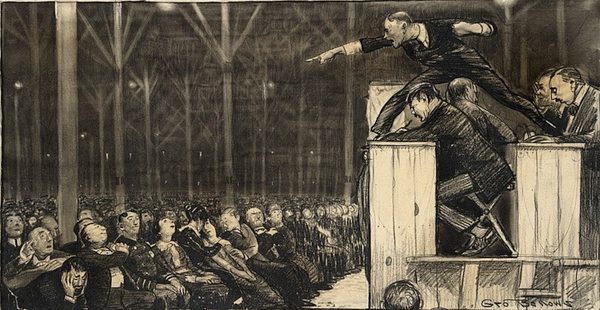
A corollary follows for the caster. To recognize one’s own operation as magic is to hesitate; hesitation drains efficacy. The most powerful agent is therefore the one who does not know what he is doing—who, certain he is merely defending himself or following the rules, commits without reservation. From within, the act is survival or administration; only from outside is it a spell. This is why the strongest enchantments wear the two faces least legible as magic: the tedium of the bureaucrat and the vulgarity of the demagogue. The slogan chanted by a crowd and the communiqué read by an official are both performatives that summon a reality; both escape detection precisely because the educated eye, trained to expect magic in robes, dismisses one as noise and the other as routine.9
4. The application: power as control of time-rate
If power is the capacity to reconstruct a coordinated reality, its most consequential exercise is upon the reality Kant identified as foundational: time. State power, redescribed, is the asymmetric control of time-rate—the ability to run one’s own clock fast and a rival’s slow.10 It manifests in three modes.
4.1. Acceleration
To compress generations of development into decades is to overclock: to strip the safety margins a mature system would retain and run the engine past its rated load.11 The spell is cast in the register of conviction, because conviction is its fuel; a clock is not driven forward by one who hedges. Hence its purest incantations sound unhinged. A slogan that summons a golden past—a floor conjured by speech and made load-bearing by repetition—is a performative of restoration, structurally identical to the performative of progress: both construct, by collective chant, a ground that was never there. The observer who dismisses the chant as vulgar has failed to identify the spell, and the failure is the caster’s advantage.
4.2. Deceleration
One cannot halt a rival’s engine from within his sovereignty, but one can lay over it a field that makes his time crawl. Deny the lithography and the last attainable nanometres, and the rival’s frontier freezes—not destroyed, merely suspended, running in place while one’s own clock sprints.12 The field’s operation is legible in grammar. A rival’s frontier industry, by the ordinary clock long since due to be described in the past tense—a completed success, written up as a textbook—is instead held perpetually in the future: the breakthrough always coming, never arrived. That stranding in the future tense is the deceleration field rendered as syntax. And the caster, as the self-concealment thesis predicts, experiences the field not as sorcery but as defense: the terror of a hostile peer who cannot be absorbed swings the arm before reflection arrives, and the spell delivers full power precisely because it is believed to be no spell at all.
4.3. Stasis
The third mode is the least respected and the most demanding. For a generation a state may hold in suspension everything the ordinary clock insists must detonate: bad debt unwritten-off, deflation pinned flat, sovereign obligation past any prudent ceiling held aloft by a central bank that purchases it without limit.13 To call this “lost” is a slander; nothing was lost, everything was held. To make nothing happen is the most strenuous magic of all, requiring endless liquidity to keep the unexploded thing unexploded—the Red Queen’s labor, run at the scale of a treasury. Its reagent is tedium itself: were the official ever to appear interested, the market would read alarm and the held thing would fall. The freeze holds only under the bored monotone, which is to say the freeze is held by the self-concealment thesis in its purest form. Its danger is structural: a freeze, unlike an acceleration, cannot hand off; when its energy fails it releases at once, and to thaw a generation of arrested time without shattering it is harder than the freezing was.
5. Interlude: the world wars as temporal collision
The three modes are visible today as peacetime institutions—the central bank, the embargo, the long stagnation. But they were forged, and first collided, in their hot form. The world wars are legible as the catastrophic meeting of incompatible time-rates: clocks running at different speeds, brought by the integration of the globe into a single board on which they could no longer keep separate time.
The first war was a collision of accelerations. The late nineteenth century set several clocks to full throttle at once—German and Japanese compressed industrializations overtaking, in two decades, what Britain had taken a century to build—while the spatial order (colonies, markets, prestige) stood fixed.14 A risen power whose clock read 1900 confronted a map frozen at 1850; Germany’s demand for a “place in the sun” was a complaint of phase mismatch—temporal arrival without spatial vacancy. And the detonation, when it came, was itself temporal. Mobilization ran on railway timetables computed to the minute years in advance and incapable of partial execution; once a clock began to turn, no statesman could halt it, and time outran politics into general war.15
The second war was a collision of time-philosophies. Fascism was the deification of acceleration as such: its aesthetic avant-garde had already proclaimed that “a racing automobile. . . is more beautiful than the Victory of Samothrace,” and, in the same breath, that “Time and Space died yesterday.”16 Against this stood two further temporalities. One was the project, traced in thedevelopmental literature, of synchronizing an entire region’s clocks to a single metropole—the controlled-economy planning of the wartime Japanese empire, in which the five-year plan was itself an instrument for casting time as schedule.17 The other—the one that won—was the temporality of production: not how fast a campaign could be concluded but how long and how much an economy could sustain. The blitzkrieg was a spell of temporal compression, victory in an instant; it was answered and defeated by a spell of temporal extension, the unlimited manufacturing time of an arsenal that simply did not stop.
The decisive outcome of the wars was therefore not the redistribution of territory but the determination of whose clock would serve as the world’s standard time. Greenwich—the imperial time of Britain—was challenged by Berlin, by Tokyo, and finally superseded by Washington. The postwar order is the synchronization of the globe to a single time-rate: the dollar’s tempo, the hegemon’s capacity to wind other nations’ clocks, and, latterly, to slow a rival’s. Seen this way, the peacetime modes of §4 are not the antithesis of the world wars but their continuation by other means—the temporal war shifted from the hot register of the timetable and the blitzkrieg to the cold register of the interest rate and the export control. The synchronization the wartime empire sought through arms, the postwar state would seek through credit.
6 Conclusion
The three modes—acceleration, deceleration, stasis—are not three policies but three inflections of a single operation: the reconstruction of a constructed reality, performed upon its temporal rate, by agents who must misrecognize the operation to perform it at strength. The developmental state, the technology embargo, and the long stagnation, ordinarily filed under separate literatures, are species of one genus. Their common reagent is the most despised and least scrutinized of materials—money, and beneath it the market that prices the very return of time, the province of spectacled functionaries whom no one mistakes for magicians, and who would be the first to deny it.
That denial is not incidental to their power. It is its condition. The world was never disenchanted; it merely learned to perform its enchantments in a suit, and to call them by other names.
DOWNLOAD
Footnote
- John R. Searle, The Construction of Social Reality (New York: Free Press, 1995), 27-29.
- J. L. Austin, How to Do Things with Words (Oxford: Clarendon, 1962), 4-7.
- Immanuel Kant, Critique of Pure Reason (1781), "Transcendental Aesthetic." §4-6.
- Stephen Morris and Hyun Song Shin, "Unique Equilibrium in a Model of Self-Fulfilling Currency Attacks," American Economic Review 88, no. 3 (1998): 587-597.
- The fractional-reserve multiplier is the textbook mechanism.
- Alfred Gell, "The Technology of Enchantment and the Enchantment of Technology," in Anthropology, Art and Aesthetics, ed. Jeremy Coote and Anthony Shelton (Oxford: Clarendon, 1992), 40-63, at 43-44.
- Jason A. Josephson-Storm, The Myth of Disenchantment: Magic, Modernity, and the Birth of the Human Sciences (Chicago: University of Chicago Press, 2017), 3-14, 269-314.
- This radicalizes Bourdieu's méconnaissance: domination is most complete when it is not perceived as domination but as the order of things. Pierre Bourdieu, Outline of a Theory of Practice, trans. Richard Nice (Cambridge: Cambridge University Press, 1977), 164-171.
- The point inverts the popular intuition: the utterance that looks like a spell-archaic, robed, theatrical is the one safely marked "not real" and therefore disarmed.
- That time is itself a cultural construction, mapped and imaged differently across societies, is established in Alfred Gell, The Anthropology of Time: Cultural Constructions of Temporal Maps and Images (Oxford: Berg, 1992).
- The developmental-state literature describes the mechanism without naming it as temporal: Chalmers Johnson, MITI and the Japanese Miracle (Stanford: Stanford University Press, 1982); Alice H. Amsden, Asia's Next Giant (New York: Oxford University Press, 1989).
- The mechanism is documented as the strategic exploitation of asymmetric positions in networks of finance and technology: Henry Farrell and Abraham L. Newman, "Weaponized Interdependence: How Global Economic Networks Shape State Coercion," International Security 44, no. 1 (2019): 42-79.
- The balance-sheet recession-in which private deleveraging compels the state to sustain demand indefinitely-is analyzed in Richard C. Koo, The Holy Grail of Macroeconomics: Lessons from Japan's Great Recession (Singapore: Wiley, 2008).
- The contemporaneous transformation of temporal experience by railway, telegraph, telephone, and cinema is documented in Stephen Kern, The Culture of Time and Space, 1880-1918 (Cambridge, MA: Harvard University Press, 1983), esp. 10-35.
- A. J. P. Taylor, War by Timetable: How the First World War Began (London: Macdonald, 1969).
- F. T. Marinetti, "The Founding and Manifesto of Futurism." Le Figaro, 20 February 1909, §§4, 8.
- The continuity between the wartime planned economy and the postwar developmental state is the through-line of Johnson, MITI and the Japanese Miracle (cited above)